
From the Argives: “Have Fun—Don’t Be Stupid”: Tracing the History of WeScam
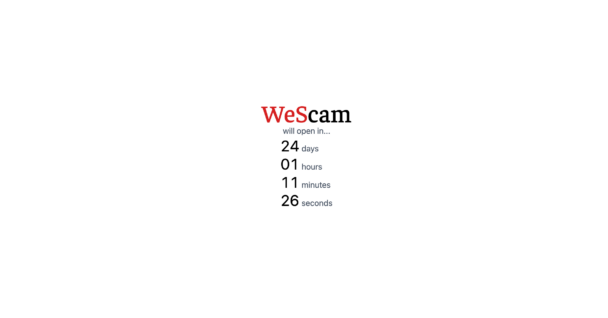
If you are a University student, you may have gotten an Instagram follow request from @wescam2026 earlier this semester. In the account’s bio is a link to WeScam, a website featuring a countdown to 7 p.m. on Sunday, Mar. 22, the last day of Spring Break. So who or what is behind this mysterious WeScam?
In the late ’90s, before the dawn of Tinder, Hinge, and sliding into someone’s DMs, University students had WeScam. WeScam was a class project turned yearly tradition that automated the age-old question: “So…are you into me?” While originally stylized as WeScam, the website has been referred to as wescam, Wescam, and WesCam throughout the years.
Automated, responsible decision-making
According to a 2021 Argus article, WeScam debuted in May 1998, created by Jesse Vincent ’98 as his final project for Professor Hope Weissman’s class, “Pornography: Writing of Prostitutes” (COL 289).
The mechanics were simple. Every undergraduate at the University had their name automatically listed on the website. Seniors could select anyone they were interested in, and underclassmen could only select seniors. After finals ended, WeScam emailed each participating student a list of the names of people that they had picked who had also picked them. If a student selected someone on the website but their name didn’t show up in the system’s fateful email, they had no way to know whether their crush hadn’t participated or just hadn’t picked them.
WeScam’s website included a webpage with answers to frequently asked questions from its users. The original FAQ, preserved in a 1998 archive on the Wayback Machine, serves as a miniature ethnography of University hookup culture in the early days of WeScam.
“WeScam is an automated system which allows you to figure out if people you’re interested in are interested in hooking up with you without making a fool of yourself by getting drunk/stoned/whatevered enough to pour your heart out to them or stick your tongue down their throat,” the FAQ explained. “It promotes responsible decision-making about who you’re going to hook up with. Yeah, that’s the ticket.”
“It is not consent,” the FAQ stressed about matching with someone on WeScam. “If someone puts you on their list, it could mean just about anything.”
“S/he does not necessarily want to get down and dirty with you,” the FAQ page read. “S/he might just want to get to know you a little better before you go off into the big bad world.”
WeScam’s advice was blunt: “Have fun—don’t be stupid,” because, as the FAQ puts it, “if there’s anything you should have gotten out of your time here, it’s that you need to respect other people.” For anyone who found that the whole thing “really scares” them, the answer was equally simple: “Don’t play.”
WesScammers, WesSleazes, and Public Health Threats
As the project grew, Vincent worried that students would simply “pick everybody” to get a complete list of everyone interested in them. His first solution was to seed the system with fake students to catch over-eager clickers. When that wasn’t effective enough, he introduced labels that would appear beside a student’s name on the website. If a student chose 20–49 people, they were tagged a “WesScammer”; 50–99 earned them “WesSleaze”; 100+, and they were branded a “public health threat.”
Over the next few years, Vincent and his collaborator, Aaron Weiss ’99, dressed the site up with themes, including a ’70s motif and an Amazon parody called “Scamazon.com.” A new function introduced group matching that allowed everything from threesomes to what Vincent described as at least one fully interconnected nine-person love triangle.
The project quickly drew attention from beyond the University. A 2004 New York Times story “Are We a Match?” included the site among several campus-specific matching services trying to digitize late-night courage.
By 2004, though, Vincent pulled the plug. In a 2018 interview with The Argus, he explained that, as an alum five years out, it felt “unacceptably sketchy” to keep running an undergraduate dating and hookup service. Thus, for a while, the WeScam database went dark.
Goodbye WeScam, hello Wescam
Around 2010, Vernon Thommeret ’10 resurrected WeScam with a new name in time for his own Senior Week, deciding to rebuild it as a modern web app. It was an instant hit, and the stewardship model that would define the next decade of Wescam fell into place: Seniors would inherit the codebase, build the site in whatever framework made sense that year, and hand it off to the rising seniors before graduation.
Carlo Francisco ’11 soon rewrote the code for the site’s system with a new stack, emphasizing what he saw as Wescam’s unique appeal in a 2018 interview with The Argus. Mainstream dating apps, he argued, quickly reveal identities and gamify swiping, but Wescam prioritizes suspense.
“One thing that Wescam always had over dating apps that took over the mass market later on, like Tinder, was how it told you that someone had added you, but didn’t reveal their name—since you knew it wasn’t a stranger, it was fun thinking about who it could be,” Francisco said.
Francisco’s successor, Diego Calderon ’13, took over, then passed it to Justin Raymon ’14, who passed it to Sam Giagtzoglou ’17.
“I basically redid the entire site from the ground up so I could make an iOS app as well,” Giagtzoglou said. Brandon Baker ’18 later added features like a “supercrush” option and worked with Emma Freeman ’19.
Hookup culture, pressure, and sex ed
By the late 2010s, Wescam had established itself as a firmly entrenched University tradition.
At the same time, the platform had shifted significantly from its original format. While earlier versions purely revealed mutual matches, newer Wescam models also allowed users to send anonymous messages via the site’s internal messaging system, sometimes before mutuality was confirmed. This meant that students could receive messages they hadn’t explicitly opted into, shifting Wescam from a binary mutual‑match engine toward something closer to a campus‑specific dating app.
In a 2014 post to her personal blog, “Senior week and wescam: Why we need #adultsexedmonth,” Ella Dawson ’14 described Wescam and Senior Week as a kind of emotional pressure cooker.
Senior Week is “inherently a goodbye,” she wrote, suggesting that for some students, the end of college became an excuse for “end of the world” sex. In that context, Dawson argued that Wescam wasn’t just an app; it was an outlet for the “fear of missing out” plugged into a campus culture that often treats meaningful closure and regrettable hookup as indistinguishable.
Dawson’s call for “#adultsexedmonth” after graduation also highlighted something that the early FAQ only gestured at.
“Adult sex education is critical for our physical and mental health, and higher education and sexual education should go hand in hand,” Dawson wrote. “After all, senior week did not create problems that did not otherwise exist: it just poured lighter fluid on an ember to make it a flame.”
Wescam’s 1998 post stating that “[Wescam] is not consent” aimed to mitigate the platform’s harmful effects, but Dawson argued that no disclaimer text can substitute for a robust education about consent, communication, and sexual health.
Wescam during COVID-19
In Spring 2021, a new team of student maintainers brought Wescam back with a different message. Students could still add people and chat, but the site now carried prominent COVID-19 safety warnings, explicitly urging users who chose to meet in person to do so outside and in accordance with the University’s public‑health guidelines.
“While we want seniors to enjoy their final semesters, we are still in the midst of a global pandemic,” the message reads. “If you are going to meet someone, do so outside,” maintainers Ben Bushnell ’21 and Rafael Goldstein ’21 warned on the website.
In a 2021 interview with The Argus, Bushnell noted that many Wescam conversations never led offline at all.
“Most Wescams are just chats,” Bushnell said. “You never even find out who it is or it’s your roommate messing with you, there [are] so many Wescams of that nature.”
Goldstein echoed that sentiment, describing Wescam as “a way to connect with friends and spend time and connect with other people, which has been increasingly taken away because of COVID.”
In this version, Wescam functioned less as a hookup engine and more as a sanctioned space for anonymous flirtation and digital socialization.
What’s next for WeScam?
As of today, there are only 23 days until the WeScam countdown runs off and a new iteration of the platform is born. These final days are an apt time for reflection on the project’s evolution. And as a reminder, “Have Fun—Don’t Be Stupid.”
Lyah Muktavaram can be reached at lmuktavaram@wesleyan.edu.
“From the Argives” is a column that explores The Argus’ archives (Argives) and any interesting, topical, poignant, or comical stories that have been published in the past. Given The Argus’ long history on campus and the ever-shifting viewpoints of its student body, the material, subject matter, and perspectives expressed in the archived article may be insensitive or outdated, and do not reflect the views of any current member of The Argus. If you have any questions about the original article or its publication, please contact Archivists Hope Cognata at hcognata@wesleyan.edu and Lara Anlar at lanlar@wesleyan.edu.


What a fun blast from the past! Thank you for including my old blog post — I’m thrilled Wescam lives on.