
WESU: Wesleyan’s Eclectic Radio Station Still Fights the Mainstream
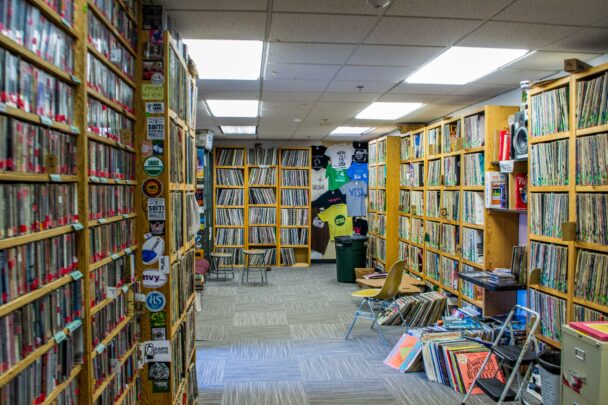
Right at the corner of Broad Street and William Street, above Red and Black Cafe, sits one of the oldest college radio stations in the country, proudly airing eclectic, free-form radio across the heart of central Connecticut and playing everything from Curtis Fuller to Ariana Grande.
Despite the station’s illustrious longevity, the colorful creatives that make up WESU’s tapestry remain somewhat hidden behind the curtain of eccentric DJ names, which are just as unconventional as the shows that they host.
Before diving into these vibrant figures, let’s begin by situating ourselves in the station’s history. Founded in 1939, WESU—pronounced W-E-S-U, not the common misnomer WES-U—initially found its footing in Room 23, in the basement of Clark Hall, thanks to sophomore founder Arch Doty ’41, according to an unaccredited article published in The Argus on Oct. 16, 1939.
As detailed on a post on WESU’s website about the station’s history, Doty brought a self-made radio transmitter, a turntable, a series of records, and a microphone, and, after sticking an antenna out his window, began broadcasting AM radio under the name WES (without the U) across Clark Hall on Thursday, Nov. 9, 1939.
The station soon grew popular and eventually spread across campus, with student-funded wires running through the now-closed tunnels connecting Clark to Harriman Hall (now The Frank Center for Public Affairs), North College, and the other dorms, all via Olin Library. In tandem with this expansion, the University then permanently assigned Clark Room 23 to WESU, and students converted it into a full-time, functioning station.
WESU continued to evolve, albeit slowly, adopting the U in 1949 and later doing away with its old AM system, airing on 88.1 FM by 1961. In 1980, Arista Records—which worked with many college radio stations, including WESU—revoked its free subscription service across all university-affiliated stations, prompting WESU to spearhead a boycott of the company. Following this movement through the ’80s and ’90s, the station, which had long been popular with the Middletown community, eventually began accepting community members as both DJs and board members to ensure the organization’s continued operation.
By 2001, the radio station was thriving, with a continuously growing group of community members and students running the program, to the point that the station’s idiosyncratic shows were described as the “enemy of the top 40.” However, a shake-up following the 2001 renovation of Clark Hall led the University to hastily move the studio from its home of 70 years into its current, smaller space on Broad Street, resulting in a large number of records and pieces of equipment being thrown out.
“It was a very haphazard move,” WESU General Manager (GM) Ben Michael said in an interview with The Argus. “It took the wind out of the sails of the station…. There were community volunteers that I know who were [going] dumpster diving, trying to save artifacts and music on behalf of the station.”
There’s no one quite as thoroughly intertwined with the station as the ever-cheerful Michael, who just celebrated his 20th year as GM this past October. As the station’s sole full-time employee, he is tasked with keeping everything running, including assisting board members, maintaining equipment, and fundraising. If there’s a problem, chances are Michael might just have the solution.
Michael got his start at the station co-hosting the show “Difficult Listening” with his friend Chris Museo in the summer of 1997, and he describes his relationship with the station as “a large part of the soundtrack to [his] life.” A Middletown native, Michael recalls fond memories of driving with his father, listening to the station, and hearing the still-airing show “Moondog Matinee,” which got its start in the mid-’80s.
“[I remember when] I tuned in to listen to heavy metal and hip hop that you couldn’t find elsewhere,” Michael said. “You know, this is where we were getting our Public Enemy fix.”
It’s that eccentricity that has kept Michael around to this day, and though the Federal Communications Commission station license is issued to the University, he is quick to note that the day-to-day operations and management of the station, aside from himself, are firmly student- and community member–run.
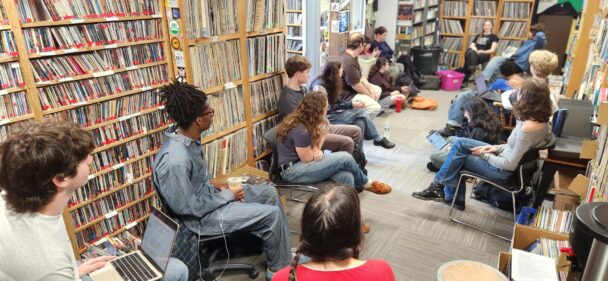
One student who aids in the station’s smooth operation is Clio Gourevitch ’26, the station’s current Production Director and host of the show “Shuffle” under the name DJ Clip. The show is characterized by Gourevitch literally hitting shuffle on her music library and deriving the theme from there.
“Through WESU, I’ve been able to get to know and interact with people in the broader Middletown community in a way that I probably wouldn’t have otherwise, and I appreciate the emphasis that the station puts on that connection,” Gourevitch said.
Gourevitch began her time at the station in the spring of her first year. Now, she is tasked with creating promotional materials for shows airing on WESU, as well as PSAs that must air regularly.
“Every hour, each DJ has to play two promos and two PSAs,” Gourevitch said. “PSAs are self-explanatory—they’re anything from Arbor Day awareness to medicine for arthritis.”
Gourevitch also mentioned that the task involves organizing dozens of clips, a challenge made more difficult by the age of some of the technology.
“It feels like a little silly creative thing, because [the promos] are all just 60 or 30 seconds, or whatever you want them to be,” Gourevitch said. “It feels fun to help DJs kind of catalyze their shows and personalities in that short period of time.”
Outside of her position on the board, she also spoke about the station’s culture, expanding on the unique connection between Middletown community members and University students.
“There’s [an] interplay between students who are here for four years and who do a lot of work around the station, and people who have been here for, like, 40 [years]. It’s cool seeing those people come together,” Gourevitch said.
On the other side of that dynamic are community members like Jim Martin and Dave Coon, who co-host the show “Zero Hour!!,” a hardcore punk and underground rock ’n’ roll show that often showcases various bands in Middletown. They hold the mentality “think globally, act locally,” as Coon puts it.
“I absolutely love that it’s student-run,” Coon, a resident of New Haven, said. “I know that I’ve said that before, but that is so important to us.”
In the Fall of 2023, Martin and Coon, who both have extensive backgrounds in and knowledge of the music scene, set out to debut their show on live radio rather than with a more contemporary podcasting format.
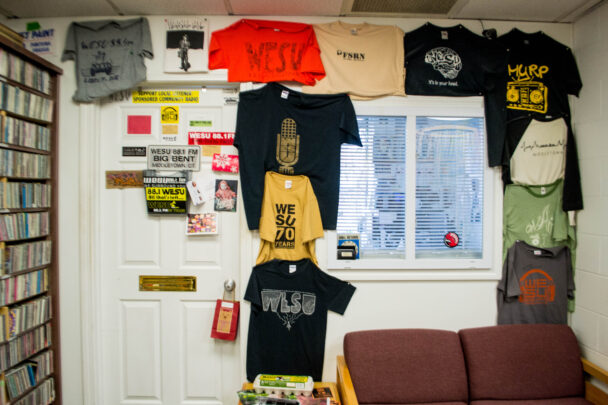
“Every station 40 years ago had late-night hardcore and punk rock shows, [and] what we’re trying to do now is extend that history,” Coon said.
Despite being Connecticut natives, Martin and Coon initially had a hard time finding a station in the state, saying their requests to volunteer at independent stations went unnoticed. However, Martin and Coon’s search for a station ended when mutual friend and then-DJ Mike Mitchell suggested WESU to them, and they finally began “Zero Hour!!”
Reflecting on their experience at the station, Martin recalled an important difference between WESU and other radio stations in the state.
“Some of the other independent radio stations in southern Connecticut get kind of bogged down in DJs that have been there for 30 years, and they’re still playing the same old thing,” Martin said. “[People say], ‘You guys got it really good over there. [You] have [a] say in what’s going on, and you can vote on things.…’ On other stations, there’s a programmer who comes in and tells [them] what they have to do. To have free-form radio… It’s just great.”
Not only are community members and University students represented on WESU, but University faculty are as well, as seen in Assistant Professor of History Maryam Patton’s show “Desert Cruising,” which features a heavy dose of psychedelia, doom, stoner, and desert rock. Patton, who joined the University’s history department in Spring 2025, has had a long journey with college radio, first airing “Desert Cruising” under the pseudonym Captain Ahab on Princeton University’s station, WBPR, back in 2012. Following a short hiatus during graduate school, Patton re-debuted her show this past summer as the distinguished Dr. Ahab, following the successful defense of her PhD. She is the only current University faculty member with a show airing.
On her first visit to the station, Patton describes an overwhelming feeling of joy. Her first thought was, “Yes, finally, I’m home! It’s a true student and community radio station in the sense that there’s no room for anything. There are records everywhere, crazy stickers in every corner, and it’s fantastic!”
Regarding her unique position in the network, Patton discussed her experience relative to students’.
“I have one foot in both camps,” Patton said. “I think I understand the students’ experience because I’m teaching them, and I can see what students’ [campus] experiences are like.”
Patton elaborated on the different dynamics in and out of the classroom.
“Because I’m a professor, I now have the experience of some of my students being DJs, [and] I think it’s weird when they call me Professor Patton, because at the station, they can call me by my name. I don’t think of you as my student, rather like my equal as a fellow DJ,” Patton said.
At the same time, however, Patton’s experience doesn’t perfectly parallel that of students.
“Having a graveyard shift is maybe not as reasonable a thing to ask,” Patton said. “I myself have a five-month-old, so when I was applying to the station, I was like, ‘Please, can I not have a midnight slot? I’m a grown-up, and I have to go back home!’”
Patton’s eclectic experience at the radio station hasn’t deterred her from spreading the message: Get involved!
“I definitely want to encourage more and more students to join WESU…. Radio is the last bastion of synchronic media, and I think that is an interesting thing to think about,” Patton said.
Another student who has long been involved with the station is WESU President Jacob Chatto ’26. He hosts the show “Happy Hour” under the name DJ Happytobehere.
Chatto’s role as President makes him, alongside GM Michael, one of the two faces of the station to the University, a position that is not always easy.
“It’s sometimes difficult because Wesleyan doesn’t really understand WESU as a club in terms of what it is that we do, and the fact that our organization is a bit larger than [other] student clubs,” Chatto said.
Regarding the station’s relationship with the surrounding town, Chatto discussed how WESU serves as a bridge between the two communities.
“I think [that], as a Wesleyan student, you’re always a little bit aware of this narrative of the University versus the town,” Chatto said. “That was something I had very much internalized…and this is a cool way to get integrated with the community.”
On this University-Middletown dynamic, Jewett Center for Community Partnerships (JCCP) Director Clifton Watson elaborated on the important quality of community cross-section at the radio.
“We see Wesleyan as a neighbor in this larger community, and good neighbors are hospitable,” Watson said. “Our commitment and investment in civic and community engagement is about creating a space for folks to collaborate.”
In all, how can one describe WESU?
“It’s common ground for everybody,” Michael said.
Patton added to this sentiment by describing the station’s uniqueness.
“I think WESU is a gem, a treasure, and [a] real service to the community…. There are very few independent radio stations [like this] left,” Patton said.
Martin and Coon elaborated on this diverse nature.
“The thing that I love about it most is that there’s this constant churn of students that are moving through…and it brings a freshness to it, and a lot of ideas that are so valuable and so important today,” Coon said.
“The eclecticism of what’s being presented on WESU [is] something that I think people would be surprised to find out about, and hopefully delighted,” Martin said.
WESU is certainly an anti-mainstream, sonically and socially comprehensive space on campus, and they have only one more message for the community.
“Get involved!” Chatto said. “The more people we have on air, the more different music we’re playing, the more voices we’re hearing, and the more people we bring to it.”
Willow Simon is a DJ for WESU.
Willow Simon can be reached at wsimon@wesleyan.edu.

Leave a Reply