
Connecting Science and the Community: The Van Vleck Observatory’s Outreach Efforts
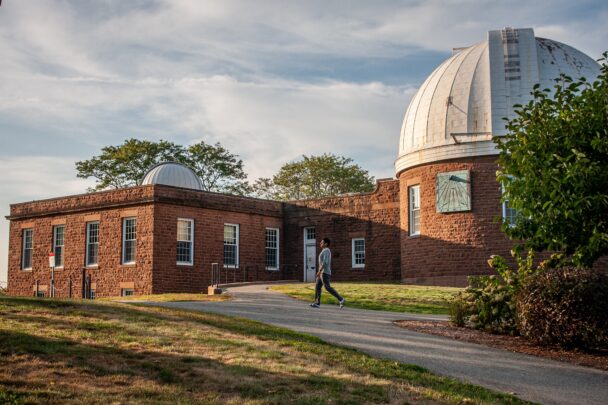
Atop Foss Hill sits the Van Vleck Observatory, home to the Astronomy Department and various outreach programs for Wesleyan University students and the general public. This week, The Argus interviewed individuals involved with the observatory to learn more about what events they hold and how they interact with Wesleyan students as well as local communities.
Space Night
Every Wednesday at 8 p.m., the observatory hosts Space Night, an event opening its doors free to the public. Theo Chawla MA ’26, a second-year astronomy master’s student, explained some of the activities that take place during Space Night.
“Typically for the Space Nights we do public observing, if it’s clear,” Chawla said. “We always have a lecture from one of the students in the [Astronomy] Department, whether it’s one of the master’s students or one of the undergrads, and then [we] kind of show people around the observatory. Even if it’s cloudy, we always hold Space Night, and we try to make sure that we have some kind of activity, whether it’s a talk, or we put [up] our inflatable planetarium, [or] we pull out a spectroscopy demo from the closet.”
Space Night provides a weekly opportunity to engage with the campus’ historic observatory and the Astronomy Department in general. Students are able to see, in incredible resolution, the rings of Saturn or a globular cluster through the 20” telescope, which is a once-in-a-lifetime experience. Chawla also touched on the importance of Space Night to the Wesleyan community.
“I think a lot of Wesleyan students don’t know about Space Night, and I see people knocking every time at our door [on a] random Tuesday evening,” Chawla said. “And, if we’re around, we like to show people around, but Wednesday nights are really our time to let anybody come and let anybody view through the telescopes.”
Kids’ Night
The observatory also holds Kids’ Night every Friday, where children from the local community can engage with the telescopes and learn more about astronomy. Astronomy Department Chair Meredith Hughes spoke about the outreach to children and her favorite parts of Kids’ Night.
“It never gets old when someone looks through a telescope for the first time and goes, ‘Wow, is that real?’ or ‘Was that a sticker of Saturn that you put on the front of the telescope?’” Hughes said. “I just love getting kids excited about space…. Sometimes they’re scared to climb the ladder, or they don’t know how to look through the eyepiece, but then when they get it, they’re excited about science: That’s one of the best things that we can do. I love that we’ve been so successful over the last several years [at] drawing in the Middletown community.”
Kids’ Night is one way that the observatory tries to engage with surrounding communities and make it into a place of learning and fun.
“We offer Kids’ Nights through Middletown Parks and Recreation Services [where] people can sign up for free on the website,” Hughes said. “And so we’ve really drawn a much larger cross section of kids from our community. I love that this is their space, and they can grow up in Middletown knowing that they are scientists, and they can come and look through our telescopes and learn about science here on campus. I think it’s one of my favorite things that we do.”
Sturm Lecture and Astronomy Colloquia
One of the Astronomy Department’s largest outreach events is the Sturm Lecture. Dedicated to alumnus Kenneth E. Sturm ’40, the lecture sees esteemed astrophysicists, including Nobel Laureates, discuss their research and astronomical topics. Hughes discussed the importance of these lectures, as well as the upcoming talk on Tuesday, March 3.
“The Sturm lecture is awesome,” Hughes said. “This is when we bring in a really prominent astrophysicist on a national or international level, who also is excellent at science communication, and they give a presentation about their outstanding science on a level that is accessible for the general public. And this year, we have Vicky Kalogera coming from Northwestern [University]. She’s one of the people who discovered gravitational waves, and she’s going to talk about her discovery of gravitational waves and all of the work that LIGO—the Laser Interferometric Gravitational[-Wave] Observatory—has been doing to learn about gravitational waves. We’re really excited to have her on campus.”
These lectures are in addition to the colloquia that the Astronomy Department hosts on Wednesdays during the daytime, which are open to the public. These talks range from the detection of exoplanets to astronomical public policy, providing a wide variety of relevant topics.
LGBTQIA+ Events
Chawla further discussed the star GAYzing event, taking place every Fall—and possibly in the Spring—where queer people can have a space to engage with astronomy and the observatory’s offerings.
“I’m not sure if we’ll hold one for the Spring, but every Fall and sometimes in the Spring, we hold a big star GAYzing event—G, A, Y—and that’s a lot of the same activities like public observing,” Chawla said. “We have people, several people, who give talks. We take out our planetarium, and it’s really focused on having an evening for queer people to come and feel like they are at home in the universe, too. And that’s one of our biggest events.”
Why Outreach?
In an interview with The Argus, Hughes gave insight into her dedication to scientific outreach and the duty of the modern scientist to share their research with the public.
“Science education is an important part of what astronomers do, and it’s also a whole set of careers that our astronomy majors can prepare themselves for,” Hughes said. “We have definitely had astronomy students here who have gone into careers in education and public outreach, whether that’s teaching [or] being a planetarium director working at a science museum. Those are all potential careers for astronomy majors, and they can develop skills and experience that will contribute to those directions in our program. Also, as astronomers who rely on federal funding for the telescopes and the equipment that we use, it’s our responsibility to share the things that we discover with these taxpayer-funded instruments with our community and so on. I think that public outreach is an important responsibility of being a scientist who works with federal funding.”
In addition to this notion of responsibility, Chawla explained how scientific education can often be inaccessible, highlighting the importance of the Department’s outreach efforts.
“My other favorite part of being here is definitely the public outreach, because there is nothing I love more than talking to people about space,” Chawla said. “It’s the best thing in the world for me, and I think it is a topic that can be pretty inaccessible. “[We are] a part of making [space] more accessible for anybody that wants to come, and our events are always free too, that is really special.”
Aliya Nurmohamed ’26, a senior astronomy major and communications intern for the observatory’s outreach program, further spoke on the general lack of awareness students at Wesleyan have about the astronomical events occurring around the observatory.
“I always thought a lot of Wesleyan students knew about the observatory in public, like Space Nights, but they don’t,” Nurmohamed said. “And a lot of people I’ve talked to [have said], ‘Oh, I didn’t know the observatory does this.’ I think we definitely need to do more focus on people at [this] school, and I think a lot of people, especially in their senior year, [are like], ‘Oh, I’ve never been to the observatory, so I want to go once.’”
Nurmohamed added that the observatory also makes efforts to include homeschooled children in their activities.
“I feel like also one of our aims is really towards homeschool kids, because they don’t have as many opportunities to go into a school setting,” Nurmohamed said. “And so [we are] just really trying to reach them through Facebook or Instagram so that they know that there’s a place that they can come to learn that’s outside of their homes and free again.”
Why Attend?
While the observatory offers a plethora of activities aimed at a wide array of communities, including those who don’t attend Wesleyan, one may still wonder why students should go to these events. To this end, the interviewees spoke passionately about their rationale for encouraging more students to take advantage of the Astronomy Department’s resources and why they enjoy working at the observatory.
As a student herself, Nurmohamed strongly believes that students would be remiss if they missed the opportunity to engage with the observatory.
“I think other students should come, because I don’t think that [they] actually have a lot of opportunities to do something like this again,” Nurmohamed said. “Once you graduate and you go do your job or go to graduate school, where’s the next time you can really just walk into an observatory and look through a telescope with paying nothing, with having no necessary background, no sign up, nothing? It’s a great opportunity to have a really low-commitment but high-exposure [experience].”
For Chawla, not only is the research being conducted at the observatory important, but so is the connection with the local and the Wesleyan community.
“There’s this incredible research that’s going on that I think is really opaque to the general public, and so our goal is to use this observatory as a way to bring people into that as much as possible, because I think it’s something that everyone should have the ability to learn about,” Chawla said.
Hughes highlighted the long history of the observatory.
“As an Astronomy Department, we feel really lucky to be able to work in this historic observatory that’s been sitting on the top of Foss Hill for over 100 years, and it’s still incredibly active as a site of astronomy research and education, and we want to share that with the campus,” Hughes said. “This is your space, and we welcome everybody on campus to come look through our telescopes and learn about the work that we do here.”
Lara Anlar can be reached at lanlar@wesleyan.edu.
Remi Peltzman can be reached at repltzman@wesleyan.edu.


Leave a Reply