
From the Argives: JCCP & A Short History of the Rift Between Wesleyan and the Local Community
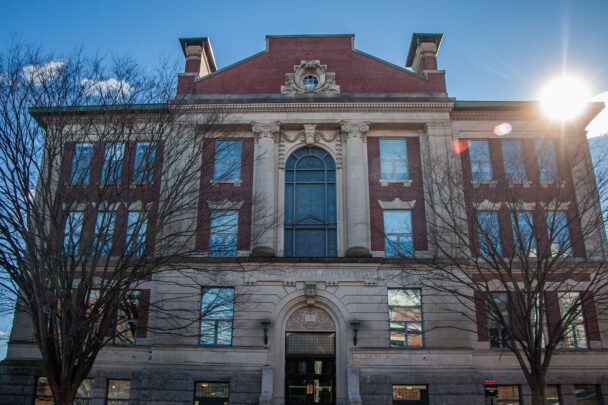
Presently, many University students and faculty express interest in developing meaningful connections with the Middletown community, focusing on the positive impact the University can potentially make. One way of doing this has been through the Jewett Center for Community Partnerships (JCCP), which supports the efforts of implementing student-run, community-oriented programs in Middletown.
Though the quaint town atmosphere undoubtedly shapes the University’s identity as a small liberal arts institution on the East Coast, Middletown and the University have had a strained relationship historically.
The nature of a residential liberal arts university attracts students and faculty from far and wide who consider Middletown only a temporary home, ultimately creating a sense of impermanence. Additionally, as the University expands, it acquires valuable property throughout the town. These tensions, present since at least the 1950s, have contributed to a sense of resentment among some Middletown residents toward the University.
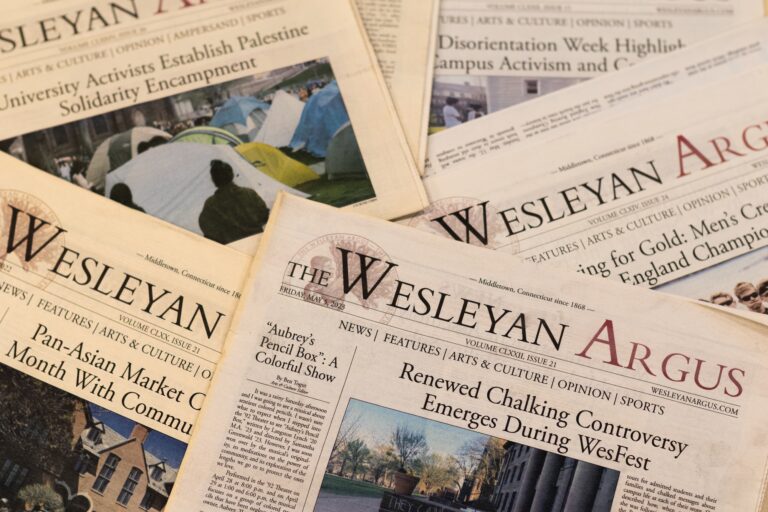
An Argus article published on Oct. 30, 1959, details the tensions between Middletown residents and the University community. In the article, titled “Study Finds University Isolated From Middletown,” author Wesley B. Mason ’63 references a study analyzing this relationship, focusing specifically on the negative economic effect of the University on the city.
“Middletown, the report found, considers Wesleyan to be an ‘economic burden’ since the local residents see the college as a wealthy institution partaking of many of the municipal benefits without giving its share to city revenues,” Mason wrote. The study was conducted by economics majors Stuart Anderson ’59 and Dana Plante ’59.
The article highlights the University’s dual economic impact on Middletown: While the University injects considerable money into the local economy through spending on housing, food, and services, it contributes comparatively little in local tax revenue due to its tax-exempt status for most things.
“[A] ‘tangible point of concern’ involves so-called ‘erosion of the tax base’ through college purchases of formerly taxable property,” Mason further referenced. “In 1957-58 a substantial $88,500 worth was taken off the tax lists by Wesleyan. This process adds a small amount of impetus to the rising tax rate for other Middletown property owners.”
Essentially, when the University buys property in Middletown, that property is removed from the town’s tax base, meaning other residents’ taxes go up. For the working-class community of Middletown, this presents a very real concern.
Beyond the economic factors, community engagement over the years has been less than ideal. Inevitably, as faculty and students come and go, there is impermanency in how the University engages with the Middletown community.
In an extracted text by James Kent ’80 and Robert Lichtenstein from the University’s Digital Collections published on Sept. 24, 1979, the tensions between Middletown residents and the University community are highlighted again.
“The nature of an academic institution like Wesleyan presumes a constant flow of faculty and students entering Middletown and leaving in a few years,” Kent and Lichtenstein wrote. “Many organizations and projects are started and staffed by Wesleyan people, but when those people leave Middletown, as most inevitably do, these organizations often must struggle to survive.”
However, as the text notes, this instability is only one aspect of the strain on the University-Middletown relationship. Middletown residents have felt some antagonism toward the manner in which the University contributes to their city. The article includes an interview with Mark Masselli, founder of the Community Mental Health Center on Main Street.
“According to Masselli, we at Wesleyan are ‘among the best and brightest,’ but it appears that we lack a sense of responsibility to the area we inhabit; Middletown suffers for it,” Kent and Lichtenstein wrote. “Though many of our professors and administrators travel the country to give advice on committees and panels, we donate little energy to our hometown.”
Indeed, this perspective paints the University in a somewhat unfavorable light. As a top university, our expertise must be widely spread, but where does that leave the community that fundamentally sustains us?
In recent years, there have been more concerted efforts to integrate the University and Middletown life, like the creation of the JCCP, which helps students connect with the Middletown community and eases tensions within the tumultuous relationship.
An unaccredited Argus article titled “University Announces Jewett Center for Community Partnerships” published March 12, 2016 describes the JCCP’s commitment to providing students with ways to engage with the Middletown community.
“The JCCP seeks to serve the development of the University community and the larger Middletown community,” the author wrote. “It houses the Office of Community Service and Volunteerism, the Green Street Teaching and Learning Center, the Center for Prison Education, and WESU 88.1FM.”
The JCCP has also led the initiative to start a Civic Action Plan, which further aims to foster ties with Middletown residents and the surrounding community.
In the Argus article “New Civic Action Plan Aims to Connect Campus with Middletown Community” published on Sept. 8, 2017, Emmy Hughes ’20 quoted Michael Roth ’78.
“‘The good folks at Allbritton are hard at work on a Civic Action Plan, which will guide Wesleyan’s future engagement with Middletown,’” Hughes recorded. “‘Based on conversations on campus and in the city, this plan will determine how to best allocate our resources in order to have the greatest impact on the surrounding area.’”
In accordance with this announcement, the JCCP hosts a variety of student organizations that enable students to participate in community service and civic engagement during their time at the University. In particular, the JCCP awarded a grant to students in 2014 to create the Doula Project, a student-run organization that provides support for reproductive health and justice.
In the article “The Wesleyan Doula Project Celebrates 10 Years of Reproductive Justice in Action” published on May 3, 2024, Sophie Jager ’25 paid homage to the student and community impact of the Project.
“Ten years ago, Hannah Sokoloff-Rubin ’16 stood before a panel of judges on the top floor of the Allbritton Center and made her case for The Wesleyan Doula Project (WDP) to win a New Venture Award (then known as a Seed Grant) from the Patricelli Center for Social Entrepreneurship,” Jager wrote.
The JCCP has led many successful outreach programs and has made a significant impact on the relationship between University students and the Middletown community.
Unfortunately, due to recent overspending on the JCCP budget, much funding for their student organizations has been cut in order to align with the new budget.
In an Argus article published on Friday, Oct. 10, 2025 entitled “JCCP Mismanages Last Year’s Budget, Cuts Funding for Student Organizations,” Akari Ikeda ’29 and Spencer Landers ’26 wrote, “According to the University, the JCCP spent well beyond its budget in the 2024–25 academic year, making financial commitments to student groups that it could not sustain without a significant budget increase.”
Following this, the JCCP must now stay within its given budget, causing a ripple effect in funding cuts to the student organizations that rely on JCCP funding.
Ikeda and Landers further quoted a petition seeking a higher budget for the JCCP, writing, “‘Decided behind closed doors and announced only in the last few weeks, these budget restrictions slashing hundreds of hours of paid community work have left student organizations scrambling to continue providing essential community services across the city,’ the petition read.”
Following this announcement, student organizations have had to refrain from paying working members. Previously, many of these organizations had paid positions that enabled work-study students to participate in clubs and civic engagement. While they can still participate if they are work-study students, this development has made it much more difficult to afford to spend time working for these organizations.
Moreover, to the dismay of students, this strain on funding has led to wavering in relationships with Middletown residents. Moving forward, students can only hope that the JCCP will stay within their budget and only promise what can be given.
Lara Anlar can be reached at lanlar@wesleyan.edu.
Beth Huggins can be reached at bhuggins@wesleyan.edu.
“From the Argives” is a column that explores The Argus’ archives (Argives) and any interesting, topical, poignant, or comical stories that have been published in the past. Given The Argus’ long history on campus and the ever-shifting viewpoints of its student body, the material, subject matter, and perspectives expressed in the archived article may be insensitive or outdated, and do not reflect the views of any current member of The Argus. If you have any questions about the original article or its publication, please contact Archivists Hope Cognata at hcognata@wesleyan.edu and Lara Anlar at lanlar@wesleyan.edu.

Leave a Reply