
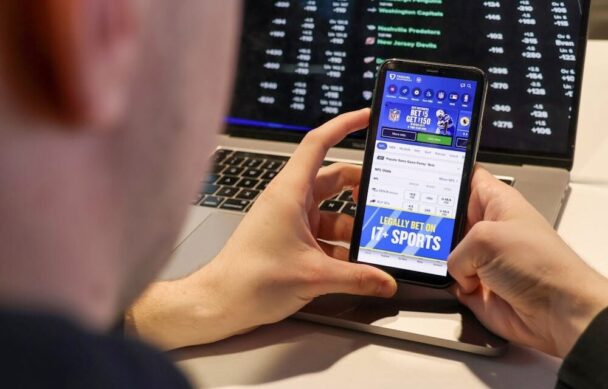
Murphy v. N.C.A.A Turns Eight Years Old: How Sports Betting Frayed and Severed the Fan-Athlete Relationship
This past summer, I spent every day waiting for the train at the Secaucus Junction station in Secaucus, N.J. It’s not the most nuanced place on Earth, but after getting used to being there every day, I became fascinated with all of the different advertisements near the tracks.
In particular, right by where I got on the train every afternoon to head home, there was a massive display of Jamie Foxx holding up a phone with the BetMGM app open, with the words “Score Without Leaving Your Seat.”
I’d then get on the train, realizing that the advertisement’s only purpose was pushing people to use the commute time they were already spending on their phones to try to hit it big on their way home from work.
The next thing I knew, I was getting ready to get off the train, only to see FanDuel, “America’s #1 Sportsbook,” as the doors opened at my stop. It felt inescapable: Everywhere I turned, there was a sportsbook encouraging me to bet on the next game.
That’s the reality of being a sports fan today. You can’t be a fan, let alone a consumer of media, without catching a FanDuel, DraftKings, or local sportsbook advertisement on your phone, television, or out in public. Considering that professional sports leaned heavily against betting no more than 15 years ago, the perspective has certainly changed for the industry titans.
In 2018, the Supreme Court ruled in Murphy v. N.C.A.A. that the federal ban on sports betting operations was unconstitutional, leaving it to the states to decide whether or not to legalize the activity. Since then, 38 states have signed it into law, with California and Texas as notable exceptions. Sports betting went from being taboo to being widely accepted by major sports industries, as leagues and states have found ways to profit from sportsbooks’ operations.
Even before Murphy was passed, FanDuel and DraftKings—the two companies with the largest shares of the betting industry—were already finding ways for people to earn money off their sports knowledge. They both started as Daily Fantasy Sports companies, which combined fantasy sports with immediate action and large cash rewards.
In 2015, both companies became two of the largest spenders on American advertising, and while they raked in massive profits early on, they were subject to controversy. Frequent questions of “how is this not gambling?” flooded their operations, but Murphy relieved most of the tension, and FanDuel and DraftKings immediately went to work creating their sportsbooks and getting a jump on the new industry.
Today, sports betting is everywhere. According to the Pew Research Center, 1 in every 10 adults says they have placed an online sports bet in the last year. Likewise, 63%—up 7% from 2022—of adults say they’ve heard or read about sports betting being legal. The mass exposure of sports betting to Americans has impacted both the engaged and unengaged sports fans. A Boston Celtics fan would normally not care about a 10:30 p.m. hockey game between the Los Angeles Kings and Anaheim Ducks, but placing a bet on the game gets them more invested, raking in more money for the league and the sportsbooks.
While straight-up picks on who will win a game are still very popular, prop bets have really taken off. Prop bets allow a bettor to attach a wager to a specific outcome within the game, often having to do with a particular player. For example, you can bet LeBron James will get over or under 5.5 assists in his next game. These have the potential to be the most divisive for potential bettors, as they can cause the most turmoil between the relationship of fans and players.
The irrational sports bettor may go to a basketball game and heckle at a player to hit another three so his parlay can hit, and if he doesn’t, the bettor can curse the player out in his DMs after the game. This happens far too often between players and fans, and its twofold impact on athletes and sports fanatics has harmed both sides.
In an Athletic poll of 133 baseball players during last year’s MLB season, 78% said legalized sports betting changed how fans treated players. Many who were anonymously quoted cited instances where their family or their lives had been threatened by fans via social media. World Series Champion Lance McCullers Jr. and three-time All-Star Liam Hendriks had high-profile incidents with these types of threats, increasing the platform for players and coaches to speak out against the unacceptable behavior of bettors.
Others are worried that younger players will be manipulated by bettors to perform to a certain standard rather than the team’s standards, putting the athletes in hot water. In the last six months alone, we’ve seen Cleveland Guardians pitchers Luis Ortiz and Emmanuel Clase marred by betting controversies, Miami Heat basketball guard Terry Rozier and Portland Trail Blazers coach Chauncey Billups arrested due to a mob-related underground betting scheme, and most recently, 39 college basketball players busted for involvement in point shaving for a gambling ring. We can no longer worry about the possibility of young athletes being impacted by crazed bettors: It’s happening in front of our eyes.
From the fans’ perspective, sports betting has turned fanatics into addicts at the drop of a hat. New fans are turning towards sports betting as a way to be engaged with the game, as fans 18–29 years old are more likely to place a bet than any other age group. Unlike sports gambling of the past, where you would have to physically go to a casino or a sportsbook to place a bet, the accessibility of sports betting has also contributed to its rise in popularity, and fans are quick to use this opportunity to cash in on their sports knowledge. FanDuel frequently advertises how easy it is to place a bet, “with just a few clicks.” In conjunction with this, in-game betting has been flagged as a concern by the National Council on Problem Gambling for speeding up the process of turning a bettor into an addict.
Ultimately, what sports betting has done to the sports industry has changed the way we view the average sports fan. It’s not necessarily that the average sports fan bets, but the perception—based on the countless commercials and endless exposure—is that to really engage as a sports fan, betting should play a part. As I wrote about in an opinion piece about prediction markets last December, it’s not enough to know about sports anymore: You have to put your money where your mouth is.
As the Murphy decision turns eight years old this upcoming May, we now understand the impact this decision has on sports as a whole. Not only do we now accept sports betting ads as part of the norm, as live odds are announced by broadcasters from partnering sportsbooks, but we also see how it influences the relationship between athletes and young adult fans.
In the aforementioned Athletic poll, one player was vehement in his position against sports betting: “It needs to be abolished,” the player said. “It’s brought more fans to the games the wrong way.”
While it can be an entertaining and easy way to bring more fans to games both in-person and watching on TV, it should not sever the relationship between players and fans as it has recently. The industry should listen to its athletes and reflect on how it can better protect the integrity and interactions around the games we love.
Max Forstein can be reached at mforstein@wesleyan.edu.



Leave a Reply