
We Won! Now What?
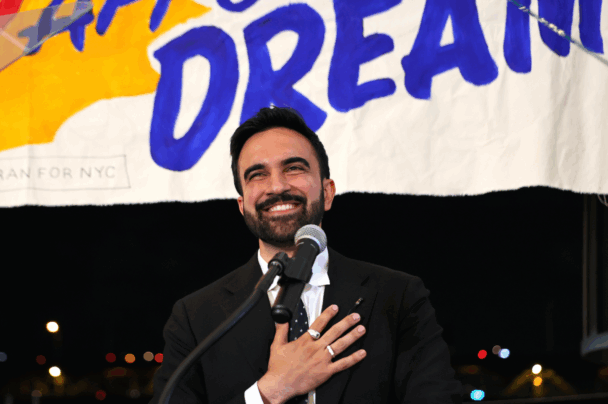
Two weeks ago, Democrats saw major wins across the country: Mikie Sherrill became the first Democratic woman elected Governor of New Jersey, Abigail Spanberger became the first woman elected Governor of Virginia, and California’s Proposition 50—which will likely secure more seats in the House of Representatives for Democrats—passed. Perhaps most notably, democratic socialist Zohran Mamdani won the New York City mayoral race.
Beyond these, democrats earned smaller wins (but wins nonetheless) in other states, including Pennsylvania and Georgia. What many anticipated to be a competitive, unpredictable night instead unfolded as a clear demonstration of returning Democratic momentum.
These elections did more than just determine state and local leadership positions: they gave the first real indicator of the public’s response to Donald Trump’s return to the White House. According to NBC exit polls, the majority of voters in these elections noted their disapproval in the way that Trump is handling his second term in office. In fact, many counties that had been shifting right over the past few years swung back to the left, and, in some cases, even outperformed expectations, with lots of regions seeing higher voter turnout than they had in years.
Still, there is no doubt that the Democratic Party has been taking hits recently, particularly in a less-than-enthused public perception. Because of this narrative, the results of these elections prove significant: these victories are exactly what the Democrats need to revive a depressed and dying party and to signal that the coalition may actually, finally, be regrouping with new energy and direction. Across these races, Democrats executed a disciplined, values-led strategy that appealed to shifting voter desires for stability, competence, and practicality.
So how did they do it?
What the Democrats Did Right
All of the newly-elected Democrats focused on economic policies during their campaigns—particularly affordability. While Republicans have focused their energy on other issues that they see as more pressing, such as the perceived threats of immigration and transgender Americans, Democrats gained traction by speaking directly to concerns that shape voters’ everyday lives. Even though Trump’s presidential campaign in 2024 centered on a promise to fix the economy, his governing priorities ultimately undercut that pledge and weakened his party’s economic message.
This is not a new revelation—it has been proven time and time again that the economy is the most important issue to voters. Despite the fact that Mamdani, Spanberger, and Sherrill all ran different campaigns, the main aspect they all focused on was affordability, ultimately scoring all of them wins. Mamdani ran as a democratic socialist in a left-leaning city, making big promises to freeze the rent of the city’s rent-stabilized apartments and make buses free. Spanberger and Sherrill ran more moderate campaigns simply vying to win back Democratic control in their red-shifting states, pledging to lower rising costs of living across several facets for their constituents, with Spanberger declaring an anti-Trump position as well.
Beyond policies, Democrats also succeeded in marketing themselves as real humans with real solutions in these elections, something that the party severely struggled with during the 2024 election. Mamdani, Spanberger, and Sherrill all showed up in communities, knocked on doors, spoke plainly, and addressed everyday concerns. This reset of tone, more grounded and responsive, helped repair some of the reputational damage the party had sustained as Democrats have been coming across as out-of-touch with many voters’ lived experiences.
The congressional redistricting of California is also arguably one of their most consequential wins. While Republicans have been heavily gerrymandering their states for years, Democrats rarely fight back with the same aggression.
Historically, California’s congressional district maps have been redrawn every decade by an independent commission. However, amid many Republican-led mid-cycle redistricting efforts (most notably the one in Texas led by Governor Greg Abbott) Democrats responded. This move from California is projected to gain five more Democratic seats in the U.S. House of Representatives. This shift marks a party becoming more willing to leverage institutional tools, and not just campaign messaging, to shape the political terrain and protect its governing capacity.
How They Can Keep Winning
If you ask anyone who knows anything about modern U.S. politics, they would tell you that these days, it sometimes feels like the Democrats enjoy doing everything they can to keep shooting their party in the foot. While they enjoyed some major victories a few weeks ago, we must now hope that they do not lose this streak. Propelling this momentum even further will require them to treat this moment not as a finish line, but as the start of a longer-term strategic reorganization.
There are a couple of things the Democratic Party must keep doing to prolong this run. First and foremost, they must keep their focus on affordability and economic stability. Voters responded most favorably not to ideological branding, but to concrete plans that addressed rent, healthcare costs, and childcare. Second, they must continue to invest in local presence. The recent blue sweep was built on early organizing, accessible outreach, and candidates who were physically present in their communities. Sustaining this requires treating these operations as infrastructure, not just a short-term campaign expense. Third, Democrats must continue to engage with institutional power. The California redistricting push demonstrated a willingness to counter systematic disadvantages created by Republicans in other states. If Democrats hope to compete on a level playing field, they cannot rely on their moral high ground alone.
With the 2028 presidential election looming ahead and still no clear choice of a Democratic nominee, these elections do offer a sense of renewed confidence and a strategic framework for what is to come next. Whether the party can convert this moment into lasting strength will depend on its willingness to stay focused, disciplined, and committed to the communities it hopes to represent. The strategy is clear, the question now is whether they can carry this energy forward.
Shloka Bhattacharyya is a member of the class of 2028 and can be reached at sbhattachary@wesleyan.edu.





Leave a Reply