
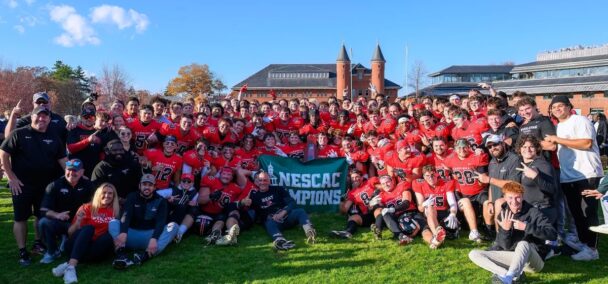
Football Makes Program History, Winning Back-to-Back NESCAC Titles
Sitting at 5–2, just one game back of first place in the NESCAC, Wesleyan controlled its own destiny heading into the final two games of the season. That journey started on the road against Williams, with a chance to clinch the program’s fourth straight Little Three title.
Williams took command of the game late in the first quarter, scoring a touchdown to close the frame and adding another at the beginning of the second. Behind double digits, quarterback Matt Fitzsimons ’27 found his reliable receiver Blake Newcomb ’27 for a 22-yard touchdown that put Wesleyan on the board. The two rivals would share empty possessions for the rest of the half, entering the locker rooms with a 14–7 advantage in favor of Williams.
Even though the Ephs switched their quarterback due to injury to start the second half, their attack didn’t miss a beat. They rode a six-play, 87-yard drive to the endzone, finding success through the air, and taking their second 14-point lead of the game.
The Cards’ first two drives of the second half ended poorly. On the first, the Ephs’ pressure got to Fitzsimons, forcing a fumble and scooping up the recovery. After the Red and Black defense forced a three-and-out, the offense once again struggled, only moving the chains once before stalling out. It took the Cardinals until the fourth quarter to get back on the board, as Angelo LaRose ’27 punched it in from three yards out to bring the Red and Black back within one score.
An interception by Williams’ defense on Wesleyan’s next possession set them up for an easy next score and their third two-touchdown lead of the game. The Cards battled, but the Ephs’ defense held them off the scoreboard, and the outlook was grim as the game entered the final three minutes.
Even with the odds against them, LaRose pointed to the seniors as instilling the team with unwavering confidence until the final whistle.
“[The seniors] really created a standard, and that this is a new culture at Wesleyan, and we take pride in that,” LaRose said. “And now, we expect to win every time against purple. That’s just how it is. They created that standard, and that’s the standard that we have to keep ourselves to.”
Staring down a 28–14 lead, it would take a Herculean effort from the Red and Black on all units to even force overtime. Fitzsimons and Sam Wien ’28 began that effort, with the two connecting for a nine-yard score with 2:48 left in the game. Now it was up to the defense to shut down the Ephs, and they did just that, forcing a quick three-and-out and getting the ball back to Fitzsimons and the offense with 1:45 left.
The offense would only need 50 seconds. A 44-yard pass to Newcomb, to cap off his 161-yard performance, put the Cardinals near the red zone, and Fitzsimons found Sean Cannon ’27 in the back left corner of the end zone to complete the comeback. Now knotted at 28–28, the defense still needed to prevent the Ephs from reaching field goal range.
Who else but Dylan Connors ’26 to come up big when the Cards needed it? On a crucial passing play that would have put Williams well within their kicker’s range, Connors jumped the route and intercepted the ball, sending the game into overtime.
NESCAC overtime rules allow each team to possess the ball 25 yards from the endzone. Williams immediately got the ball inside the 10-yard line, but a strong goal-line stop from the Cards’ defensive line forced a field goal attempt. While it looked like the Cards would need to respond to points from the Williams’ offense, Dean Sokaris ’26 had other plans. He flew by the Ephs’ linemen and blocked the field goal, tipping the momentum heavily in the Red and Black’s favor. Sokaris would be named NESCAC Special Teams Player of the Week for the block when Wes needed it most.
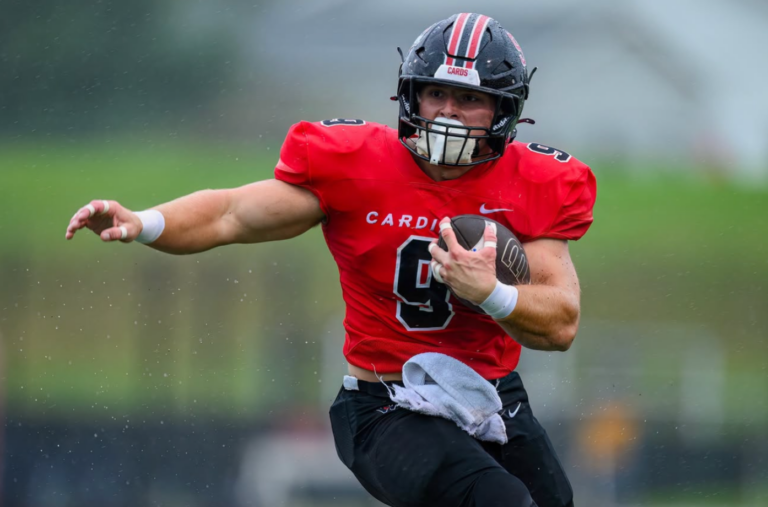
The offense took over and immediately capitalized on the momentum generated by their special teams. Fitzsimons once again found Cannon when they needed it, gaining 24 of the 25 yards needed to score. From there, LaRose did the rest of the work, pushing through the Ephs’ defensive lineman, finding the end zone, and capping off a team-characterizing win for the Red and Black.
Fitzsimons spoke on the progression of overtime.
“We’re a team that always feels like we’re waiting for big play to happen, and we hadn’t gotten one defensively during the game, and it was perfect timing with Dean,” Fitzsimons said. “And then Sean Cannon coming off injury like that was just great and made my job easy. All I had to do was get one yard. You can’t really describe the feeling of the whole team rushing the field on their homecoming. Indescribable feeling when everyone’s that excited.”
The comeback exemplified the team’s identity on all three levels. The pass offense was prolific, as Fitzsimons threw for a Wesleyan record 458 passing yards. He received his second New England Football Writers Association Gold Helmet and NESCAC Offensive Player of the Week for his performance. On defense, their huge stops in the red zone helped swing the momentum, and Connors’ interception once again anchored the unit. The special teams shone as well, as Sokaris’ FG block provided the Cards with the creativity to open it up immediately in their OT drive.
For the second consecutive season, the NESCAC Championship would be decided with the in-state rivalry between Wesleyan and Trinity. For Wesleyan’s senior class, everything converged at once: their final game of organized football, an opportunity to avenge the 56–8 beatdown Trinity delivered on this field two years ago, and a chance for the program’s first-ever back-to-back championship.
“For us as a senior class, it was like, what more could we really ask for [than] the opportunity to play our last game on our home field for a championship,” Connors said. “It is probably the best ending you could have and every guy was super excited. Obviously, you don’t want it to end, but if there’s an end, that was just an awesome combination for it.”
Continuing the trend of defense-dominated starts, the first quarter passed without a point. Remarkably, only 31 of the 436 points scored in Wesleyan games this season have come in the opening quarter. Early in the second, a 15-play drive got the Cardinals on the board first, with Gage Hammond ’27 knocking through a 22-yard field goal. A quick three-and-out for the Bantams gave the Cards offense the chance to build. On second and seven, Fitzsimons escaped the pocket with three Bantams rushers charging. Running towards the sideline, he directed Justin Meyreles ’27 towards the middle of the field and delivered a strike. Meyreles caught it at the 35 and continued running diagonally upfield before planting his foot and switching fields and taking it to the house to put Wesleyan in front 10–0.
“That was the play of the year in my opinion,” Fitzsimons said. “He had a long developing route and he didn’t finish it by the time I started scrambling. So I was pointing for him to go up the sideline, and he ran back into the middle of the field. And I threw it across my body, and there was a little pocket where he could be open and he found it perfectly, made the catch, and then I think he juked out their entire team. It was sick, and it definitely changed the momentum of the game early in our favor.”
The Bantams got a touchdown of their own with 2:30 left in the half, but LaRose only allowed it to be a one-possession game for 13 seconds as he took the first play of the drive 78 yards to the end zone, putting the Cards up 17–7.
LaRose credited the offensive line for his success on the ground.
“Our starting tackle, Gerard Garofolo [’27], came up to me before the game and was like, let’s run it today, this is our game to win,” LaRose said. “And that fired me up. The offensive line, they all came to play. They were all physical up front. They all matched up their assignments really well, and it made my job easy, because running back to the most dependent position on the field. I need all other 10 guys to do their job for [the] running back to be successful. So all my success is because of the offensive line.”
The first three possessions of the second half resulted in touchdowns. Trinity struck first, but LaRose answered again, breaking loose, this time for 65 yards down to the Bantams’ 11. Two plays later, Fitzsimons hit Wein for a 13-yard score. Wesleyan’s 10-point cushion didn’t last long. The Bantams trimmed the lead to three, but the Cardinals responded with a clock-draining stretch of dominance, holding the ball for 13 of the next 15 minutes. Fitzsimons eventually cashed it in with a quarterback sneak, restoring the 10-point margin with under seven minutes to play.
Trinity tried to rally, but Sokaris blew through the line for his second sack of the day, forcing a punt. However, a clock-management miscue prevented Wesleyan from icing the game, and the Bantams capitalized, scoring with 1:58 remaining and forcing a quick three-and-out to give themselves one final chance.
From his own 41, Bantams QB Jaxon Carroll heaved one up intended for All-NESCAC receiver Nolan O’Brien. The ball never reached him as Connors and Mike Solimando ’26 converged, with Solimando coming down with the game-sealing interception.
“I jump up there, and I feel good, but then I hit the ground I don’t know who has it for a second, but then I see Mike get up and throw the ball,” Connors said. “So I honestly thought O’Brien took it out of my hands in the end zone and we lost the game. It was probably the most terrifying moment of my entire football career. But, yeah, I couldn’t be more happy that Mike came up with that ball, and he definitely let me hear it afterwards.”
Because of the archaic NESCAC rules, despite the Cardinals and Bantams both being 7–2 and the Red and Black winning the head-to-head, the two teams ended as co-NESCAC champions. Still, for a team that entered this season having lost eight of their nine All-NESCAC players from last year’s championship team, winning the Little Three and sharing the NESCAC title is nothing short of remarkable, and an indictment on the foundation of the program.
The Cardinals swept the major NESCAC awards with Fitzsimons winning Offensive Player of the Year, Connors grabbing Co-Defensive Player of the Year, and Donte Kelly ’29 taking home Rookie of the Year. This marked only the second time in NESCAC history that one team earned all three major individual awards (the other in 2019 at Middlebury). The Red and Black also cleaned up on the All-NESCAC awards. Jack Bohnsack ’27 and NESCAC-leading receiver Newcomb also earned first-team nods, with Garofolo finding his way onto the second-team. Defensively, the Cards got seven acknowledgments with Austin Baker ’27, Sokaris, and cornerback Vincent Lytle ’28 joining Connors on the first-team. Cornerback Aiden Nelson ’27, linebacker AJ Morris ’26, and defensive tackle Will Orso ’26 made the second-team. Baker also earned a spot on the special teams.
For the graduating seniors, this season cemented them as the most successful class in program history. They passed the class of ’49 as the winningest group ever with 27 wins over four seasons, became the only class to never lose the Little Three, and have claimed two of the program’s three NESCAC titles.
Sam Weitzman-Kurker can be reached at sweitzmankur@wesleyan.edu.
Max Forstein can be reached at mforstein@wesleyan.edu.
Leave a Reply