
From the Argives: Chalking Up Trouble Since 2002
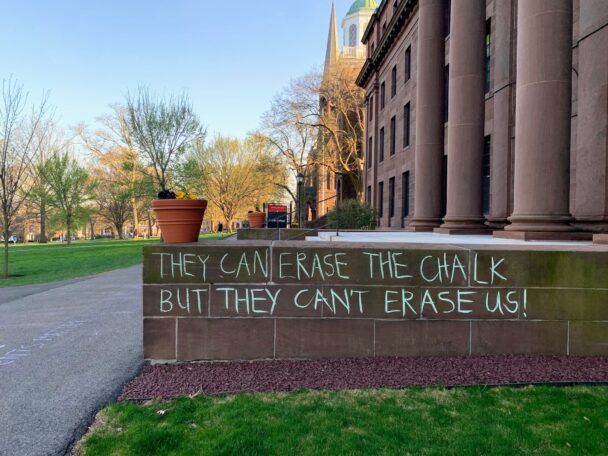
In light of recent bans on our campus (BORGs and beer pong and ice luges, oh my!), this week, the Argives reflect on the University’s contentious chalking ban, a policy stretching back over 20 years.
In October 2002, former President Douglas Bennet ’59 instituted a campus-wide ban on the use of chalk on campus grounds, inciting an uproar among the student body.
“The indefinite moratorium on chalking instituted by Bennet in the fall of 2002 was as controversial then as it is today,” Sulan Bailey ’25 reflected in an article published in The Argus on May 4, 2023, titled “Renewed Chalking Controversy Emerges During WesFest.” “Bennet sent a campus-wide email prohibiting the use of chalk on University property in response to targeted, sexually explicit chalk messages and drawings that sometimes included racial slurs.”
The chalk ban has remained in effect since the 2002 memorandum despite Bennet’s promise to devise a chalking policy that would make all members of the community comfortable, as described in an Argus article issued on April 18, 2003, titled “Chalking discussions show some progress.”
“Bennet hopes to decide on the policy recommendation by the end of the semester,” Rebecca Erenrich ’06 reported. “It would allow for chalking with the provisions that anybody specifically named who perceived it as harassing could contact the administration to have it erased. The proposal also suggests open forums to allow for public discussions on controversial issues.”
Discussions regarding the use of chalk dominated campus politics from October 2002 to May 2003. Students believed that chalking represented an important form of self-expression that allowed them to be heard by the administration. While Bennet acknowledged the importance of free speech, he believed that harassing chalk messages would return if the ban were to be lifted.
“According to Bennet, however, chalkings are creating negative dialogue within the University rather than improving communication among students, faculty and administrators,” Xiomara Lorenzo ’05 wrote in an article published in The Argus on Oct. 4, 2002.
Despite the ban, many students continued chalking or took on other forms of visual communication, especially given the financial burden that the erasure of the chalk caused the University, Brett Beach-Kimball ’05 revealed in an article published in The Argus on May 6, 2003.
“Amidst the discussions, some University students have turned to spray painting as a form of expression,” Beach-Kimball wrote. “While the official numbers were unavailable, estimates on the total price of erasing chalkings so far range well above the 8,000 dollar price tag for erasing the spray-paint, but the spray-paint has still raised financial and judicial issues.”
As students retaliated against the administration, student organizations such as the Wesleyan Student Assembly worked closely with President Bennet to come up with a definite solution to the issued suspension, Erenrich wrote in her April 2003 article.
“[…] Bennet is considering, among other ideas, a Wesleyan Student Assembly (WSA) proposal that would allow chalking with specific guidelines,” Erenrich described. “Bennet hopes to decide on the policy recommendation by the end of the semester. It would allow for chalking with the provisions that anybody specifically named who perceived it as harassing could contact the administration to have it erased. The proposal also suggests open forums to allow for public discussions on controversial issues.”
There was a bitter tension between Bennet and the students, a push and pull between the importance of free speech and concerns about the insensitive use of chalk. Hoping to lighten the students’ spirits and make progress on this matter, Bennet decided to seek help from outside.
“President Doug Bennet lifted the University’s moratorium [temporarily] on chalkings in an attempt to teach students the proper use of sidewalk chalk. Children, ages seven through 10, from the local elementary school were bused to campus on Monday and taught a tutorial called ‘The ABC’s of Chalking,’” Hanna Ingber ’03 and Doro Globus ’05 wrote in an article published in The Argus on Oct. 14, 2002.
Unfortunately, while this event may have temporarily created peace between students and administrators, many still believed that President Bennet wasn’t assessing the true issue at hand.
Despite decades of debate, chalking has remained a prominent form of protest on campus. In 2023, during WesFest, students engaged in a significant chalking campaign, writing messages ranging from criticism of anti-chalking policies to notes about the threat of climate change. During the 2024 pro-Palestine encampment, protesters regularly chalked University sidewalks with slogans proclaiming support for Palestinians under Israeli siege.
It’s clear that the 2002 chalking ban continues to have a hold on campus, even if many current students might be unaware of its history.
Lara Anlar can be reached at lanlar@wesleyan.edu.
“From the Argives” is a column that explores The Argus’ archives (Argives) and any interesting, topical, poignant, or comical stories that have been published in the past. Given The Argus’ long history on campus and the ever-shifting viewpoints of its student body, the material, subject matter, and perspectives expressed in the archived article may be insensitive or outdated, and do not reflect the views of any current member of The Argus. If you have any questions about the original article or its publication, please contact Head Archivists Hope Cognata at hcognata@wesleyan.edu and Lara Anlar at lanlar@wesleyan.edu.



Leave a Reply