
An Emmys Full of Upsets Shows the Mess of Our Post-Peak TV World
Host Nate Bargatze opened the 77th Emmy Awards with a sketch in which he played the inventor of television: a fitting opening since, going into last Sunday, some in the media thought the future of TV was at stake. Some predicted that the newcomer hospital drama “The Pitt,” an ensemble series taking place over the course of one 15-hour shift, would signal a definitive end to high-budget, star-powered shows, such as its competitor “Severance.”
The Emmys raised difficult questions: Is television a place where new stars are minted or where old favorites try something new? How many episodes should a season have? Should more productions be moved to Los Angeles? The winners of this year’s Emmy Awards evaded easy conclusions.
“Severance” is in many ways an artifact from the age of peak television, the period from the early 2010s to 2023, when streaming services produced a high quantity of popular, critically acclaimed shows. In 2023, the number of scripted shows dropped a steep 14% and only continues to fall. In its aftermath, the industry has been grasping to find a new model to capture audiences, as niche streaming services and social media platforms crowd the show landscape.
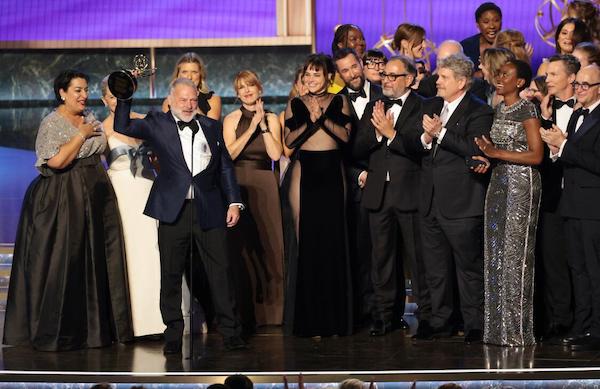
One of the most definitive winners of the awards night was “The Studio,” a fast-paced comedy about a Hollywood executive. An expensive and ambitious undertaking by Seth Rogen and his longtime collaborator Evan Goldberg, with cameos from Martin Scorsese, Charlize Theron, and Zac Efron, each compact episode is almost as glitzy as the awards ceremony itself.
It won a total of 13 Emmys (a record for a freshman show), including Outstanding Comedy Series. That was not the only shake-up in the comedy category, with Hannah Einbinder earning her first win for her role on “Hacks” after four nominations and Jeff Hiller winning for “Somebody Somewhere,” an upset over the predicted winner Harrison Ford, for his role on “Shrinking.” Hiller’s nomination itself was a surprise, and his win demonstrated the breadth of good television that exists outside of the more popular nominees.
All the award winners from streaming service shows reflected the model’s current environment: few episodes per season. “Somebody Somewhere,” for example, had only five episodes in its third and final season. The new winners were less indicative of industry-wide change and more a sign of the talented pool of nominees and Hollywood’s love of seeing itself reflected on screen.
The night’s most anticipated awards were in the drama category, where “The Pitt” and “Severance” were poised to face off. Instead, it was a draw. “Severance” won a total of eight awards to the five won by “The Pitt,” and the highly contested categories of Outstanding Drama and Best Actor in a Drama Series went to “The Pitt.”
“Severance” had been an early favorite, the second season of an acclaimed show that many thought had been snubbed the first time. Some possible explanations for “The Pitt” pulling through for these big categories include its Los Angeles-based production, long season (for a streamer), and lead actor Noah Wyle’s comeback status, as well as the three-year wait between seasons of “Severance.” The two shows’ paths continue to diverge, as the cast of “The Pitt” flew back to Pittsburgh the next day to continue shooting exterior scenes for Season 2, while Season 3 of “Severance” is not yet in production.
The past couple of years have been disruptive for TV: Strikes, COVID-19, and company mergers have led to a mess that could be felt on the broadcast. Perhaps the only constant in this post-peak television era seems to be a buzzy Netflix limited series sweeping the category, an honor bestowed upon the hit “Adolescence,” which won eight total awards. Otherwise, voters failed to indicate a clear new direction for the industry.
Abby Slap can be reached at aslap@wesleyan.edu.






Leave a Reply