
Sudan expert offers harsh insights on Darfur genocide
In a sobering presentation Thursday, Eric Reeves, professor of English Language and Literature at Smith College, offered students a daunting look into the realities of the genocidal war in Sudan.
Reeves is a leading expert on the situation in Sudan and the only person currently doing mortality research on a situation which has been described as the world’s worst humanitarian crisis of our time.
“I am terribly, terribly pessimistic,” Reeves said. “I don’t want to create false hope.”
According to Reeves, on any given day 3,000 people may die in Darfur, a remote region in the western part of the country. In Darfur the Khartoum National Islamic Front (NIF) has waged what many people refer to as ethnic cleansing against the four main African ethnic groups in the area.
“More than 250,000 people have already died,” Reeves said. That number could conceivably reach one million by next year. “In the coming months, disease and famine will strike, and people will have to watch their families die.”
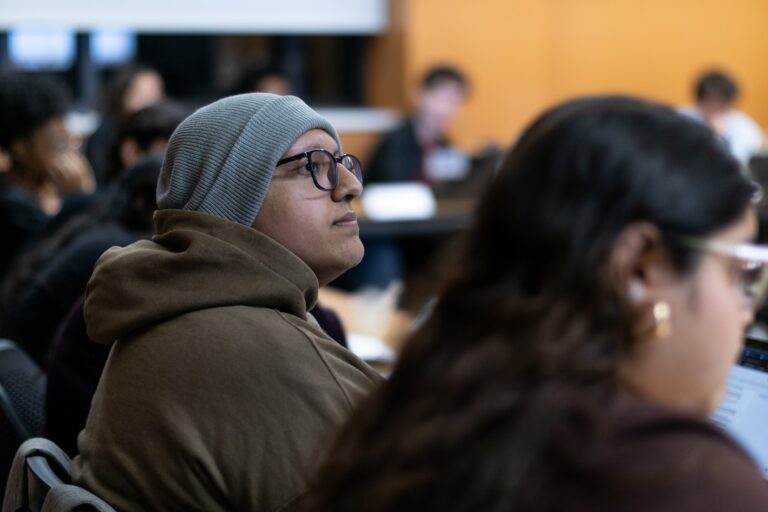
The Center for African American studies, which hosted the event, was flooded with students, who had to sit on the floor after all seats were taken.
“There were clearly more people than they expected,” said Matthew Bagnall ’07.
The lecture continuously referenced the humanitarian atrocities that are committed every day in Darfur.
According to Reeves, women and children are mass-raped in front of their husbands and fathers before being brutally massacred.
“The captives that are executed are the lucky ones,” he said. The NIF also resorts to destroying crops and poisoning the water supplies of the black Sudanese.
While some major world leaders, such as United Nations Secretary-General Kofi Annan, do not wish to label the killings in Sudan as ‘genocide,’ Reeves argues that the murderous actions taking place in Sudan are only explicable as an attempt to eliminate blacks.
According to Reeves, the situation is complicated by the fact that there is much inter-marriage and ‘blurring’ of the lines that separate ‘racial’ groups.
The problems in Darfur began in February of 2003, when the National Islamic Front Regime overthrew the elected government in a coup.
Since the beginning of these problems, other countries have been hesitant to get involved because Sudan is seen as such an unstable country. This perception is due in part to Sudan’s poor economy, and also to stereotyping of its large Muslim population. Reeves argues that this attitude dumps responsibility on Africa.
“But genocide is not at African problem, it is a problem for the entire world,” Reeves said.
Reeves criticized the lack of attention the crisis has received in the media.
“Every death in Iraq is reported, yet we hear nothing of the 3,000 people who die every day in Sudan,” he said.
According to Bagnall, he came away from the lecture with the strong message that, due to the vast amount of misrepresentation of the crisis, the next main step is to increase education in the United States. Reeves, however, did not refrain from emphasizing the neglectfulness of inaction up to this point.
“It is fundamentally important to understand that we have already failed,” he said. “What we need now is action, not words.” He argued that the issue should not turn into a semantic debate.
Reeves emphasized that there is a political route to positive change. Due to large deposits of oil in southern Sudan, many investors are interested in the outcome of the war, and are supporting the NIF. Tatneft, a Russian oil company, and Petrochina, a Chinese oil company are two such investors that Reeves suggests the United States ought to campaign against.
Some African countries, Rwanda in particular, have sent support to Darfur. Australia and New Zealand have also offered aid.
“I’m sorry to leave you with one of the most dispiriting talks you might ever experience,” Reeves said, “but there’s no reason for false optimism.”


Leave a Reply