
Tone Clusters tackles truth
Wesleyan students take for granted that the media and the truth are often different animals. But we speak of The Truth as though it is an object, a diamond in the rough—or someone’s bulging pocket—waiting to be found and claimed. February 24-26 in the MPR, truth was indeed on display, and it proved quite different from our expectations.
“Tone Clusters,” by Joyce Carol Oates, tells the story—ostensibly—of the parents of an alleged killer. Frank and Emily Gulick’s son Carl has been arrested for the sadistic murder and dismemberment of Edith Kaminsky, a teenage girl whose body was finally found in the Gulicks’ basement. The play itself occurs well after this; the audience is witnessing the Gulicks’ televised interview by a disembodied Voice. They are adamant that their son is innocent, and what unfolds is a clash between the worldly, condescending media and two individuals’ desperate attempts to claim ownership of their own lives.
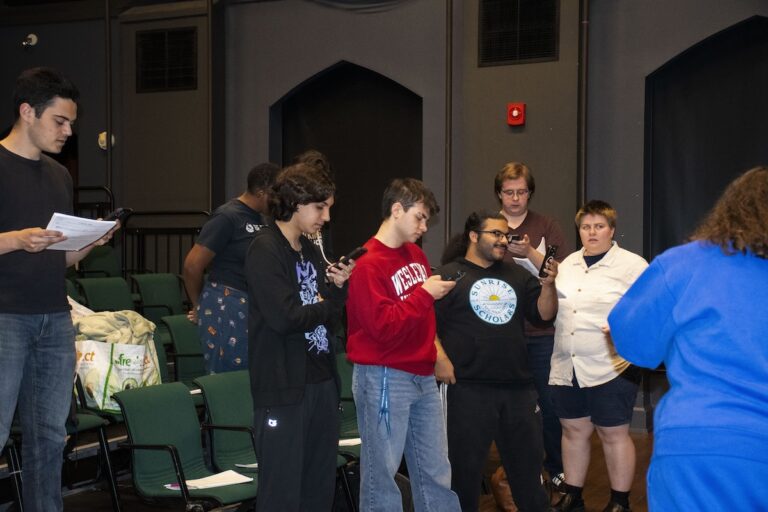
Director Jess Chayes ’07, whose production of “The House of Blue Leaves” went up in the ’92 last fall, had an excellent cast in Mike James ’07 and Hayley Stokar ’06. Their performances, in fact, at times upstaged the text. Stokar, who at Wesleyan has mostly played character parts, proved she can carry a challenging lead role with aplomb; perhaps the most compelling moment of the piece was hers, in which Emily rises from her chair defiantly in an outburst against all the rubberneckers who want to see her hide her face in shame.
James is making good on the promise he showed last semester, both in his small part in “The Long Christmas Dinner” and his multiple, wide-ranging roles in the Wesleyan Playwrights Collective showcase. His Frank seemed to know more than he actually wanted to. He has one of the play’s most crucial lines: “It’s hard to speak of your own flesh and blood, as if they are other people, it’s hard, without giving false testimony against your will.” Frank realizes that, in their love for their son, they will never really know whether they themselves are telling the truth.
This slender, thought-provoking play used the MPR well, showing that alt-space and production values are compatible. TV monitors showed a live feed of the goings-on, turning the audience into a studio audience. “Applause” go-between was not only disconcerting in the context of the play, but was also visually eye-catching (and sources say it was homemade to boot, by light designer Greg Malen ’07). The slideshow underscoring the play was its own character, the photographic evidence promising a glimpse at the facts. But even the undeniable images couldn’t add up to make sense of the story for us.
Eric Wdowiak ’06 provided the Voice, the host of whatever show or shows on which the Gulicks are appearing. The Voice steamrolls right over the nervous, lower-middle-class pair, starting innocuously, but subtly looking for blood. Questions about Aristotelian values and the state of civilization are interspersed with laundry lists of the suspicious items found in Carl’s room—mutilated Barbie dolls, a collection of knives, Nazi memorabilia. This is all done in the same unctuous, insinuating tone that leaves little room for disagreement. The Voice is there to tear them apart, to get the story, not to get to know them; he gets Emily’s name wrong and, in a particularly unsettling slip-up, accidentally calls them “Mr. and Mrs. Kaminsky.”
But the play is not about media vulgarity. Both sides have an agenda in this story, and both sides feel that theirs is the side of justice. There was thus no final, tangible truth to be uncovered, because the undeniable reality of Carl’s horrific deeds simply does not square with the normal, loving relationship that Frank and Emily undoubtedly shared with their son. The truth might well exist, but it is not hidden by intentional deceit or even by factual complexity. As “Tone Clusters” shows, the problem may be that we don’t actually know what we mean when we use the word truth. It is not simply multi-faceted, like a gem, but amorphous, irregular, and disorganized. Talk about truth produces only random clusters of sounds (or, if you prefer, tones). Our job is to listen, as best we can, through the din.
TONE CLUSTERS by Joyce Carol Oates; directed by Jess Chayes ’07; stage managers Eliza Ford ’08 and Jeni Morrison ’07; light design by Greg Malen ’07; scenic design by Marty Schapiro ’08; sound design by Jeremy Marks ’07; costumes by Christine Rabstenek ’08.
WITH Mike James ’07 (FRANK GULICK), Hayley Stokar ’06 (EMILY GULICK), Eric Wdowiak ’06 (VOICE).


Leave a Reply