
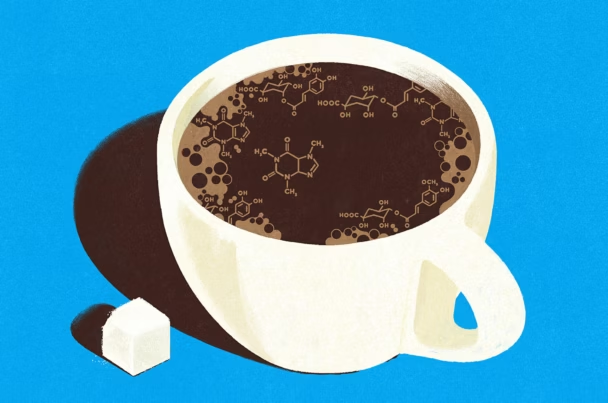
Can Friends Replace Coffee? A Hypothesis on Getting Energy From Companionship
I found myself in a peculiar position this summer. I woke up and craved coffee. Every. Single. Day.
Not in a cute “I could have a little morning latte” kind of way. I mean in a way that I felt like I needed it. I’ve always tried to follow the medical advice of not drinking coffee within the first hour of waking up, but for some reason, this summer, waiting felt impossible. My brain seemed to have one request the second I opened my eyes: coffee.
The weird part was that I had never really been dependent on it. If I skipped my morning coffee, I’d be fine. Maybe a little less enthusiastic about everything, but fine. So why, all of a sudden, did I feel like I needed caffeine to start my day?
I started thinking about what had actually changed.
Coffee contains caffeine, which the National Institute of Health (NIH) describes as a “naturally occurring central nervous system stimulant.” Caffeine works partly by blocking adenosine receptors. Adenosine is a chemical that accumulates in our brains throughout the day and contributes to feelings of tiredness. Blocking it allows you to feel a little more awake. Caffeine can also induce neurotransmitters involved in motivation, attention, and mood, including dopamine and norepinephrine.
Basically, coffee gives your brain a little kick.
Now you might be thinking, “I know. I need coffee to be happy and functioning. Tell me how friends can replace coffee.”
Calm down, amigo.
It turns out that social interaction can give your brain its own kind of boost. Spending time with people we like can activate reward pathways and influence neurotransmitters such as dopamine and serotonin. Positive social interaction can also help regulate stress and reduce feelings of loneliness and isolation. In a very unscientific way of putting it: Friends can make your brain feel good.
Obviously, friendship is not literally caffeine. Your roommate is not going to chemically block your adenosine receptors while you eat breakfast together. But both coffee and meaningful social interaction can change how we feel: more awake, more happy, more motivated, and less suffocated by stress.
And then, eventually, I connected the dots.
During the school year, I lived in a house with my friends. When I woke up, there were immediately people around me. Someone would be making breakfast. Someone would be complaining about an assignment. Someone would walk into the kitchen half-awake and start telling me something what had happened the night before.
Nothing particularly profound was happening. But maybe that was the point.
I was waking up in a social environment. Before I had even checked my phone or thought about what I had to do that day, I was interacting with people I cared about. There was noise, conversation, laughter, and the occasional completely unnecessary debate about something that definitely did not matter.
And somehow, I had energy.
Then I came home for the summer.
Suddenly, my mornings were quieter. I would wake up and find a peaceful house. No friends stumbling into the kitchen. No spontaneous conversations. Just me, my thoughts, and the suspiciously large amount of time I now had to think about how tired I was.
So I started drinking more coffee.
Maybe caffeine was solving a problem that wasn’t entirely about caffeine.
There’s something easy to overlook about social interaction because it doesn’t feel like a health intervention. We tend to think about health in terms of obvious things: exercise, nutrition, sleep, medication. We know that going for a run is good for us. We know that vegetables are good for us. We know that getting eight hours of sleep is probably better than staying up until 3 a.m. watching videos that we won’t remember the next morning.
But we don’t always think of friendship the same way.
Yet, research has consistently linked strong social relationships with better mental and physical health, while loneliness and social isolation are associated with worse health outcomes. Humans are social creatures. We need other people.
And yet, when life gets busy, friendship is often one of the first things we cut.
“I’m too busy.”
“I have an exam.”
“I’ll call them later.”
“I’m just tired.”
Sometimes, of course, you really are tired. But what if the thing that might make you feel better is the exact thing you are too tired to do.
That’s where my coffee theory comes in.
I’m not saying that friendships will replace coffee. I am not suggesting you throw your espresso machine into the trash and start inviting your friends over at 7 a.m. (Although, honestly, that sounds pretty nice.)
I’m saying that we might be underestimating the energy we get from other people.
So if you wake up feeling exhausted, unmotivated, or just generally like you would rather not participate in the day, maybe the solution isn’t always another cup of coffee. Maybe call an old friend. Go grab breakfast with someone. Sit with people you like and talk about absolutely nothing.
You might still need the coffee.
But maybe you’ll need a little less of it.
Saara Saini is a member of the class of 2028 and can be reached at ssaini@wesleyan.edu.





Leave a Reply