
Life Sciences Building Debuts Despite Donor Controversy
Seven years after its conception, the Casper Life Sciences Building had its official debut on Tuesday, Sept. 8, giving students access to 197,300 square feet of labs, classrooms, and study spaces on a $250 million budget.
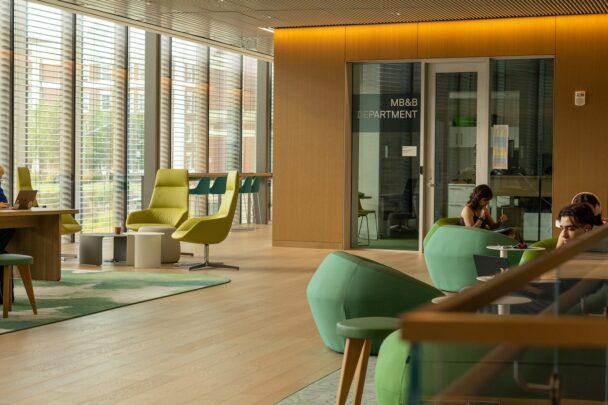
The building will replace Hall-Atwater, previous home to biology and chemistry labs, which is set to be demolished in 2027. The building’s floor-to-ceiling glass windows, fossil-inlaid exterior, and expansive open floor plan signify a visible shift in the University’s interest in the sciences, including the specific focus of University President Michael Roth ’78 on repositioning of the school as a competitive alternative to STEM-focused research universities.
Development for the project was aided by a $25 million donation from Marc Casper ’90 P’23, the Senior Vice Chair of the University’s Board of Trustees, and his wife Alison, for whom the building was also named. Casper serves as the CEO of Thermo Fisher Scientific, a $240 billion biotechnology and medical supply corporation.
“Wesleyan’s new science building is a generational investment in the University’s capacity for scientific discovery, and in the bold, rigorous education we provide our students,” Roth wrote in the University’s news blog over the summer, lauding the Caspers’ “deep commitment” to science education.
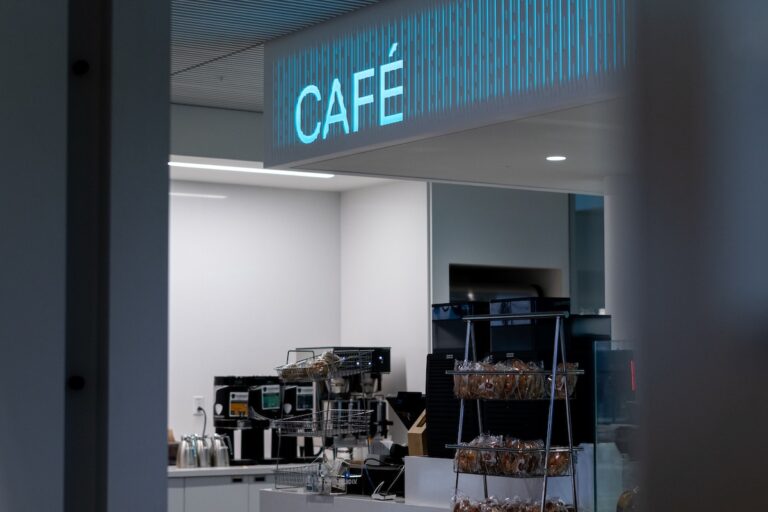
Comprising of 48 new labs, seven classrooms, office and conference rooms, a vivarium, and a greenhouse, the building is home to four of the University’s science departments: chemistry, biology, molecular biology and biochemistry, and neuroscience and behavioral studies. It also hosts the new location of Pi Cafe, now known as Pi² Cafe, on the second floor.
Hall-Atwater, which is 60 years old, has air-conditioning problems, flooding concerns, and limited shared equipment. Notably, in 2009, a lab in the chemistry department caught fire, damaging a third of the property. Professors and students also complained about the lack of collaborative spaces and windows.
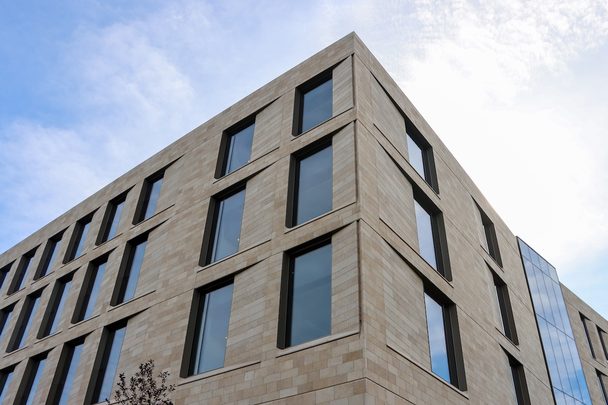
Development has been underway for the building since 2017. The lead contractor, FIP Construction, broke ground in 2022. The building was designed by architectural firm Payette, which specializes in architecture for science and healthcare spaces for universities, and has previously worked with other liberal arts colleges. Construction concluded over the summer.
Science Facilities Liaison and Associate Professor of Biology and Integrative Sciences Ruth Johnson described Casper as a significant upgrade from Hall-Atwater.
“[Hall-Atwater] was incredibly unwelcoming,” Johnson said. “It was just a place that you would never go.”
Faculty feedback on the design for Casper was encouraged. Johnson facilitated conversations with all faculty and Payette during construction to ensure labs and classrooms met the specific needs of their classes.
Energy conservation is a priority of the new building. In Hall-Atwater, a universal ventilation system transferred air throughout the entire building. In Casper, lab airflow is separated from that of the rest of the building, ensuring high turnover only when necessary and reducing energy consumption. An automated system of blinds on the front facade of the structure is likewise an energy-reducing method: during daylight hours, the blinds remain open, casting light through the space, and when cloudy or dark, they shutter and the building draws on artificial lighting. According to Associate Vice President of Facilities Alan Rubacha, Casper will have an energy use intensity (a measure of energy used per square foot) of 84, compared to Hall-Atwater’s 270.
According to Johnson, the building’s layout was developed around communal spaces and focused on student experience. Each floor of the building features a central seating and study area framed by glass walls separating the labs. Abigail Oduro ’27, a founder of the club Wesleyan Students in Research and a researcher in the University’s Fisher Lab, hopes that the layout will serve as an incentive for more students to consider engaging with undergraduate research and to seek out their professors.
“I’m happy that they’re trying to prioritize a lot of things like the research labs and give them their own space, because I think as time [goes on], life sciences research especially has gotten more popular,” Oduro said.
The building’s opening coincides with a 30.7% increase in STEM major enrollment since 2016, per the University’s Spring semester major reports. Neuroscience and Behavior and Molecular Biology and Biochemistry were among the University’s most popular majors in 2026.
The Casper Life Sciences Building is the University’s most recent construction project, following the three-year renovation of the Frank Center for Public Affairs, which opened in 2024. Construction is still in progress on nearby spaces. Shanklin is expected to be remodeled, and the land between the two buildings is undergoing landscaping work. The University intends to lead guided tours for students and parents of the completed building during Homecoming + Family Weekend.
Johnson expressed enthusiasm for the collaborative focus of the property and the facilities. She saw the development as indicative of a push to elevate the work of liberal arts colleges and demonstrate their ability to compete with larger universities without sacrificing their unique identity.
“This is the kind of building that you would expect to find, and you would find at an R1 university,” she said. “We’ve been doing good research all along. Now this building is going to challenge us to do even better.”

Despite the positive reaction from the University community to the new center’s offerings, the Life Sciences Building will be bogged down by Casper’s controversial career.
Thermo Fisher made headlines in the scientific community after recent research was published alleging that the company, along with other biotech producers, fabricated and edited images en masse to better sell antibodies.
As a member of the Board of Trustees, Casper additionally drew scrutiny and critique for his company’s business partnerships with the People’s Republic of China. In 2019, the New York Times reported that Thermo Fisher had sold the DNA-sequencing equipment to the Chinese government that was used in its mass campaign to collect the DNA of ethnic minorities residing mostly within the Xinjiang province. The DNA collection occurred in tandem with the mass detainment of over one million Uyghurs and Turkic Muslims in extrajudicial so-called re-education camps, which the United States called a genocide in 2021. Thermo Fisher ended its sale of the technology in the province following the reporting and subsequent congressional pressure.
But, in 2022, Thermo Fisher was again implicated in the Chinese government’s repression of ethnic minorities. Following a Citizen Lab report revealing that Chinese police in the Tibet Autonomous Region (TAR) had collected roughly 900,000 to 1.2 million DNA samples between 2016 and 2022, the bipartisan Congressional-Executive Commission on China sent a letter to Casper expressing concern that the company’s equipment, sold directly to police in the TAR, “could enable further gross violations” of the Tibetans’ rights.
“We are alarmed that U.S. companies, including Thermo Fisher Scientific, may be wittingly or unwittingly aiding or abetting human rights abuses,” the commission wrote. In a letter written on Thermo Fisher letterhead, Casper denied that the corporation’s equipment had been used in the repression of Tibetans.
The building’s naming comes after the Public Affairs Center, located across Church St. from the Casper Building, was named for former Board of Trustees Chair John B. Frank ’78 P’12 in January 2024.
In February 2024, The Argus reported that Frank had been accused of sexual harassment by a University student in a Title IX complaint. Frank denied the student’s account. The University’s chapter of the American Association of University Professors, in a letter published in The Argus and signed by 35 professors, called the University’s handling of the accusation against Frank “a moral failure.”
Casper has not faced significant public criticism from the University student body since the announcement of the building’s name. But a petition circulated by students in 2024 called for Casper’s removal from the Board of Trustees; it received 376 signatures.
Miles Pinsof-Berlowitz contributed reporting and can be reached at mpinsofberlo@wesleyan.edu.
Aarushi Bahadur can be reached at abahadur@wesleyan.edu.
Correction: The article previously stated that Alan Rubacha was the former Vice President of Facilities. He currently holds the role.



Read miles horner ‘26’s thesis “Genetics, Race, and Power” in the archives to learn more!