
SHADES’ “Fuddy Meers” Charms With Neurotics, Horror, and Heart
Claire has a lot of questions. And so does the audience.
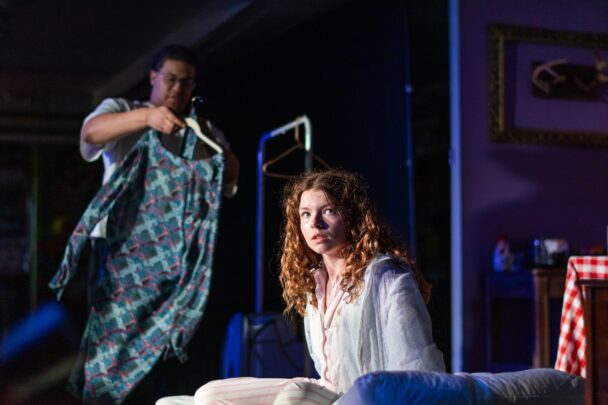
“Fuddy Meers” begins when Claire (Sophia Bourne ’28) wakes up, as she does every day, to rediscover that she has amnesia. In the day that follows, she is wrested from domestic bliss and transported through a violent and confusing world of neurotics, escaped convicts, and mistaken identities. Directed by Jerry Persaud Jr. ’26 and staged by SHADES, the play brought us along on her whirlwind day this past weekend, on Friday, April 3 and Saturday, April 4.
As the seats in WestCo Cafe filled up, Claire lay sleeping on a small cot onstage just feet from the audience, an experience Bourne said she found “very nerve-wracking” due to pre-show adrenaline. When her alarm goes off, Claire’s husband Richard Fiffle (Marcos Arjona ’26) patiently guides her through a binder that contains valuable information. It has everything from household appliance instructions to who her family is. He freaks out, however, when she starts to deviate from the morning routine, wondering if her amnesia was caused by trauma. He leaves to take a shower, and with Claire left alone, a mysterious limping man with severe facial burns and a lisp (Kekoa Dowsett ’28) appears under her bed. He convinces Claire to leave with him to go to her mother’s house.
Claire’s mother Gertie (Peyton Brill ’26) does not have the answers Claire wants, as a stroke has left her speech garbled. The phrase “funny mirrors” is rendered as “fuddy meers,” for example, joining several other mispronunciations throughout the show. The house gradually becomes a meeting point for all of the show’s strange, broken characters, who can barely contain their crazed frustration. During the show, I saw the falling apart of the family unintentionally captured in the set when a large flat came crashing down, generating gasps from the audience.
Here’s what happened: When Millet (Campbell Greenberg ’26), an escaped convict and friend of Limping Man, sprinted to make his exit, he accidentally bumped up against the flat. Then, sprinting in the other direction, he tripped over another wooden support, breaking it. It took me a couple of seconds to realize the destruction wasn’t intentional; outsized chaos was just that integral to the show. The cast took to the accident well, as Bourne, Brill, and Dowsett powered through an emotional scene, and others later cleverly improvised references to a wrecked basement.
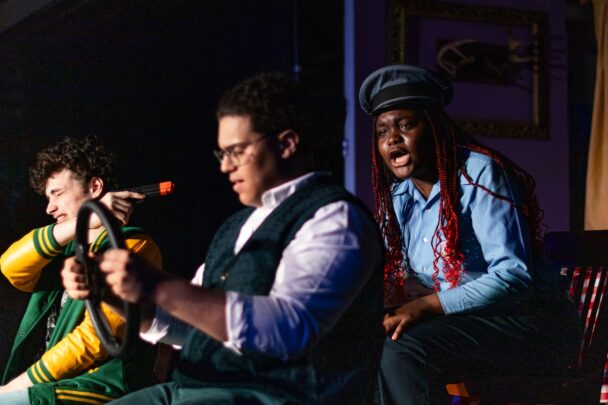
In every scene, the cast was fully committed, whether it was a kidnapped police officer (Osato Oronsaye ’29) wrestling Claire’s son Kenny (Conrad Lewis ’26), or Claire’s powerful moments of realization. Dowsett and Brill gave in to their characters’ eccentric maladies, convincingly stumbling, mumbling, and lisping through performances that still never went over the top. There was a clear understanding that, as Persaud Jr. said, “beneath all the chaos, the play also has a lot of heart and darkness to it.”
As Claire’s initially simple world of a seemingly loving husband and unexplained amnesia is violently disrupted, Bourne understood that for all the play’s “fuddy” moments, “Fuddy Meers is not really a comedy, it’s more a horror,” saying that, “it was important to me to balance the play’s humor with intensity.”
Audiences were enmeshed in the horror due to the small venue. Props flew at us, actors were close, and jump scares were plentiful. Though Persaud Jr. said “The biggest challenge was the space, from securing one to adapting to a tight stage,” it became a strength through careful staging.
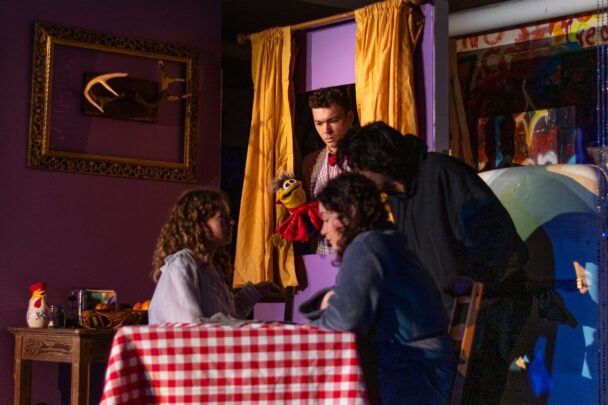
Despite the space, set designer Ollie Hoffman-Paul ’26 managed to create a stage that felt intimate but not cramped through flats and bead curtains, which they said “added an auditory element to the performance and helped create a more homey vibe in an otherwise strange house.”
“Fuddy Meers” challenges audiences to find meaning and heart in its weird world, reflecting on memory, trauma, and family without providing easy answers.
Abby Slap can be reached at aslap@wesleyan.edu.
Conrad Lewis is an Arts & Culture Editor for The Argus.

Leave a Reply