
AP Mania: A Reflection of High School and Why the College Board Should be Replaced
If there’s one opinion that I have changed the most throughout my life, it would be my view of the education system. Previously, I believed it would be a good idea to burn it all down and start over with a fresh new system. I concocted an idea in my head for a completely new K–12 system. It was similar to how college works: You picked a specific subject that led you on a career path, and took classes mostly for that specific subject. However, as I learned more about the school system, I started to support how the existing system worked. Yes, there were changes that needed to be made, but the basic structure of school was fine. I became a reformist instead of a revolutionary when it came to the school system.
However, there is one thing with school that I really do believe is broken, and that is Advanced Placement (AP) classes.
I’m not saying this as someone who struggled in these areas. I took many AP classes, did well in all of them, and got mostly fives on the exams I took. I’ve weathered the storm, so to speak. But the “AP Mania,” as I call it, is real. And it is not stopping anytime soon.
So what is AP Mania, actually? Well, let me give an example. When I was in 9th grade, my parents pushed me to take AP Computer Science. I was really against it: Not only was I paranoid about having to take an AP class in 9th grade, but computer science was not my favorite subject. In a class of 30, I was one of TWO freshmen in the entire class. My teacher was astonished at the fact that I even took the class as a freshman.
However, my brother, only two years younger than me, had a different story. When he took AP computer science, he said half of the class were 9th graders! This is what I mean: There is a significant increase in the amount of students taking AP classes, and it’s seriously damaging the school system.
First, AP courses introduce a whole host of problems to grading. Each AP course is weighted an entire 1.0 grade point average (GPA) point higher than a normal course, which turns the whole ordeal into a high-risk, high-reward situation.
The exact structure will depend on the specific school, but in general, the system doesn’t prioritize intellectual rigor. Honors courses are graded out of 4.5, 0.5 GPA points higher than a normal course, despite not having a big jump in difficulty. A student who earns a B in a strenuous AP class will receive the same 4.0 as a student who earned an A in a regular class.
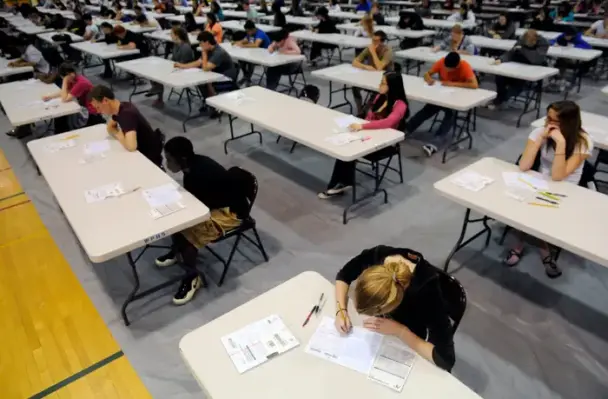
This specific grading scheme of AP classes gives an unprecedented level of pressure to students. These high schoolers are simply not up for the sheer level of rigor in these classes. They are pushed beyond their limit, and they often resort to cheating in order to get ahead.
Another problem is that all AP classes have to follow a similar rubric shared across all classes, no matter if it’s English, Math, or any other subject. There’s also some overlap in topics covered in AP classes, such as Human Geography and Environmental Science. Some classes are just poorly designed, like AP Computer Science A teaching how to code using Java, a difficult and obtuse language. AP Business and AP Precalculus feel entirely like scams and have no right to be an AP-level class.
The College Board is the root of all these problems. They pretend to be a “non-profit”, but they act with all the scumminess of a large corporation. AP tests cost a large amount of money to take ($100 each). If you’re lucky, the cost will be waived by the school, but having paid AP tests in public schooling will only cause inequality to rise. If taking 10 to 15 AP courses through high school becomes the new normal, that can cost anywhere between $1000 to $1500. A large number of students or their families won’t be able to pay that money, so they’ll be left behind.
In the end, what should be done? The main thing is that the College Board needs to be removed and replaced with a government institution that offers similar programs. Hopefully, through this, government funding can ensure AP tests are free for all.
However, I think more things need to be done. A government institution could perhaps allow for more regulations with AP tests, limiting the amount taken per year to make them feel like an engaging challenge once again.
Atharv Dimri is a member of the class of 2029 and can be reached at adimri@wesleyan.edu.





Leave a Reply