
Inferno!: “Diet Dante” Takes Us to Depths of Hell, Heights of Student Theater
“So, if I wrote a Dante’s Inferno Musical, would yall vibe with it?” read the story Elijah Philip ’28 posted to his Instagram account on March 7, 2025.
By no coincidence, that story was posted an odd week after Phillip had journeyed down to Broadway to see a production of “Hadestown,” the smash hit musical by Anaïs Mitchell. Drawing from Hellenic myth, “Hadestown”—written in 2006 and premiered on Broadway in 2019—stages the tragic romance of Orpheus and Eurydice in Depression-era America. Accents of sultry New Orleans jazz and American folk music underscore a story of persistence amidst apocalypse.
After that, a lightbulb flashed over Philip’s head—and right out of the gate (-s of Hell, perhaps), he knew exactly what he wanted. In the Instagram story, he added that violins would be the “main instrument of choice,” and that the music would draw heavily from classical and jazz music, just like “Hadestown.”
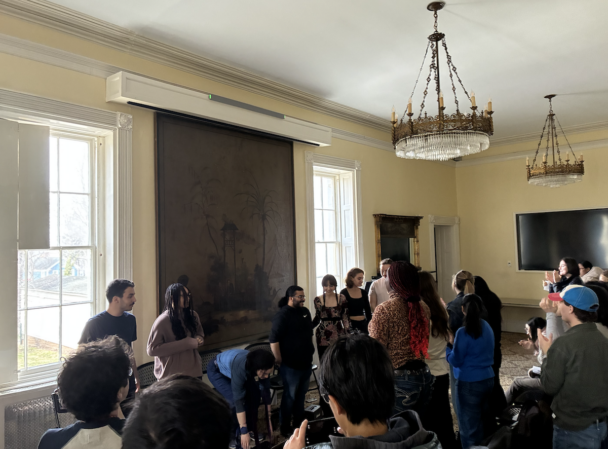
For Spike Tape’s Spring 2026 playwright showcase, an abridged version of Elijah Philip’s “Inferno”— or as he likes to call it, “Diet Dante”—went up, and it seems Philip cooked up just what he wanted. A blazing hot fire.
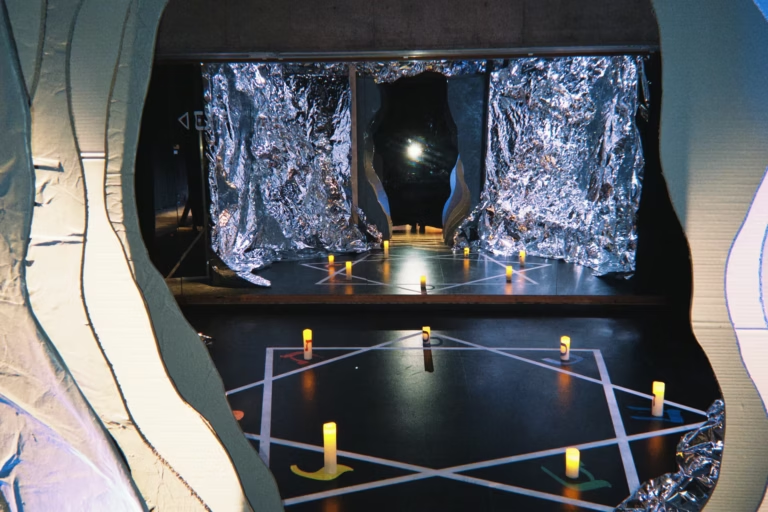
The show has been a year in the making and is running on a tight budget of zero dollars. Such is the nature of Spike Tape’s student playwright showcases: not intended to be full productions, they are diet in every sense of the word (abridged, low budget). But that doesn’t rule out ingenuity, craft, and creative vision. Philip’s show is a testament to the limitless passion and imagination of Wesleyan artists. They say Broadway is running low on money these days, but a frontierless production like “Inferno” suggests money is no matter where art is concerned.
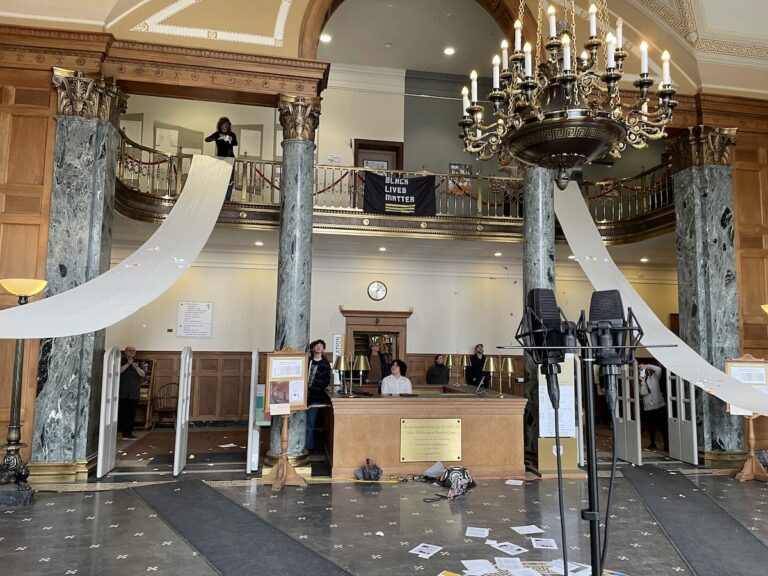
An audience of some 60 eager fans gathered in the main hall of Russell House. It was fitting that a building of such neoclassical extravagance, built in the fledgling years of independent America (1828, to be exact), would host a tragic story adapted from both Greek myth and American history.
The show begins with an atmosphere of chaos, which it never leaves. I don’t mean this in a negative way: In fact, the show’s musical style effectively transports us to the fiery depths of Creation. Outsider artist Henry Darger, who painted reams upon reams of drawings of little girls carrying flowers at the end of eternity, comes to mind when describing the elusive exoticism of “Inferno.” It seems at once coherent and familiar, pandemoniac and distant.
Yet where Henry Darger’s hair-raising paintings might drive you insane, “Inferno” is as goofy and lighthearted as we might expect of the best Broadway shows. It never takes itself too seriously, though Philip’s precise conducting shows he has a tight grip on the situation. There are notes of Studio Ghibli in the lush, impressionistic orchestration, a whiff of Hazbin Hotel or Pokémon in the bluntness of spoken lines like “We have a journey to do” or sung lines like “Yeah, the Infernooo!” The show’s unafraid to show its true colors: “Inferno” tells us that everyone, from the enlightened Virgil and Dante to the bile-spewing spawn of hell, is a little delicate on the inside.
The score and story, as mentioned, were abridged for Diet Dante. When the full musical is staged, however, Philip plans to present thirteen songs. Diet Dante featured six of those songs, starting with “Through the Dark of the Woods” and ending with “We Again Beheld the Stars,” song titles named after the famous opening and closing lines of the epic poem. There are also titles like “Splish Splash (In a Flash),” which bear Philip’s signature humor.
Even though there was no audience participation in the typical sense, the experience should be described as a collective one. I was excited to see the show, but I was even more excited to see it with my friends, laugh along at the jokes, and be transported through the fiery core.
As someone who has read “Inferno” twice, I was already quite familiar with the story. But story and plot have different meanings, as we see, because Philip took us on an entirely new journey in his rendition. In the original story, as the poet Virgil guides Dante through Hell, he dotes heavily on Dante, showering praise on the author’s work. (Subtle flex.) But Christopher Roche ’27 plays a more commanding Virgil, whose booming baritone emulates the bubbling lava of Styx. Virgil does not so much worship Dante as coach him, even chide him, so that he can correct his foolish ways. In turn, Dante, played by Gabby Hoefner ’29, is even less sure of themselves than the Dante of literature; Gabby plays Dante as more of an ingénue, a babe in the (haunted) woods who is smart but short on confidence.
Philip’s dedication to his craft is deeply felt, even in diet form. It is creative thinkers like him who keep the art of student theater alive.
Conrad Lewis can be reached at cglewis@wesleyan.edu.
Leave a Reply