

A Second Term for Climate Change Denial
Nestled between the foothills and Flatirons of Boulder, Colo., the National Center for Atmospheric Research (NCAR) has been a recent target of the Trump administration’s attacks on federal scientific institutes.
Russell Vought, Director of the United States Office of Management and Budget, called the climate research center “one of the largest sources of climate alarmism in the country” in an X post on Dec. 15, 2025. NCAR is not focused specifically on climate change, but rather on weather and climate modeling, air pollution, and storm prediction. This research has been critical to the national understanding of climate patterns and changes over time, and perhaps to its own dismantling.
At the University, student advocacy against the actions of the Trump administration seems to have strayed from environmental issues. This past Saturday, March 28, students participating in Middletown’s third “No Kings” protest seemed primarily disenchanted and disillusioned. The use of rhetoric denying climate change further frustrated Max Klie ’29, who took part in the demonstration.
“I think [climate change denial is] just a smokescreen to disguise the fact that obviously the White House is pretty deeply into the interests of oil and natural gas companies,” Klie said. “I think it’s literally just framing some advocacy as alarmism to get away with keeping the interest[s] in the back pocket.”
The future of NCAR is unclear, with plans to disband the Boulder center already underway. After 66 years of continuous operation, the NCAR’s sponsor, the National Science Foundation, opened the center to privatization after Congress failed to protect NCAR in a funding bill proposed by Colorado Senators John Hickenlooper and Michael Bennet.
Some have questioned whether the Trump administration intends to punish the liberal town of Boulder, Colo., through its attacks on NCAR. Trump blamed Governor Jared Polis for the incarceration of Tina Peters, who was convicted of criminal charges after aiding in an attempt to overturn the results of the 2020 U.S. presidential election.
“Maybe if Colorado had a governor who actually wanted to work with President Trump, his constituents would be better served,” a White House spokesperson told CNN.
Asserting climate alarmism is one way the Trump administration has justified its attacks on federal climate change science, simultaneously citing the benefits of cutting federal spending and boosting energy independence. NCAR, despite its importance to the scientific community, is a lesser-known victim in the long list of climate deregulation that has accelerated since the beginning of Trump’s second term.
In his first term, Trump primarily denied the existence of climate change through his rhetoric, consistently using the word “hoax” to refer to the crisis. Today, Trump is rapidly dismantling federal environmental protections, removing public access to environmental data, and restricting public discourse related to climate change.
In addition to decreasing environmental protections, the Trump administration has provided direct financial support for fossil fuel conglomerates, including $18 billion in tax incentives and faster phasing out of tax credits for renewable energy, as well as rolling back on protections created in the past to prevent tipping points in our climate.
According to the Columbia Law School Climate Deregulation Tracker, the Trump administration took 176 steps to weaken or eliminate federal climate mitigation efforts during Trump’s first term. Only a year into Trump’s second term, Columbia reported the Trump administration has taken 336 steps against federal climate control, a consequential increase in the administration’s attacks on environmental regulation.
This intensification became evident on March 12, 2025: “Today is the greatest day of deregulation our nation has seen,” Environmental Protection Agency (EPA) Administrator Lee Zeldin said in reference to 31 actions the agency was taking to advance the previous executive orders “Unleashing American Energy,” which were signed on Jan. 20, 2025.
These first-day orders withdrew the U.S. from the international Paris Agreement climate treaty and fast-tracked oil drilling, promising support for nonrenewable energies such as crude oil, natural gas, and coal. Brooke Suter, a former state and national director for climate organizations and current teacher at the MIT (Massachusetts Institute of Technology) Sloan School of Management, provided an explanation of the swift implementation of environmental deregulation.
“I think [Trump] wasn’t prepared to enact a presidency in his first term,” Suter said. “But in his second term, he came in ready to hit the ground running. He and his allies had created a very clear game plan, [such as Project 2025].”
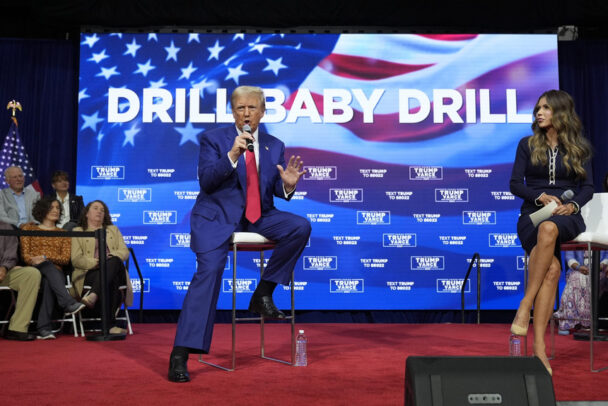
“[These actions] are driving a dagger straight into the heart of the climate change religion to drive down the cost of living for American families, unleash American energy, bring auto jobs back to the U.S., and more,” Zeldin said. One of these actions prompted reconsideration of the Endangerment Finding, a 2009 finding that declared greenhouse gas (GHG) emissions as harmful to public health and welfare, which was revoked on Feb. 12, 2026.
The Endangerment Finding required the EPA to take actions to curb pollutants and allowed the EPA to federally regulate emissions around cars, trucks, and major stationary sources. As their justification for rescinding the scientifically backed research, the Trump administration argued that it overstepped legal authority and damaged the economy. This effectively implies that human health costs are no longer taken into account, and concerns are now limited to considerations about economic costs. Since air pollution control costs money, this is likely to result in increased emissions.
“[This deregulation is] like pulling a tablecloth out from a finely set dining table,” Sharon Tisher, professor of Environmental Law and Policy at the University of Maine, said.
She believes the Endangerment Finding was a critical part of the larger fight against climate change, and now fears there will be extensive damage done with no obligation to measure or control GHG emissions in vehicles and power plants.
Since the 1950s, the term Great Acceleration has been used to describe the rapid surge in human environmental impact and, in particular, the rapid anthropogenic accumulation of carbon dioxide. Dr. John McNeil, an environmental historian and professor at Georgetown University, calls Trump’s second term “the Great Unraveling,” in reference to the swift steps against climate mitigation.
“We don’t know how ‘great’ it’ll be,” McNeil said. “It could be a blimp of underlying trend that’ll accelerate the Great Acceleration.”
Climate data is now threatened by the gutting of the EPA, dismantling of NCAR, and removal of funding for climate scientists, as environmental agencies gave $36.8 billion in project grants in 2025, a 44.3% decrease from 2024. Suter warned of the danger that comes with disruptions in data collection.
“What’s really challenging about dismantling these things is that having consistent data is very important,” Suter said. “By dismantling that consistency, it has a ripple effect. It becomes harder to get things back up and running. There’ll be, potentially, sort of a hole in some data.”
Violations of the First Amendment are now directly attacking climate scientists as a continuation of the alleged fight against climate alarmism. The New York Times lists 198 terms that appeared throughout documents intended to eliminate these terms from the government. Roughly a third of the 100+ listed in a memo to the United States Department of Agriculture’s (USDA) research division relate to climate change, including “global warming,” “climate science,” and “carbon sequestration.”
“Under President Trump and Secretary Rollins, USDA is getting back to work and putting farmers first, not woke ideology, ” a USDA spokesman said.
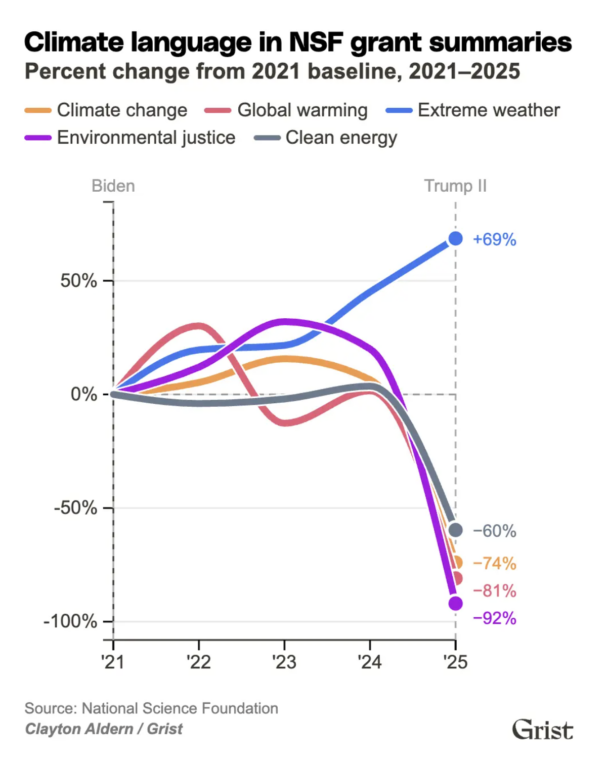
This trend of suppressing certain terminology has created self-censorship within the climate science community. Terms such as “weather extremes” and “weather variability” have also been used in place of “climate change” to allow grants to pass.
Climate scientists are now working around the new censorship that federal workers were informed of in memos, preventing them from using certain words deemed woke by Trump’s administration.
The move reflects the broader trend in this second term, where talk of climate is much less prevalent than denial in action. A notable lack of discussion about the climate is a clear outcome when this administration bans its government from using words surrounding the topic.
Trump himself seemed more irresolute when speaking on climate change before his second term. He exhibited a less staunch stance in January 2020.
“Nothing’s a hoax about [climate change],” Trump said. “It’s a very serious subject…. I want the cleanest air, I want the cleanest water. The environment is very important to me. I also want jobs. I don’t want to close up our industry because somebody said you have to go with wind.”
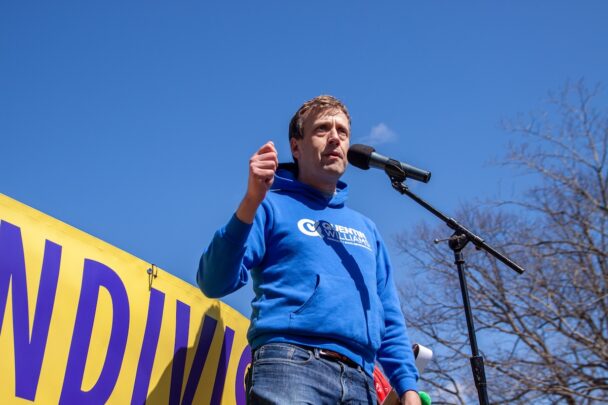
Now, there are fewer comments specifically about climate change, and more action is being taken to prevent others from speaking about the environment. Some view the prevention of certain language as feeding into a false reality, one that denies climate change as a fact. Matt Lesser, Connecticut State Senator for the 9th district, shares this opinion.
“The reality of our climate change struggle, just like the reality of racial inequity and health and equities and all of the other concepts [Trump] wishes would go away, [is that they] don’t just go away because you delete the words,” Lesser said. “It just makes it harder for us to have real conversations with each other.”
Finn Feldman can be reached at ffeldman@wesleyan.edu.




Nationalize the oil companies and shut them down.