
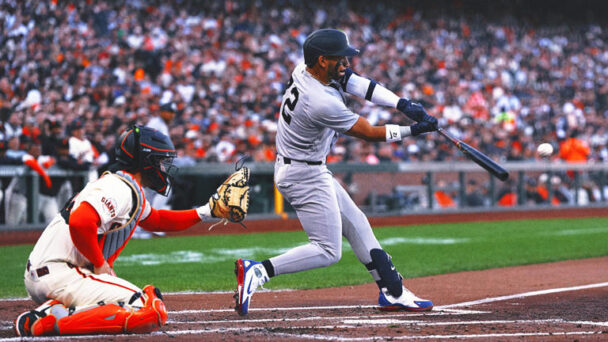
The Argus Predicts the MLB: Three Bold Takes for 2026 Opening Day
On Saturday, Nov. 1, 2025, Will Smith took a Jeff Hoffman pitch deep to put the Los Angeles Dodgers ahead and win the World Series over the Toronto Blue Jays. Since that homer determined the outcome of the 2025 season, various superstars have switched teams, Spring Training has displayed the next generation of sports superstars, the World Baseball Classic saw Venezuela topple the United States in the finals, and collective bargaining debates continue to loom over the league. As the 2026 season kicks off this week, Head Copy Editor Anna Thomas and Sports Editors Max Forstein and Ethan Lee provide us with their boldest prediction for the upcoming season of America’s national pastime.
Anna’s Take: Devin Williams bounces back to All-Star form.
Prior to being traded from the Milwaukee Brewers to the New York Yankees in December 2024, Devin Williams was close to unhittable, pitching to a sub-two ERA each year from 2022–24. But when he took the mound in the Bronx, there were struggles no one expected, with his shaky performance on Opening Day a portent of worse things to come. Maybe it was the bright lights of New York—a notorious x factor for players changing teams—or perhaps the Yankees’ facial hair policy, a rule almost a half-century old, that Williams helped abolish. Either way, he had a rocky season with the Yanks, blowing four saves, pitching to a 4.79 ERA, and at one point losing the closer job to Luke Weaver.
Fast forward to the present, and Williams is just one of many question marks in a New York Mets roster that looks almost entirely different from the one that missed the playoffs in heartbreaking fashion last season. Lifetime Mets Pete Alonso, Brandon Nimmo, and Jeff McNeil will all be wearing different jerseys this season, and, of course, in the move most relevant to Williams, long-time closer Edwin Diaz left for the Dodgers, citing his desire to win a ring.
Relievers are notoriously volatile, so there’s no way to say with any certainty how Williams will fare with his new team. However, last season was an outlier for him, and there’s reason to expect some level of regression to the mean. This is backed up by the stats: Williams’ xERA was 3.05 and his FIP 2.68 by the end of last season, indicating that some part of his struggles can be chalked up to bad luck. Moreover, his underlying stats remained largely the same from 2024 to 2025, with his chase, strikeout, and whiff rates staying among the best in the league. Not only that, but he did see some improvement as his Yankees tenure neared its end, pitching four scoreless outings during the playoffs.
The Mets’ coaching and front office staff provide still more reasons for optimism. Williams is already familiar with Mets president of baseball operations David Stearns from his time in Milwaukee, during which Stearns served as the Brewers’ general manager. Further, the Mets recently hired former Red Sox director of pitching Justin Willard as their pitching coach. Willard emphasizes velocity—something that could be helpful for a reliever like Williams, whose slight drop in fastball velocity was one of the few changes to his underlyings in last year’s rough season. Willard is also helping both Williams and Weaver—another offseason bullpen acquisition for the Mets—develop and refine cutters, another pitch which could help balance out Williams’ notorious changeup, a pitch nicknamed the “Airbender” for its high levels of spin and horizontal break.
In short, both Williams and his new team underachieved last year. Expect better things this season for both, whether thanks to improved luck or some serious offseason overhauling.
Max’s Take: The Athletics Make the Playoffs
Last year, I made a bold prediction about Athletics’ outfielder Lawrence Butler, whom I predicted would become a superstar. While he remained solid, his splits dipped a bit, and it was two different young phenoms who stole the spotlight for the Green and Gold: American League Rookie of the Year Nick Kurtz and runner-up to the award Jacob Wilson. However, I am not willing to learn from my lesson yet, as a big season is to come for the location-less A’s.
The A’s starting nine is one of the strongest baseball has to offer. Kurtz, Wilson, and Butler are enough to anchor any big league lineup, but their experienced veterans and pipeline of talent push it beyond the league average. Brent Rooker has been a 30-home-run guy since he joined the team, Shea Langeliers joined Rooker at 30 dingers last season while holding it down behind the dish, Tyler Soderstrom is coming off a 4.3 WAR year, and the addition of Jeff McNeil to man second base adds some experience to a young infield. Plus, the upside of Max Muncy at third base and the fourth-ranked prospect in the majors, Leo De Vries, steadily rising in the minors mean that the young core will only get stronger over time.
The biggest concern with the Athletics will always be the pitching. Since they are spending another season at Sutter Health Park, a minor league field in Sacramento, Calif., it will likely be an uphill battle for the staff. However, there seems to be some optimism coming out of what looks like a subpar group on paper. Luis Severino had a steep drop-off from his strong 2024 season, but there’s only room for improvement as he begins his second season in the Green and Gold. Jeffrey Springs should continue to play above-average ball and Aaron Civale should add another quality arm to their rotation. J. T. Ginn and Scott Barlow will continue to develop in the bullpen, and the upside of their battery could convince general manager David Forst to add some depth at the trade deadline. If it all implodes again, though, the Mason Miller trade from last season may continue to haunt them.
Ultimately, this is a prediction that hinges on the offense’s ability to outscore any team that stands in their way. The AL is ridiculously competitive this season, and in a division that consists of a stacked Seattle Mariners team, there’s no way the A’s capture the top spot in the West. However, if they can get some production from their pitching staff and the lineup continues to develop as they have, don’t be surprised if we are comparing this year’s Athletics to last year’s Cincinnati Reds, as they sneak into the playoffs in September.
Ethan’s Take: ABS Does Not Change the Game (Too Much)
With a swing of the bat in 1920, Babe Ruth sent America’s game into the live-ball era; with a few taps on his keyboard in 2002, Billy Beane sent it into the moneyball era; finally, two nights ago, with a tap of his helmet, the Yankees’ Jose Caballero began the Automated Ball-Strike System (ABS) era.
The introduction of ABS, by most accounts the most significant MLB rule change of the 21st century, has been met with lots of opinions. But both sides agree that the challenging of ball and strike calls will have profound impacts on how the game is played.
So how does the system work? ABS uses a system of 12 cameras paired with a player’s height to create a three-dimensional strike zone and can replay a pitch to accurately determine whether it hit the zone. Each team is granted two ABS challenges that can be used by the hitter, pitcher, or catcher throughout the course of the game. With a successful challenge, the team holds on to its two, but after being unsuccessful on two attempts, the team can no longer challenge.
While this year marks the first time ABS has been used in the regular season, the MLB has been testing out a pilot-program version in Spring Training and the minor leagues for the last several years to some unexpected results. Personally, I thought that major league hitters, who make their money by swinging at strikes, would be able to use these challenges fairly effectively, thus retaining them and making many challenges over the course of a game, but in 2026 Spring Training, calls initiated by hitters were only successful 46% of the time (405/887). Defenses were slightly more effective with a 60% hit rate on their challenges (607/1020), but both of these rates are still far less efficient than I assumed they might be. This introduces several key factors which will limit how impactful ABS can be.
Firstly, a lower rate means that the game is simply less affected: less overturned calls, less changes to how a game would play out in 2025. Next, the limited number of calls per team paired with their ineffectiveness means that teams will be very reluctant to use calls in the first half, and maybe even the first seven innings of games. People have feared that ABS would take away beloved strategic parts of the game like a catcher’s framing, but I believe that because of the points outlined above, framed calls (typically pitches close to the strike zone) will not be challenged and the art of framing will survive. Most likely, the more frequent use of ABS will be to overturn flagrantly bad calls which are not at risk of losing the team a challenge (not all that common in the post–Ángel Hernández era).
This could all change as players get more accustomed to where the ABS zone is, and these percentages will probably go up, but for now, I think that the game of baseball as we know it is safe. Purists can rest easy knowing that we won’t see a tap on the helmet or hat every other pitch.
Fittingly, the lone challenge of opening night, Caballero’s fourth inning contest of an up-and-in first-pitch strike, was unsuccessful. Umpires one; ABS zero.
Max Forstein can be reached at mforstein@wesleyan.edu.
Ethan Lee can be reached at ejlee@wesleyan.edu.
Anna Thomas can be reached at asthomas@wesleyan.edu.
Leave a Reply