
Students and Faculty Organize Event Marking Fourth Year of Ukrainian Resistance Against Russian Invasion
On Wednesday, Feb. 25, over a dozen students gathered in the Zelnick Pavilion to commemorate the fourth anniversary of Russia’s invasion of Ukraine and its ongoing occupation of the country.
Organized by Associate Professor of Dance Katja Kolcio and Ukrainian international student Yaryna Kholod ’28, the event drew students and faculty with connections to Ukraine as well as the student body attending in solidarity.
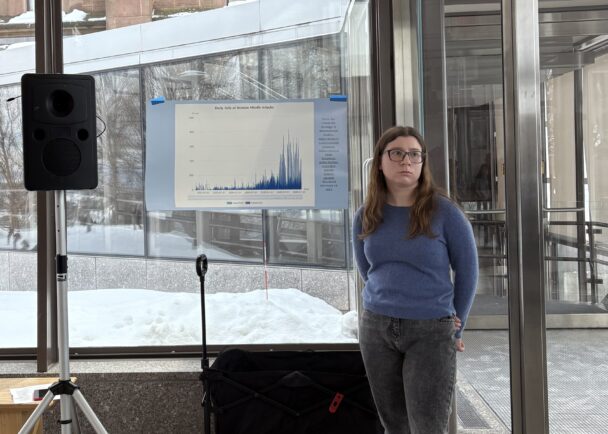
The vigil, which lasted 45 minutes, began with remarks from faculty speakers and Kholod. Attendees read poems written during the war, highlighted posters featuring statistics about the war’s increased violence, and shared postcards comparing how monuments in Ukraine looked before and after the Russian invasion. The vigil concluded with four minutes of silence to honor the soldiers and civilians killed—one minute for each year of the war—and the Ukrainian national anthem.
Kolcio, the vigil’s faculty organizer, highlighted what she perceives as an increased normalization of the war outside of Ukraine.
“The facts are grim,” Kolcio wrote in an email to The Argus. “Russia is committing mass war crimes. Tens of thousands of Ukrainian children have been forcibly deported. Civilians are hunted by drones simply for walking outside with a friend or pushing a stroller. Sexual violence and sterilization is used systematically as a weapon of war and in Russian-occupied territories. If we turn away, or let Russia take Ukrainian territories in the name of a US/Russia negotiated ‘peace’, then we are saying this is ok.”
Associate Professor of the Practice in French Liana Pshevorska, who grew up in Ukraine, read “The First Letter to the Corinthians” by the Ukrainian poet and soldier Artur Dron. Pshevorka chose to share the poem because of its message of resistance and the perseverance of love.
“Creating culture under fire becomes a form of resistance,” Pshevorska wrote in an email to The Argus. “It carries memory, resists erasure, and it preserves the voices of those who lost their lives in this war. In the words of Viktoria Amelina, so long as the poets are read, they are alive.”
Pshevorska and Kholod both noted that advocating for Ukrainian freedom is especially imperative this year, given the lack of federal support of Ukraine since the second Trump administration took office.
On Tuesday, which marked the war’s fourth year, President Donald Trump offered no statement affirming the continued backing of Ukrainian resistance, in stark contrast to his predecessor, Joe Biden. In his final weeks in office, Biden pledged $2.5 billion in weapons and $3.4 billion in economic assistance to Ukraine. In contrast, Trump has framed the war as in need of equal compromise. He has expressed interest in brokering peace even if it comes at a cost to Ukrainian territory, and referenced the conflict in his State of the Union Address on Tuesday as “a war which would have never happened if I were president.”
Kholod continues to bring attention to Ukrainian politics to campus, spearheading the organization of speaker events with Ukrainian Parliament Members Inna Sovsun and Tamila Tasheva.
“I was trying to communicate how it’s the opposite of normal,” Kholod said. “We should not be treating the work and the sacrifices that Ukrainian soldiers are making as a given.”
Kholod finished her speech with a look to the future.
“The next months and years will be very difficult, but no matter how difficult that it gets, Ukrainians will never have to be ashamed [of] ourselves, because we are resisting,” she said. “I hope that Americans will also be able to say that.”
Aarushi Bahadur can be reached at abahadur@wesleyan.edu.


Leave a Reply