
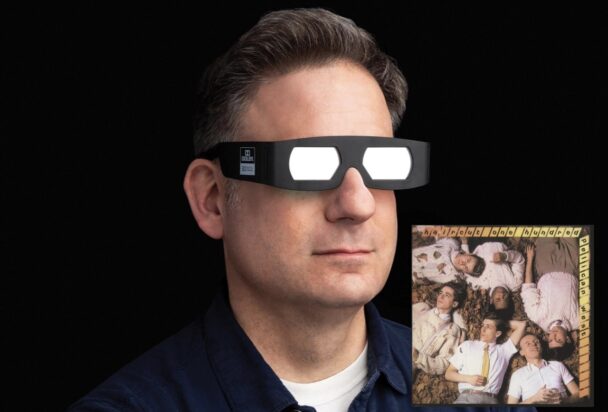
On the Record: Professor Scott Higgins on Haircut 100’s “Pelican West” and Why the Album You Love at 14 Means More Than You Think
This semester, I’m starting a new column called “On the Record,” in which I ask University professors a deceptively simple question: What’s your favorite album of all time?
The goal isn’t to rank music. It’s to get to know professors through the records that shaped them. When I asked Professor Scott Higgins, Director of the College of Film and the Moving Image, I did not get a one-word answer; I got a tour.
The tour began with shelves of vinyl. Higgins walked me to the back of his office and moved through his collection like a museum docent, pulling records halfway out as he spoke. He started on the shelf furthest to the left.
“I moved all my crime jazz here to one section,” Higgins said, scanning spines.
Crime jazz.
Within minutes, we were in 1950s television soundtracks, the debut of stereo demo LPs in 1957, Henry Mancini, Duke Ellington, and the strange cultural moment when White America discovered “safe” jazz through TV shows like “Peter Gunn.” Higgins described how early stereo was marketed almost as spectacle—sound on the left, sound on the right, and “the phantom third channel in the middle.” The historian in him was fully activated.
There was also his father’s 1962 General Electric stereo set—a mid-century cabinet with detachable legs and speakers that fold shut like wings that he restored during the COVID-19 pandemic. It was once a basement hand-me-down, later an attic relic, and now a revived artifact. If you walked in at that moment, you’d assume his favorite album was a Mancini soundtrack, but when I gently pressed him—“If you had to choose one. The one you’d take to the grave.”—he paused. Then he pivoted.
“I guess it would have to be the teenage years,” he said. “Haircut 100.”
The album is “Pelican West” (1982), the debut record by the British new wave band fronted by Nick Heyward. It is bright, sax-heavy, and relentlessly poppy—a sharp turn from crime jazz and early stereo demos. Higgins first heard it in junior high school. He grew up in Pontiac, Mich. (he insists I not say Detroit) and fell in love with music through late-night radio. After listening to a “Star Wars” audio drama on his local NPR affiliate, he’d stay tuned for a college music program that played punk and new wave—The Specials, The English Beat, The Clash. One night, they played Haircut 100.
“It had this freshness to it,” he said. “It didn’t sound like anything else.”
He remembers being in a record store when the album came on and watching customers ask, “What is that? I want that?” At first, every song sounded the same.
“It was my first experience of listening to a record where the first time through, it’s like, yeah, it’s great…. That’s the same damn song,” Higgins said. But after a few listens, something clicked — the palm-muted rhythm guitar, the saxophone flourishes, the sheer energy.
“It’s all about the feel and the rhythm and the energy,” he said. “It is certainly not about lyrical depth.” That, he suggested, was exactly the appeal.
Teenage taste isn’t always about complexity. In fact, Higgins argues that much of what passes for sophistication in adolescence, especially in the 1980s British scene, is coded as gloom. He mentioned records by The The and The Smiths, albums he loved that were saturated in cynicism and teenage melancholy.
“Your idea of sophistication through puberty was that the world is awful,” he said. “That’s just teenage things.”
“Pelican West” was different. It was bright. Playful. Slightly absurd. One of his favorite examples is “Favourite Shirts (Boy Meets Girl),” which builds a conventional pop hook around a throwaway line about a shirt on a bed. Higgins laughed about mishearing the lyric for years, inventing nonsense syllables where there were none. It didn’t matter. The point wasn’t precision. It was momentum.
Then came the story that reframed everything: I asked him what positive memory he associated with the album and that period of his life. Higgins didn’t buy the record first. His best friend from high school, Jay, did. Records were expensive for a teenager in the ’80s—seven or eight dollars. Jay taped it for him. That taped cassette became Higgins’ own version of the album. He played it endlessly on his Walkman. Jay had set the recording level too high, so the tape distorted at the end of side one. Even more strangely, the stylus picked up faint room noise during the recording.
“For me, it’s like a little time capsule,” Higgins said. “That was the sound in his bedroom when he was making that recording.”
When Higgins eventually bought the vinyl, part of him missed the imperfections—the distortion, the accidental ambient noise. The “official” version felt less intimate than the flawed copy taped by his best friend. Suddenly, the restored stereo, his collection of novelty records from the 25-cent record bin, the crime jazz section—all of it felt connected. For Higgins, music isn’t just sound. It’s memory embedded in sound.
Before we wrapped up, I asked what he’d want students to understand about him through this choice. His answer was simple: “The music you love when you’re 14 is the music that defines the rest of your taste for the rest of your life,” he said. “Have respect for 14-year-olds. Have respect for their taste.”
Haircut 100 was a flash-in-the-pan band. A brief moment, then gone. But “Pelican West” isn’t trivial to Higgins. It’s foundational, and while Haircut 100 may not sit comfortably in any official canon, that isn’t the point. The point is that somewhere between late-night radio and a worn-out cassette, a 14-year-old decided what sounded like a possibility. And decades later, that sound still shapes how he hears everything else.
If this column is about anything, it’s about taking that moment seriously. Because the albums we love aren’t just reflections of who we were. They quietly shape who we become.
Have a professor you’d like to see featured for their music taste next? Shoot me an email!
Griffin Abdo can be reached at gabdo@wesleyan.edu.

Leave a Reply