
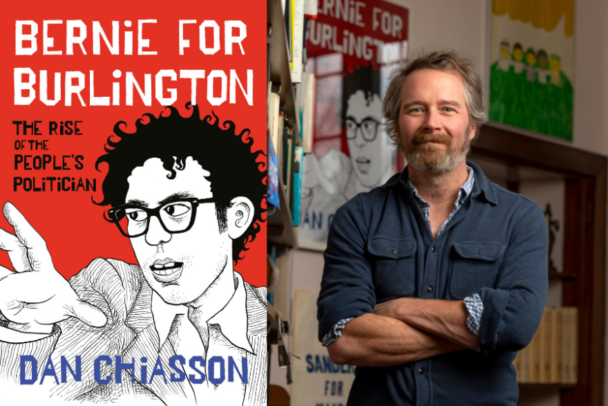
Award-Winning Poet and Journalist Dan Chiasson Discusses New Book at RJ Julia
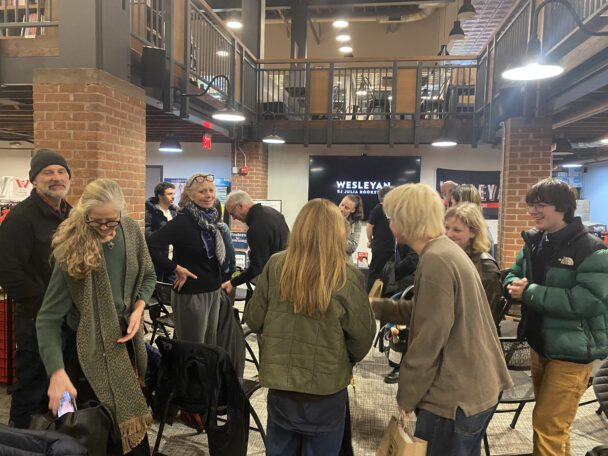
Dan Chiasson P’28, Lorraine Chao Wang Professor of English Literature at Wellesley College, spoke at the Wesleyan RJ Julia Bookstore in conversation with novelist Nicholson Baker on Wednesday, Feb. 18.
A longtime contributor to The New Yorker and the New York Review of Books, Chiasson discussed the reporting and storytelling behind his latest book, “Bernie for Burlington: The Rise of the People’s Politician,” an origin-story biography tracing U.S. Senator Bernie Sanders’ rise through Burlington, Vt. politics during the city’s transformation.
Students who attended the talk reflected on Chiasson’s unique coverage of the subject and connections to local and regional politics.
“I hadn’t read the book going in, but I knew that it focused on Bernie’s upbringing in Brooklyn and his rise to political power in the state of Vermont before coming to D.C.,” Griffin Abdo ’27 said. “One thing that stood out to me is how Chiasson’s treatment of a subject like Sanders represented the unique intimacy of Vermont as a state.“
Chiasson tracked Sanders’ political awakening back to his childhood fascination with Vermont. As a boy in Brooklyn, he and his brother would pore over catalogs advertising Vermont farms for sale, which eventually drew him north. During his time at the University of Chicago, Sanders’ political consciousness deepened through exposure to leftist thought in writings such as “Why Socialism?” by Albert Einstein, which helped him identify with democratic socialism. When Sanders finally moved to Vermont in the 1960s, he encountered a stark divide between wealthy newcomers living in mansions in the hills and the poorer people below.
“It was almost Appalachian poverty, particularly along the main roads,” Chiasson said.
According to Chiasson, one woman Sanders met around this time was deeply concerned about the acquisition of medical care for her son, who had a congenital heart condition.
“I think that just really opened Bernie’s eyes and really changed his politics,” Chiasson said. “He had really abandoned a sort of utopian dimension to his politics. At this point, he was really focused on economic precarity and economic security.”
Chiasson noted that Sanders spent the majority of the 1970s on fringe statewide runs with the socialist Liberty Union Party, where he only received a few percentage points of the votes but showed surprising strength in Burlington’s working-class Old North End. In 1978, Sanders was evicted from his apartment.
“How many American politicians were evicted, and then two years later were elected mayor of the city that kicked him out?” Chiasson said.
The event helped sharpen his focus on economic insecurity while also marking him as a political outsider, which he would frequently leverage in his 1980 mayoral campaign. Another turning point in Sanders’ life emerged when he and political strategist Richard Sugarman studied Burlington’s voting patterns and discovered Sanders’ strength in urban areas. That data suggested Burlington was winnable.
Chiasson also discussed Sanders’ career-long indignation at corporations and elites, and connection to affected communities.
“In the late 1970s, urban renewal came in,” Chiasson said. “A lot of these communities had been displaced, causing individuals to live farther from services like groceries, pharmacies, and so on. And it was Sanders who found these communities and spoke directly to them.”
Chiasson also discussed Sanders’ unique and charismatic personality that helped contribute to his 1981 mayoral victory.
“It’s the physicality, the intensity, the Brooklyn baritone, the intense urbanness of the guy in this rural setting,” Chiasson said. “There was no forgetting Bernie once you met him. I say in the book that, in a way, before we ever had the idea of a meme, Sanders was a kind of an IRL or analog meme. If you saw him in the village of Peacham, if you saw him in St. Albans, if you saw him in Brattleboro, and then you ran into your cousin at a holiday party or something, you could all say, ‘Oh, yeah, I saw the same thing.’ Same corduroys, same hair, same glasses, same message. And that really helped him scale his appeal statewide: just the sameness of it all.”
Chiasson also spoke on the relations between Sanders’ journey to political fame and that of current New York City mayor Zohran Mamdani, to whom Sanders serves as an active mentor.
“He’s at a crossroads that’s, in some ways, analogous to this tough period once Bernie was elected,” Chiasson said. “When elected mayor in a city that’s hostile to you, or where there are significant entrenched forces in place, being elected is just the beginning of your problems.”
Chiasson’s talk was attended by Middletown residents and a handful of Wesleyan students. Many emphasized Chiasson’s interviews with those directly involved in the Vermont senator’s life.
“Chiasson was able to conduct such intimate interviews, as many of his interviewees were distant by only a few degrees of separation,” said Abdo. “This is all to say, his approach and experience in writing a biographical book on Bernie Sanders seemed far less procedural and more human than a typical biography about a political figure, and that resonated with me a lot.”
Louis Chiasson is an Arts & Culture Editor for The Argus.
Brendan Kelso can be reached at bkelso@wesleyan.edu.



Leave a Reply