
University Hosts 19th Annual King Commemoration
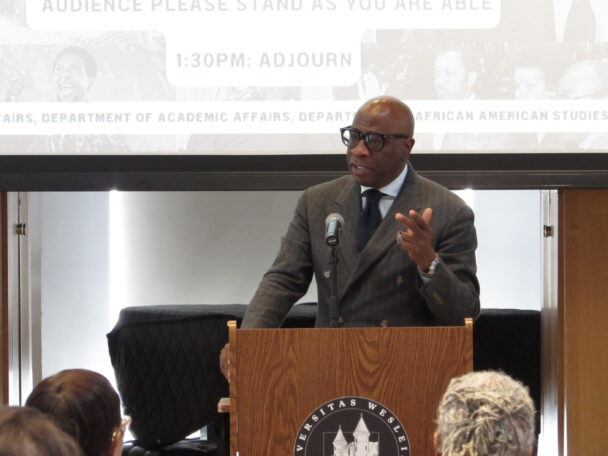
The University hosted its 19th annual Rev. Dr. Martin Luther King Jr. Commemoration on Tuesday, Feb. 10, welcoming keynote speaker Erik M. Clemons for a luncheon in Beckham Hall.
The commemoration was part of the University’s Black History Month programming, which continues with more events through the end of February. Over a hundred people were in attendance.
The event was co-sponsored by the Office for Equity & Inclusion, the Office of Student Affairs, the Office of Academic Affairs, the African American Studies Department, the Center for African American Studies, and Olin Library.
As attendees filed in and mingled, a recording of King’s baccalaureate address given at the University on June 7, 1964, played in the hall. King, who received an honorary degree from the University that same day, visited the campus four times between 1962 and 1966.
This was followed by a talk from Clemons.
Clemons is an entrepreneur whose work is focused on social and economic justice. He is the CEO and founder of two New Haven-based organizations, the Connecticut Center for Arts and Technology and the Connecticut Community Outreach and Revitalization Program (ConnCORP).
Clemons said that one reason he agreed to speak at the University was due to its continuing commitment to diversity, equity, and inclusion (DEI) in the face of Trump administration actions towards eliminating such policies, particularly in higher education.
“The work that they’re doing around DEI, especially now, where you can’t even say ‘DEI,’ you definitely can’t say ‘Black’ now, and the fact that this University has the courage to keep that office in place compelled me to want to come speak,” Clemons said in an interview with The Argus.
Much of Clemons’s speech was focused on ConnCORP’s $200 million economic development project taking place in Dixwell, a historically Black neighborhood in New Haven.
“The thrust of my being, in all the work that I do, is to aggressively address poverty,” Clemons said. “I think poverty is the most insidious thing that has ever been created and ever been allowed to live. It is not racism. I think racism is the weapon of poverty. Poverty itself can easily be eliminated, but the issue is that people who have the power and the resources to alleviate poverty don’t care about the poor.”
Clemons shared several anecdotes with the attendees that have shaped his beliefs. He described his relationship with his late mother, who asked him if he was being honest as she was dying, and mentioned inspiration from King’s 1967 speech at New York’s Riverside Church, where King denounced the Vietnam War in defiance of President Lyndon B. Johnson.
“That speech, as I mentioned, is my favorite, and I think his best, because it was a moment in time that he put it all on the line—his identity, his funding, his relationships, everything—to say these words to the world who needed to hear then, and so he didn’t care about anything else other than telling the truth,” Clemons told The Argus.
Clemons noted that he finds King’s speech especially critical now, at a time when freedom of speech has been contested by the federal government.
“Who’s willing now to risk it all for the sake of truth?” Clemons said.
Clemons ended his speech with the story of Gordon Gundrum, a white U.S. Park Service Ranger from a racist family who served as guard at the Lincoln Memorial podium when King delivered his famous “I Have a Dream” speech in 1963. Clemons noted that Gundrum adjusted the microphone for King before the address.
“The essential question that I have for myself, and that you hopefully will walk away with, is how many times have you created a way for people to be seen and heard at the same time,” Clemons said. “Because that’s what this white man, who was raised as a racist, did, and became a part of history. By simply lowering the microphone, he allowed for arguably the greatest speaker of our time to be seen and to be heard.”
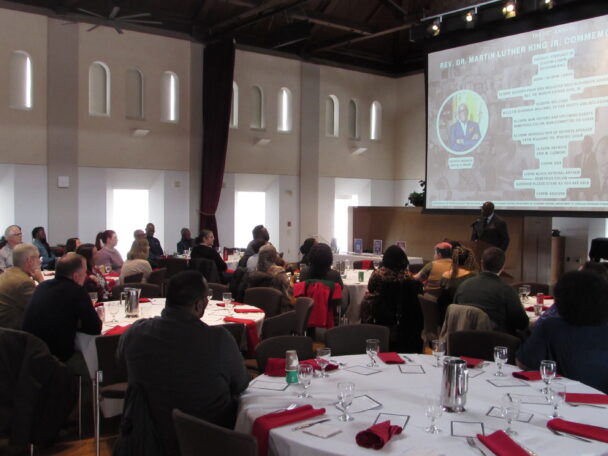
Clemons’s message resonated with Wesleyan Student Assembly (WSA) senator and chair of the WSA’s Equity and Inclusion Committee Katie Williams ’28, who introduced the speakers.
“It just really inspired me and really motivated me to make sure I’m lowering the mic and being conscious of myself and my honesty,” Williams said.
The annual King commemoration has been formatted as a luncheon with a keynote speaker for the past six years, a decision made by organizer and Resource Center Director Demetrius Colvin.
“Before I got here, it was already a long-standing tradition, and administrators and people came together as a committee and put on this commemorative event,” Colvin said. “When I first got here, I kind of developed it as a speaker with a reception, and then with [Vice President for Equity & Inclusion] Willette Burnham-Williams coming, we transitioned it into a luncheon, which I think works really, really well as a format.”
Colvin noted that each speaker was chosen to discuss a certain issue relating to civil rights, with Clemons addressing economic justice.
“We try our best to find different speakers that get at different parts of our civil rights struggle today, because it’s not just this old thing,” Colvin said. “This isn’t just about, ‘oh, this thing happened in the past, and let’s remember it,’ but rather, we have an ongoing present that’s connected to that past.”
Aarushi Bahadur can be reached at abahadur@wesleyan.edu.
Spencer Landers can be reached at sklanders@wesleyan.edu.






Leave a Reply