
Offbeat Movie Choices for a Valentine’s Night In, from Delightful to Caustic
It’s a good thing February has Valentine’s Day; if you’re anything like me, you’ve had enough of the bitter cold biting at your face on the walk across campus, of snow in your shoes and ice on your car, and want to be filled with the warmth that comes with an entire day meant to affirm love.
I remember going to Stop & Shop to buy flowers last year and being embarrassingly touched by the long line of people with the exact same thought, people from all walks of life who used their lunch break to do something with the sole purpose of making someone else smile. I dare anyone to be cynical about that. With the wind chill factor outside, however, your plans for the day may just revolve around staying inside and putting something on for your beloved (or maybe just yourself).
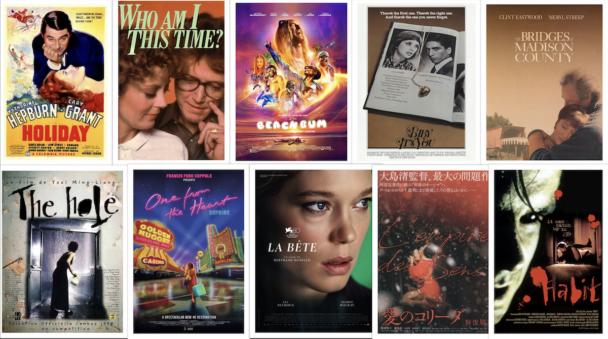
There’s no judgment if you want to go with a classic; they’ll probably love “Say Anything…” (1989) or “When Harry Met Sally…” (1989) (and their accompanying ellipses), though I may look askance at you if you put on, say, “Juno” (2007). Just maybe, however, you’d like to watch something a bit off your radar; maybe, even, you’d like to watch a love story that tends towards being a little more bittersweet, potentially even barbed. Let this list of film recommendations serve as a guide; I’ve organized the following films into three categories (Delightful, Bittersweet, and Caustic), though all of them, to me, attest to the existence of immutable love between two people.
If it’s a first date, you may want to stick to the first two tiers; don’t blame me if you get ghosted.
Delightful
“Holiday” (1938)
“Holiday” (1938) is my favorite screwball comedy. Noted winning personalities Cary Grant and Katharine Hepburn make the film’s patter exhilarating, even before they know they’re flirting with each other. The knots in the film’s plot are inspired, but not as important as the maneuvers of, say, “The Lady Eve” (1941). Instead, “Holiday” is perfectly content to become a hangout movie for long stretches, particularly during a scene when the film’s leads sequester themselves upstairs at a New Year’s Eve party. I love the trope of joyful moments happening between a small group of people trying to avoid a larger social gathering, and this film’s iteration of that is a true “the party’s in here!!” moment. Above all, it’s a film about the thrill of doing bits with someone you love, even if you don’t even know you love them. I doubt even the most cold-hearted among us could get through “Holiday” without smiling.
“Who Am I This Time?” (1982)
A wonderful pairing with the seduction-by-riffing of “Holiday,” “Who Am I This Time?” (1982) isn’t really a movie. Alright, it’s a 50-minute episode of “American Playhouse,” but despite that, it remains one of the most tragically underseen masterpieces of the career of Jonathan Demme, one of the most unerringly empathetic filmmakers of all time. An adaptation of a Kurt Vonnegut short story with the ever-wonderful Christopher Walken and Susan Sarandon, this film is a profoundly moving version of a type of love story I always adore: one in which the romantic spark appears by way of two people performing with each other (other films potentially in this subgenre include “A Mighty Wind” (2003), “Drive My Car” (2021), Clint Eastwood’s “Bronco Billy” (1980), and, sure, the 2018 “A Star is Born”). Sarandon’s character becomes infatuated with Walken’s on the stage but is let down by his socially incompetent offstage demeanor; what can the two do, then, but keep playing opposite each other? Their love story is told through fragments of other plays, from “Romeo and Juliet” to “The Importance of Being Earnest.” Anyone who has seen Demme’s “Stop Making Sense” (1984) will recall that the filmmaker already believes that performance is the ultimate conduit to making 1 plus 1 equal 3, and this short, lovely film is the ultimate evocation of that idea. It’s 50 minutes long; you have the time.
“The Beach Bum” (2019)
Cards on the table: This isn’t really a romance movie. The love story between Matthew McConaughey’s stoned poet Moondog and his luminous wife Minnie (Isla Fisher) takes up only the first stretch of the movie and ends tragically. The rest of the film chronicles Moondog’s quixotic journey from character to character, tasting everything life has to offer before, Odysseus-like, he returns home. But the love floats over the whole film; Moondog’s openness to his surroundings is evidence of it. Even if the film doesn’t spell it out— this is a Harmony Korine movie where Zac Efron’s head is shaved to look like a panini—Moondog lives for his love. It’s how we should all be, and the early scenes of McConaughey and Fisher soar as depictions of love as a near-literal state of intoxication, which is about as romantic as it gets.
Bittersweet
“Baby It’s You” (1983)
A film which initially seems like a hyperspecific conjuring of a specific time and place (1960s New Jersey, complete with a mostly Springsteen soundtrack), John Sayles’ undersung masterpiece gradually becomes a portrait of how two people can change based on the circumstances of their lives. Not unlike Ingmar Bergman’s “Scenes from a Marriage” (1973), it’s a film about how every passing day that two people spend together (or apart) makes an irrevocable change in their relationship, where the love that remains between them constitutes a sort of miracle. It is not purely romantic; there’s a great deal of heartache in Sayles’ film and plenty of moments when the two lovers act selfish and cruel. Still, when they stare at each other and slow dance, I can’t help but be bowled over by how many permutations they have gone through just to end up in each other’s arms. A line from the last episode of Bergman’s series explains it pretty well: “We love each other in an earthly and imperfect way.”
“The Bridges of Madison County” (1995)
If there’s any film that nails the spirit of the Sirk-ian romantic melodrama in a post-New Hollywood world, it’s this one. Tenderness isn’t necessarily the first word that comes to mind when you think of Clint Eastwood, that stoic tough guy who has blessed our screens with his scowl for 60+ years, but “The Bridges of Madison County” (1995) is resplendent with downright erotic, sensuous moments between a grizzled Eastwood and an Italian-accented Meryl Streep. The air in this movie is hot, and every moment of their burgeoning romance buzzes with the sort of charged romantic potential that can’t be faked; if I were either’s spouse seeing this movie, I’d hire a private investigator. The film has a lighter touch than might be expected from Eastwood—it’s sort of an “oops, all grace notes” film for a while—but the spell it casts is irresistible. By the time the regret and “what ifs” of the film pay off, I’m typically left a blubbering mess.
“The Hole” (1998)
From Taiwanese slow-cinema master Tsai Ming-liang, whose shots typically go on for minutes on end without moving, “The Hole” (1998) plunges into a world ravaged by a mysterious virus that seems to make the infected act like cockroaches. It’s not exactly a premise that lends itself to comedy, let alone to romance. Yet in the dilapidated apartment complex that serves as the setting for Tsai’s film, the virus serves as the backdrop to two lovely, often comic performances from Yang Kuei-mei and Tsai-regular Lee Kang-sheng as neurotic neighbors whose apartments become connected by a hole in the floor. Against all odds, and despite its lack of dialogue, it becomes an apocalyptic romantic comedy, complete with startlingly upbeat musical numbers. The unique spell of Tsai’s cinema and the all-consuming bleakness of the film’s environment make the film’s final romantic gesture, an outstretched hand, a purely magical movie moment that reveals the warmth at the film’s core.
“One From the Heart” (1982)
Almost the direct opposite of “The Hole,” this legendary Francis Ford Coppola plot wears all the trappings of a classic Hollywood musical romance, with richly designed neon soundstages and kinetic dance sequences. In a move not dissimilar to Martin Scorsese’s “New York, New York” (1977), however, the central romance is uncomfortably toxic and commanding. There’s a punch of uncomfortable realism in this artificial world, which makes it a deeply weird watch (listen to the soundtrack’s titular song, sung by Crystal Gayle and Tom Waits, to get a sense of the uncanny melding of glitz and grime that Coppola attempts here). Undeniably, it’s an experiment, but the images speak for themselves; one in particular, of Nastassja Kinski tightrope walking above a matte painting of a junkyard, has always stuck in my mind. It’s a polarizing film, likely by design, but one of my true enduring favorites.
Caustic
“The Beast” (2023)
Bertrand Bonello’s latest film seems to carry an enduringly romantic premise: Each of us lives many lives, yet in each one, you’re bound by the universe to find the love of your life. In the 1920s, Léa Seydoux’s Gabrielle and George MacKay’s Louis come close to an ideal romance before the universe cruelly rips it away, only for them to be reincarnated to try again in 2014 and 2044. The pain of Bonello’s film, however, is that no matter how many lives the two live, there’s only one world. As the two find themselves hurdled into the future, the forces of capital and privatized emotion conspire to keep them away from one another. It’s gutting, but ultimately a truly modern film that takes for granted that love is the greatest thing that we do. The way it positions artificial intelligence as the death of art, affect, and love also makes it worth cherishing as one of the greatest movies of the decade so far.
“In the Realm of the Senses” (1976)
Banned and censored for many years across the world, this film from renegade Japanese New Wave master Nagisa Ōshima is by far the film on this list with the most sex. If you were to skip to a random part of the film, you would more likely than not land on some deeply perverted (and unsimulated) material. The film isn’t porn; however, set against the backdrop of Imperial Japan in 1936 (a hugely charged year for the nation), behind the sex is a profound political stimulus. The film’s lovers sequester themselves in an attempt to remain untouched by power at a point in time when there is little other recourse for them. I’m always drawn to love stories in which the lovers have to hide themselves from the world (the enclaves of “They Live by Night” (1948) and “All That Heaven Allows” (1955) come to mind), and Ōshima’s film is devastating and poignant on that count. If you’re squeamish, it’s worth spoiling the gruesome ending of this film for yourself, but “In the Realm of the Senses” (1976) is one of the most punk films ever made, a furious display of sex and love as a tool of rebellion against fascism.
“Habit” (1995)
An aggressively DIY slacker-vampire film from underground horror legend Larry Fessenden, “Habit” (1995) goes all in on the idea of love as addiction. In the vein of Claire Denis’ “Trouble Every Day” (2001), “Habit” is a film about appetite. It’s not the most positive representation of lovers who can’t stay away from each other since one is a literal vampire, but the film’s textures and vibes are sublime, with stretches of the movie consisting of a sad sack walking around New York before his hungry lover takes a liking to him. Frankly, this film probably pushes the limits of what could and should be watched on Valentine’s Day. “Habit” might be enjoyed best by a guy who tells girls on Hinge to step on him, since he likely doesn’t have Valentine’s Day plans.
Louis Chiasson can be reached at lchiasson@wesleyan.edu.



Leave a Reply