
The Ankh’s Leadership on the Publication’s Past, Present, and Future
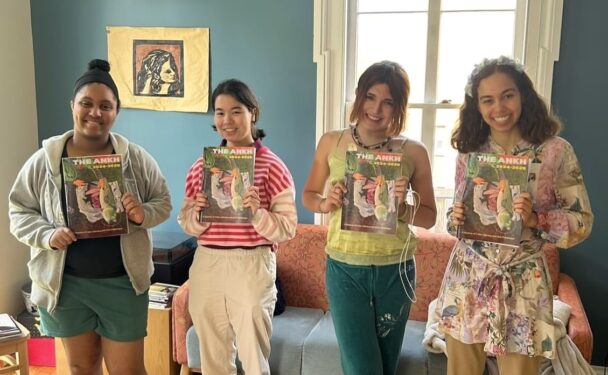
The Ankh is a publication that showcases the work of students of color at the University. Founded in 1985, the publication endured a hiatus during the COVID-19 pandemic, but was reignited by Genesis Pimentel ’23, Ava Yuanshun Guralnick ’25, and Darlene De La Cruz ’25. The club is now led by board members Tasmiah Akter ’26, Vandana Ravi ’28, and Sandrine Alouidor ’28. Ahead of their fall release party this Saturday, The Argus sat down with Akter and Ravi to hear about how they got involved, the importance of the publication’s archives, and what they’re looking forward to in the upcoming issue, “Resistance.”
The Argus: How did you both get involved with The Ankh? What drew you to the publication?
Vandana Ravi: I got involved as a freshman, and two really lovely people were leading [it], Ava Guralnick ’25 and Darlene De La Cruz ‘25. They kind of revived The Ankh, which had been sort of dormant for many years. They created this really lovely community that would meet at their house every week. And they kind of took me under their wing and showed me how to go through submissions, how to read for what people were trying to write, and help them bring their work toward what their vision was, how to reach out and make community with other POC creatives on campus.
Tasmiah Akter: For me, it was pretty similar. I actually met Ava, one of the co-editors, while working at Long Lane Farm after my freshman year. Ava and I started chatting, and she asked me if I write, and I said, “Vaguely, I mostly write for school.” But then she told me about how The Ankh had been a magazine for many, many years, but that it had died over COVID, and that she was trying to revive it with Darlene. And then she asked me if I wanted to be a part of that. And I said, “Yeah, of course, I’d love to support a cause like this.” And then over my sophomore year, I think they worked on doing all the logistics to get it back to life. I was abroad [my junior year]. That was kind of disappointing, because I couldn’t be in person to do all the really cool work that you guys were doing. I did a lot of archival work from abroad. I got to work with Amanda Nelson, who manages the school’s archives. I think because I sort of sustained a relationship with them throughout my years, we [Vandana and I] ended up getting to work together on the board.
A: What strikes me is that you both came to the organization from a very organic place. Do you think the people are what make The Ankh what it is? Or is there something else that stands out to you about it as an organization?
VR: For me, the biggest thing that I found with The Ankh was mentorship. I’ve found people who can mentor me and talk to me about the ways that my life experiences have affected how I’m writing. And I feel like a lot of the work that The Ankh publishes tends to be less in the context of an individual writer submitting an anonymous submission, and more in the context of a collective writing experience. I think what makes us different is that a lot of our writing comes out of a collective writing experience, or a collective mentoring experience. We’re thinking through the ideas together and are able to act as supports and anchors and contributors to each other’s work, even if we’re not all working in the same medium. Some people that come to meetings aren’t even artists or writers, but just want to be in the space. So there’s a lot of different ways that we can influence each other’s work and show up for each other in relational ways that maybe sometimes students of color can’t get at other publications, and I feel like that also helps us contribute more fully [than] when we’re in more white-dominated spaces on campus.
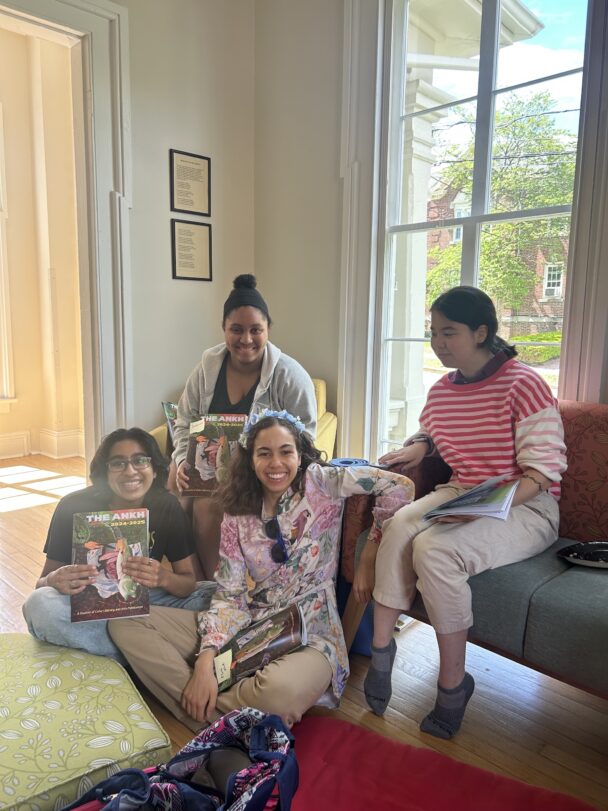
TA: That’s very well put. The archives [from the 1980s] are very editorial, which is very different from what we do now. And I kind of like what we do now; we’ve veered from essays into poetry and more creative stuff. I don’t think we view ourselves in opposition to any group. We’re [more so of] a collective, and we’re trying to produce this comprehensive work that encompasses whatever people are feeling—whether it pertains to Wesleyan or not—as students of color.
A: Can you talk a little bit more about that evolution, especially since it was re-initiated after COVID? Are you responding consciously to shifts in the administration or in the world?
TA: When we were thinking about the theme for this year, we wanted to do resistance just because of the backdrop of everything that’s happening in this country. I’ve been thinking about what [resistance] means, especially as we’re going through the archives and pulling photos for this edition. I’m really into the idea of dance and movement as expression right now, just as a theme of my personal life.
VR: I don’t think we’re consciously moving away from anything in the history of The Ankh. It’s a really exciting publication because it’s changed so much. And I think something that a lot of people try to say about campus publications, like, “it’s been here for so long.” The Ankh has been at Wesleyan for a very long time, decades and decades, but it’s gone through so many iterations. Every year, there’s a different energy and a different goal. It’s constantly adapting to the needs of Wesleyan. We’re partly choosing resistance and also sort of being pulled into that by what’s going on in our community and our friendships. I think every board sort of decides what theme they want to take up, or whatever main idea they want to push forward. With “Symbols of Life” last year, I think Ava and Darlene just really wanted to bring something joyful out into the world, and with “Resistance,” it’s not about like less joy and more like anger; I think joy can be resistance. There are so many ways to think about that, and I think that’s what we’re trying to lean into.
A: Are you still accepting submissions for “Resistance”?
VR: We are. The thing about The Ankh is we have deadlines, but we will always explore submissions. We are not a publication that’s trying to be super exclusive. We want to bring as many people into the fold as possible and have as much space as possible. That has made for really good friendships in our group because we’re not always trying to perform a specific kind of voice when we’re working with each other, and there’s a lot of space to just sort of invent and be ourselves.
A: Have you noticed anything from reading submissions?
VR: Wesleyan people are so talented. I’ve told a bunch of friends, and then word of mouth really works to get people to submit. I really love how experimental our submissions can get. I think sometimes when POC writers are in a classroom at a predominantly white institution, there’s sometimes a pressure for us to be super clear about what our point is. I love that not all of our submissions feel that pressure to just create a clear message for the dominant culture that we are then going to repeat and repeat. There’s space to be ambiguous and playful and mess around with things and not necessarily be like explaining ourselves in essays again and again and again, which is a trend I think we could see sometimes at the earlier archives, where people felt more restricted in terms of what they were able to talk about in their poems. In this “Resistance” issue, we have poems about desire and love and heartbreak, and language poems and experimental prose poems and short stories and surrealism.
A: Can you talk a bit more about why archival work is important to you?
TA: When I did an internship two years ago at a law firm, my boss went to Wesleyan, and he said that he saw the detail of me working at The Ankh on my resume, and he was like, “When I was at Wes, this was a really big publication, it was really well-known among student of students of color.” And I felt like I was a part of something. When I look through the archives, I feel that way, every single time, [that] I’m truly a part of history.
A: Is there anything the Ankh has done that you’re particularly proud of?
VR: I’m so proud of Tasmiah’s poem. [She] did off-the-cuff writing when we were all just doing a sort of collective writing meeting, and it was very playful and silly and fun. But then I read it again, and I was like, this is low-key, modernist, and fire. I’m really proud of the friendships.
TA: You stole mine! I was about to say that. We were in the students of color fashion show together, so that was really exciting. I think that really solidified our friendship. Because we’ve been getting along so much more, we have this group chemistry, and it’s fun to work together now. I’m really proud of our Substack, everything we put together, and how we formatted it. I love that we have found what works, and I love that we have this, like, perseverance to find out what will work.
VR: I’m really proud of the perseverance of everyone who’s worked on this publication, because it’s hard, it’s hours and hours of haggling with people for basic funding, of writing and editing and emailing and constantly going over every single little detail in our layouts. Sandrine has done so much incredibly detailed work on outreach and finances. I do think that because we have often been a more transient publication, we don’t always have prior generations to help us out. We have to figure things out for ourselves all the time. [I] think Ava and Darlene set such a good example of people who just put their heart and soul into creating that printed booklet that would come out at the end of the year. And I feel like Tasmiah, Sandrine, [and I] do the same thing. There’s so much dedication.
The Ankh is having a release party this Saturday at 5pm in Allbritton 311, alongside Disorientation and Bite the Hand. Alouidor wrote to The Argus, “The Ankh is an organization dedicated to building community for people of color creatives. In times where the arts are increasingly devalued, we believe it is important to foster this kind of community. We’re having our fall digital release this week, and we are calling upon all people of color creatives to contribute, submit, and participate with us in this work. Community requires a village, and we can only build a village with you.”
Lula Konner can be reached at lkonner@wesleyan.edu.

Pleased to see the Ankh thriving!