
Prediction Market Mania: Kalshi, CNN, and the Blinking Red Light
Do you want to bet on the Celtics winning this Thursday against the Bucks? How about who will be the first member of President Trump’s cabinet to leave? Or maybe how much it will snow in Chicago this month? If any of this sounds appealing to you, all of these questions are available to be gambled on through prediction markets like Kalshi, Polymarket, PredictIt, and more. Today, people are increasingly using prediction markets to put their money where their mouth is, and the political implications have been vast.
Prediction markets show real-time opinions from bettors, whereas polling data only comes from a previous date and may not have taken into account events that could have impacted voters in the meantime. If people are expressing what they think about a political race using their own money, that can be a live tell of how the public is thinking. And the heads of prediction markets see their platforms transcending polls as the key telling factor during election season. With the widespread acceptance of political betting as having a pulse on the public, prediction market data will be featured more than polling data by the 2028 election, possibly by next year’s midterms. And the outlook for what that says about American society is the unsung issue of Kalshi and Polymarket’s get-rich-quick agenda.
The rise of prediction markets has its origins in 2018, when the Supreme Court allowed states to legalize sports betting in Murphy v. National Collegiate Athletic Association. Murphy overturned a 1992 federal law that banned sports betting in all but four grandfathered states. Since then, 38 states have legalized sports betting, and it is impossible to be a consumer of information online without being exposed to a FanDuel or DraftKings commercial.
Since its legalization, sports betting has led to a change in both sports fan ideology and American ideology, where your knowledge of sports can turn you a profit. Jonathan D. Cohen, writer of “Losing Big: America’s Reckless Bet on Sports Gambling,” called this the “gamblification” of American sports, where it’s not enough to know something about sports anymore; instead, you have to back up your knowledge by profiting off it.
The legalization of sports betting has had both benefits and drawbacks, but regardless of your stance, there’s a much bigger beast on the rise that has gained serious traction over the last two years: prediction markets.
The premise of prediction markets is simple: bet on anything. Prediction markets are usually organized around yes or no questions, and users purchase individual shares worth up to 99 cents on a certain statement’s market. This can take the place of sports betting sites—Kalshi, Polymarket, and other popular sites still get most of their revenue from their sports-related markets—or it can present betting markets for aspects of popular culture, like who will be a bridesmaid at Taylor Swift and Travis Kelce’s wedding.
What separates Kalshi from a FanDuel or a DraftKings is its legal standing and accessibility to its users. Despite its parallels to sports betting, these platforms are classified as markets, and bets are considered investments. Therefore, anyone 18 or older can make a bet on a prediction market, further blurring the lines between betting, investing, and gaming.
The political betting markets emerged as a serious player during the 2024 elections and were influential in this past year’s local elections. In 2024, when the polls predicted a dead-even split headed into Election Day, prediction markets gave Trump the advantage, and as the day progressed, the odds tipped more and more in his favor. Additionally, Kalshi and Polymarket called the election before CNN, Fox News, and MSNBC, declaring victory for the industry once it was confirmed on television.
In a post on X, formerly known as Twitter, Kalshi chief executive Tarek Mansour wrote on election night: “Polls 0, Prediction Markets 1.”
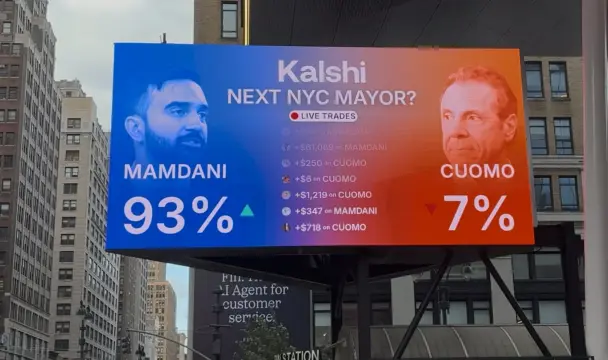
This year, prediction markets made a name for themselves through their advertising and prevalence during local elections. They accurately predicted governor races in New Jersey and Virginia and called them before networks did. But their presence in the New York City mayoral election was most notable. A massive billboard outside of Madison Square Garden and Penn Station displayed the live odds on Kalshi between Zohran Mamdani and Andrew Cuomo. All across the city, advertisements were spotted, resulting in the state going after them for their seemingly crucial presence in the election cycle.
Comparisons between prediction markets and the stock market or sports betting platforms show significant value differences. In the stock market, you are investing in companies that recognize you as an investor. On prediction markets, you are not. While the stock market is not perfect, at least it has much more regulation in place. Sports betting also has regulation, as state laws cover FanDuel, DraftKings, and other betting platforms to ensure they operate above board.
Ultimately, the nearly unregulated nature of prediction markets should raise serious red flags about their use in the public eye. At this current moment, anyone over 18 can hop on their computer or phone and access prediction markets in all 50 states. As referenced before, you can use these sites to bet on almost everything. It gives everyone access to something, without the monitoring exhibited in the stock market or the sports betting industry.
Furthermore, the global impact of prediction markets has already been felt. The Nobel Peace Prize Committee noticed that Venezuelan opposition leader María Corina Machado’s chances on Polymarket to win the Peace Prize spiked in an instant driven by one user’s trading patterns, causing concern for the committee when she was eventually named the recipient a few hours later. The Norwegian Nobel Committee launched an ongoing investigation into the user, speculating that this could have been a case of insider information informing one’s ability to profit.
If this happened with the Nobel Peace Prize, what is stopping politicians from using prediction markets to gain some monetary advantage on a political event not yet made public? President Trump’s son, Donald Jr., sits on the advisory board for both Kalshi and Polymarket, indicating a direct avenue for where this could occur. And the response from prediction market higher-ups is unclear. Kalshi co-founder Luana Lopes Lara emphasized the site’s status as compliant with government regulations: “Kalshi is a federally-regulated, fully-compliant exchange, and we have systems in place to monitor for any suspicions or unusual activity. We also have a lot of trading prohibitions in place.”
However, if Kalshi is up to code with government regulation while the president’s son is sitting on their board, what does that suggest about the possibilities government officials can explore using these sites?
Last week, Kalshi announced a deal with CNN, whose programming will now feature a ticker of live Kalshi odds. This demonstrates the mainstream acceptance of prediction markets and direct endorsement from major television networks, as they begin to trust the accuracy of these markets at a greater level than polling data.
However, prediction markets don’t necessarily show how people plan to vote or the likelihood of an event. The price of milk won’t increase just because people think it will increase, and the Chiefs won’t win the Super Bowl just because people think they will. They show what people think will happen. Someone can vote for a Republican candidate, but they are willing to bet that the Democratic candidate will win, so they place a bet on it. That doesn’t show what they did, it shows that they think everyone else did.
Now that CNN will begin showing these live odds, they will be broadcast to millions at home in the United States, which could lead to more people trusting betting odds to inform their voting measures than their own desires. And since there’s only more of an acceptance of these prediction markets to come, I wouldn’t be surprised if we care more about who the markets say will be our next president, let alone who will win in the 2026 midterms.
Ultimately, the unregulated nature of prediction markets should be a blinking red light in the face of the public, but it’s hard for anyone to take that seriously if they are only seeing green.
Max Forstein is a member of the Class of 2027 and can be reached at mforstein@wesleyan.edu.



Leave a Reply