
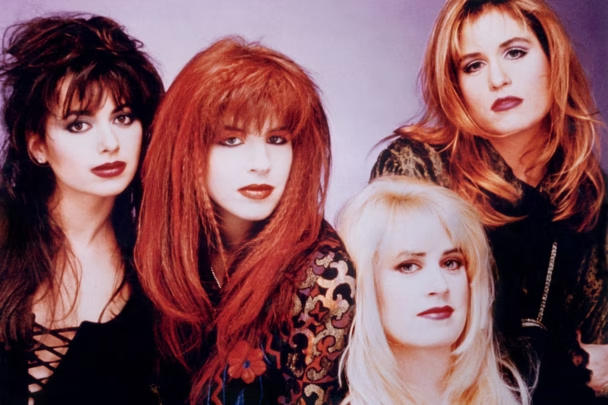
“Walk Like an Egyptian,” and Talk Like a Hall of Famer: Why The Bangles Deserve National Rock & Roll Award
When I was in fifth grade, I got my music teacher fired.
Don’t feel bad for her. She deserved it. She should never have been working with little kids. Anyway, I rebelled for the first time in my life and managed to create enough of a stink that she was let go. (The details: unnecessary. The result: Read on and find out.)
I was elated. No more freakin’ nursery rhymes. Within a couple weeks, we had a new music teacher: a mom who immediately won me over when she played The Beatles in the first class. Finally, some real music. In March, during Women’s History Month, she took on the task of teaching us about female musicians. She played songs by Beyoncé and the Spice Girls. Nothing I hadn’t already heard. And then she played us a song by The Bangles.
My entire life up until that point had been spent obsessing over boy bands: not One Direction, but actual bands like The Beatles, The Who, The Kinks, The Clash, and The Byrds. But they always seemed somewhat untouchable, like I could never do what they were doing. They were my heroes, but there wasn’t anything about them that made me feel like I was capable of doing the same thing. The Bangles were my first introduction to an all-female band, and they gave me the feeling that I could do that, too. I could make music.
I went home after that music class and spent hours on YouTube watching all their music videos and grainy concert footage. I was mesmerized by their musicianship, their stage presence, and above all, their harmonies. It was like watching angels sing rock and roll. They were effortlessly cool, and I immediately decided I was going to be in a band. I was going to tour the world and write music and record and be as cool as these four women. One small problem: I didn’t play an instrument. But this isn’t about me, despite the fact that I just spent the first part of this piece talking only about myself. Don’t worry, I have a point.
Every year, the Rock & Roll Hall of Fame (Rock Hall) has their induction ceremony, and every year, The Bangles are snubbed. They were once again left out this November. Here are the requirements to be inducted: An artist’s first commercial release has to be at least 25 years prior to the year of induction; they have to demonstrate some level of musical excellence (what does that even mean?); and they need to have had a profound impact or influence on music in one way or another, which means, let’s face it, they have to sell a lot of records.
Let’s see how The Bangles measure up:
The Bangles were the first all-female band to have five Top 5 Hits on the Billboard Hot 100. They stormed MTV with their iconic music videos for songs like “Walk Like an Egyptian” and “Manic Monday.” They won the BRIT Award for International Group in 1987. They have released four studio albums and a compilation album, with their 1986 release Different Light achieving multiple platinum status. They have toured the world and have millions of fans. They’ve even been hailed as “The Female Fab Four.” What more do you need to know?
But much more importantly, The Bangles were part of something bigger: They opened the gates for more female musicians to step into the light. And it was, ahem, a different light, a light that didn’t ask women to shrink themselves or wait for permission or settle for being the “girl in the band.” The Bangles were the band. They wrote, they arranged, they played, they harmonized, they carried their own gear (at least in the beginning), and they did it all in an era when female musicians were still treated as accessories, supporting characters at best. They proved that an all-female group could dominate charts, captivate audiences, and redefine pop-rock on their own terms.
“We had a dream. An awesome dream,” lead guitarist Vicki Peterson said in the VH1 “Behind the Music” segment done on the band.
They dared to dream about being famous musicians at a time when that wasn’t what girls were supposed to be dreaming about. Being a female singer was one thing, but girls playing rock and roll instruments? There were almost no previous all-girl bands to look to for inspiration. There was Fanny (if you don’t know who Fanny is, I’m begging you go listen to their live stuff because it will blow your mind), and there were singer-songwriters like Joni Mitchell and Jackie DeShannon, but very few female bands had ever had any commercial success. The Go-Go’s were finding it, but they stemmed from the punk scene in LA. The Bangles were a part of the Paisley Underground, a movement in LA in the early to mid ’80s that was composed of bands who wore their ’60s influences literally on their sleeves. This meant saccharine harmonies, jangly guitars, catchy riffs, and refreshing energy along with the bell bottoms and ruffled sleeves.
As four women, they had to work extra hard to get their music heard. They would carry their demos in plastic bags to local record stores and personally bring their singles to DJs. They faced constant adversity due to their gender; meanwhile, they were better than the majority of the male bands out there. They knew how to rock out, and they knew how to sing together at a level that most bands spend their entire lives trying to reach with a natural, unforced chemistry that was as charming as it was potent. They were sincere, they were fierce, and they were absolutely fabulous. Watching them felt like watching four goddesses.
Goddesses. Not Gods. That’s what made me go, “Oh, wait. I could do this.” I saw myself in them, and that gave me the courage to pick up the guitar and then later the drums. The first song I tried to write was a rip-off of “If She Knew What She Wants.” I may or may not have cried writing it, because I so desperately wanted to be Vicki Peterson right off the bat, but if there’s anything The Bangles have taught me, it’s that hard work pays off.
So here we are again, another year gone by, another Rock Hall ballot without The Bangles. And maybe on paper that’s just an omission. But for me, and for countless other women who picked up instruments because those four women showed us we could, it feels like a misunderstanding of what influence actually looks like.
Influence isn’t just measured in sales or chart positions or how many executives in a boardroom approve of the degree of your impact. Influence is measured in bedrooms and garages and first guitar lessons. It’s measured in the number of girls who looked at a stage or a music video or a grainy YouTube clip and felt a door opening. It lives in the fact that decades later, people like me are still talking about them with passionate devotion. When someone shows you a dream you didn’t know you were allowed to have, you don’t forget it.
So yes, the Rock & Roll Hall of Fame should induct The Bangles. They’ve definitely earned it. But more importantly, they deserve to be recognized for breaking down barriers in pop music. We live in a world that still—still!—acts shocked when women pick up guitars and play them well. But now we girls have women to look to for guidance, women who inspire us to turn it up to eleven.
I’ve been lucky enough to meet two out of the four Bangles: one on Zoom with an old music teacher and one in person. Safe to say I was tongue-tied, but meeting them was a reminder that they’re also humans. You know the saying, “Never meet your heroes?” Screw that: Vicki Peterson was one of the most genuine and humble people I’ve ever met. She encouraged me to keep playing, keep writing (I’m planning on sending her this, so hi, Vicki!), and to just keep going. She made me feel like I could do anything. And that’s way more important than any induction.
Honestly, the Rock & Roll Hall of Fame needs The Bangles more than they need the Hall.
Edie Anderson can be reached at emanderson@wesleyan.edu.

I love your music 🎶