
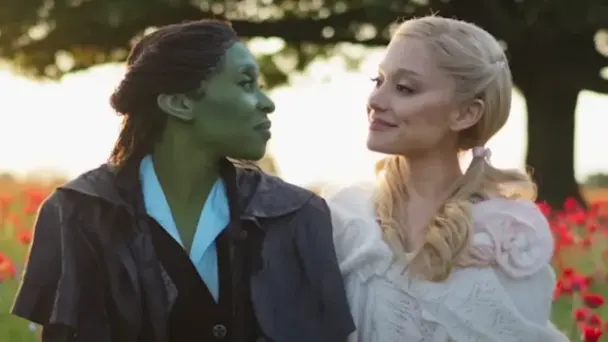
Movie Review: “Wicked: For Good” Offers a Powerful Yet Disquieting Conclusion to Chu’s Musical Parable
“Wicked: For Good” is set in an Oz inundated by propaganda and inequity—the mien of wickedness, as it is glaringly apparent, has become a driving force.
This film deserves a degree of pessimism and apprehension. It is, after all, a second act. “Wicked: For Good” is not a cheery, whimsical successor to the Ozian spectacle that is “Wicked.” Rather, it ushers in disquietude from the initial shot (forced animal labor on the Yellow Brick Road) to the moments following the titular song where Dorothy (Bethany Weaver) claims an unwittingly tragic victory.
Emerging from the shadows of the climactic first act closing number “Defying Gravity,” act two thrusts audiences into the grim villainization of Elphaba (Cynthia Erivo). The distortion of Elphaba’s inherent kindness and goodwill, amplified by juxtaposition with Glinda’s paradisal life, is one of most thought-provoking aspects of the film, upsetting the status quo of this revisionist narrative.
The musical “Wicked” is a loose theatrical adaptation of Gregory Maguire’s 1995 novel “Wicked: The Life and Times of the Wicked Witch of the West.” However, the musical diverges from the book’s contents most notably in the ending. While the musical wraps the story in a neat bow, at the heart of both the novel and the musical is a spirit of defiance, dignity, and a critique of tyranny and herd mentality. Despite its fantasy and whimsy, “Wicked” tells the story of abiding strife, a quality starkly persistent in act two.
How easy is it to contort the illusion of goodness in the favor of those who are truly wicked? This question, particularly sensitive given our current socio-political climate, festers in the subtext of “For Good.” Formerly known as Galinda (Ariana Grande), Glinda “knows the wicked’s lives are lonely” all too well, but succumbs to the glory of eminence and adulation, in part due to the legend of the Wizard (Jeff Goldblum), who is evidently no legend, or Wizard, at all. The Wizard’s iniquitous behavior is unjustifiable in all domains, but his guise of superiority catalyses the musical. He is wonderful, and wonder goes a long way.
Elevated to near mythical status, the Wizard’s bells and whistles maintain his image at the cost of the disenfranchised. But Elphaba knows (as the audience does) that the schtick is a part of the ruse. In “Wonderful,” a number performed by the Wizard, we see Elphaba entranced, but she is not so easily beguiled. As per the Wizard, “it’s all in what label is able to persist,” and unfortunately for Elphaba, what sticks to her is the image of wickedness.
While Erivo soared in “Wicked,” Grande ascends in “For Good,” even if she requires the assistance of a “pink, shiny bubble” to do so. With greater emphasis on Glinda’s character arc, “For Good” offers more than a glimpse into the “wicked workings of you-know-who.” A reflective ballad and a heartrending emotional arc place emphasis on Glinda’s redemption, a notable choice given the tonal shift in act two. While the second act inspires despair, it centers around the bubbly mascot of privilege and hope: Oz. Perhaps this juxtaposition is meant to further accentuate the true nature of each witch, keeping with the theme of disclosure.
While Oz seeks Elphaba’s persecution on account of her activism and valor, Glinda basks in the adoration of the public. Despite significant character development, she remains unworthy of the praise she so effortlessly receives by the end of the film. Nevertheless, it’s Glinda’s complexity that allows her to shine so brightly in a world where most blend into the crowd. Glinda may be an emulation of what goodness is supposed to look like, but she is not an imitation. She is an individual first and foremost, despite her flawed judgement, making her a perfect match for Elphaba, whose “outward manifestorials” are not her physical appearance but her unique resolution.
In keeping with the stage musical, the second act is less extravagant than the first, prioritizing emotion over eye-candy. Director Jon M. Chu, accordingly, indulges less in the spectacle that lies front and center, as in “Wicked,” instead leaning into the subtleties of strife and sorrow that drive “For Good.” Gone is “Dancing Through Life.” The party is over and the storms are no longer at bay. The only glimmer of the joys once shared at Shiz University are offered in a brief flashback in which Elphaba, Glinda, Fiyero (Jonathan Bailey), Nessarose (Marissa Bode), and Boq (Ethan Slater) saunter through the grass, a harsh contrast to the dismal landscape of the present.
“For Good” includes new musical material, whereas the brimming first act does not. “Wicked,” which premiered in 2003, has eleven songs in act one and eight in act two. “Wicked” remained true to the original score, but “Wicked: For Good” features two new songs written by composer Stephen Schwartz. For all the discourse regarding the two new songs, it is difficult to dispute that “No Place Like Home” and “The Girl in the Bubble” are, indeed, not plot-based. While these additions are designed to round out the film’s occasionally sparse narrative, they are not compensation for underdeveloped character arcs and insufficient storytelling. These are gorgeous compositions. While gripes about the fluidity of the narrative in the second act are reasonable, such grievances do not pertain to the beauty of the film’s score as a whole.
Justifiable criticisms, however, arise from the musical adaptation’s original stray from the book. It isn’t that the score or performances in act two are lackluster in comparison to the first act, but that the story itself wanes. While many were holding space for “Wicked,” the scope of “Wicked: For Good” seems, to those uninterested, too bare in comparison to its predecessor, which crams as much Oz as possible onto the screen. In addition, more screen time for other characters central to the story, such as Fiyero and Boq, would have bolstered both the narrative and emotional arcs of the second film, especially given their notably enthralling performances.
All this is to say, perhaps a single overarching film adaption would have resolved issues with pacing, even if its running time pushed four hours. Conversely, perhaps the inclusion of more material from the novel would have satisfied the expectations of those who are not particularly enthused by impromptu song and dance. Nonetheless, for a theater lover, both “Wicked” films are sights to behold. With impeccable vocal performances, jaw-dropping choreography, stunning costumes, breathtaking sets, and commendable direction, “Wicked” and “For Good” are remarkable cinematic experiences.
On the face of it, “Wicked” may simply be a fantastical story of witches, but under the skin lies a story of perseverance and of bravery, as well as friendship and the unyielding love that can unite supposed diametrically opposed foes. That love will leave anyone changed for good.
Kendra Williams can be reached at kwilliams@wesleyan.edu.

Leave a Reply