
Inside Wesleyan’s Rare Book Collection, From 17th Century Shakespeare to Feminist Artist Books
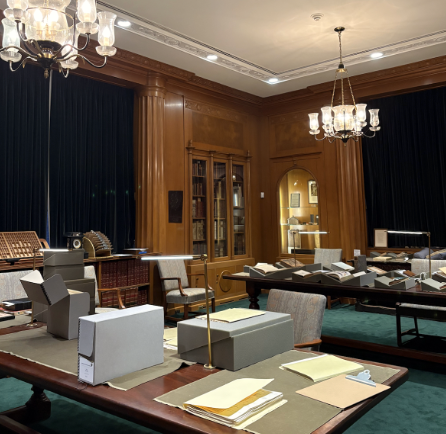
Tucked in a corner on the first floor of Olin Library lives the rare book collection, an ever-growing collection of 45,000 literary works that is a research resource for students looking to interact with physical history. The fascinating assortment of texts in the collection ranges from artists’ books that combine literary and artistic mediums, to 19th-century missionary Bibles in languages from around the world, to copies of Shakespeare’s original works. Head of Special Collections Tess Goodman recently took The Argus on a tour of the space and discussed the function and importance of the rare book collection.
The Argus: What is the rare book collection?
Tess Goodman: The rare books that we have in Special Collections at Wesleyan are pretty diverse. We have pretty solid coverage in terms of American and British literature and history. We have a lot of missionary Bibles that were collected when Wesleyan students in the 19th century were very interested in Christian missionary work. We now have a large collection of artist books that are very invested in both experimentation with the physical form of the book and printing techniques, but also in social justice and in ideas like feminism, anti-racism, or environmentalism. The book explores these concepts as a way to do advocacy.
A: How does rare books fit into the larger Special Collections & Archives department?
TG: The Special Collections & Archives department is kind of split between the rare books and the archives—the university papers—but we work very much in tandem. Often, I work with [Dietrich Family Associate University Librarian for Unique Collections and University Archivist] Amanda Nelson to try and develop a class that will teach students how to deal with both archival documents and rare books together. The advantage of a collection like this is that books are the most common historical artifact that survives from the past, aside from things like coins. They have a really intense depth with so much content. Helping students learn how to understand them is really a way to open up a portal to the past.
A: Where and [from whom] do you primarily get your books?
TG: Some of them have been donations, but the bulk of the collecting that I do at this point is from a number of different rare book dealers. There are some whom I have developed relationships with. I have known them for a while because I worked in the trade at different rare book institutions before coming to Wesleyan. I also go to book fairs. Most recently, I went to the Boston Book Fair, which is held every November. The advantage of going to an event like that is that you can wander around and find things serendipitously. So, for example, I walked into a dealer’s booth, who is based in New Haven, and found an 18th-century copper printing plate for a very reasonable price. This was something that I had been looking for for a while, and I bought it from this person whom we had never had a relationship with before, but it was very exciting to find exactly what we needed on the spur of the moment.
A: How and why do students currently use the rare books resources?
TG: One way is through class visits. These are more structured visits where I work with the professor to try and figure out the teaching goal for the session. Usually, [they are] looking at examples of texts that students are reading in a literature class or sources that students might use to do historical research.
The other way that students can visit is when working on individual research projects. Sometimes this can be for a class that has put together an assignment that relies on Special Collections, or [it can be] on their own initiative. We’ve had students doing class papers or thesis projects on all kinds of material in the collections. A student who graduated a few years ago wrote a thesis about the [“Landino,”] which is one of the first attempts to print an illustrated edition of Dante’s “Divine Comedy.” We have a copy of the 1685 Fourth Folio edition of Shakespeare’s plays, where two of the plays have been extensively annotated, and one student did research on these annotations and found out that [they were] written by somebody who was creating their own new publication by pirating the plots of two of Shakespeare’s plays and smashing them together.
A: Why should students continue to visit the rare book collection?
TG: We are currently operating in a world where facts are disputed and evidence-based truths are harder to recognize. In this environment, it’s extremely important that we all learn to distinguish fact from fiction through processes of verification, research, and the analysis of hard evidence. Special Collections holds the historical record: hard evidence about the past that is available nowhere else. Students here build a lot of different skills, from navigating a rare books library, to analyzing 500-year-old illustrations, to reading 19th-century handwriting. This is all an effort to help students learn to conduct original research.
A: Do you have a favorite book or collection of books here?
TG: My favorite book always changes. Recently, the book that I’ve been most enthusiastic about is a Dutch emblem book from the 17th century. An emblem book is a genre that’s basically dead now, but it was this literary and visual genre of book that had a cryptic phrase, motto, or proverb accompanied by an equally cryptic illustration and some sort of scholarly gloss or interpretation. There is one that I really love that was printed in the Netherlands around the 1680s that has a lot of very beautiful illustrations and a lot of bizarre mottos. There’s an image of a cheese that’s been gnawed by maggots, and the caption says something like “too sharp makes shabby.” So the cheese has been aged to be too sharp, and it’s gone bad. It’s this weird image of how 17th-century brains worked. This particular book also has really interesting, vivid pictures of daily life in the 17th century. The book has this bizarre conflation of daily life information and philosophical information with strange imagery.
A: Do you see any challenges facing the rare book collection now or in the future?
TG: There are all kinds of challenges facing the collection. Trying to help people understand why this stuff matters is something that is always going to be important for us. I think at Wesleyan, we have a very healthy community interest in Special Collections. A lot of the faculty are really good about bringing their classes here, and I think many students are enthusiastic. But making sure that people understand that we are here, that we are accessible is always an uphill battle because the door is always locked for security reasons. But we want people to be able to come in and ask questions. I also think that as people get more and more in the weeds of things like AI and digital databases, there may be a growing conviction that everything’s available online, which isn’t true. Continuing to make ourselves obviously relevant is one of the biggest challenges that we face.
A: Is there anything that you are currently looking to add to the collection?
TG: We have been really trying to add Native American and South American books to the collection. We just added a little book that was printed on birch bark but is not actually written by a Native American person. It is challenging because a lot of resources from the 19th century were written by white settlers and not by Native Americans. Much of the physical documentation that exists comes from one perspective, so trying to figure out how to build a complete picture means that we are kind of looking for a needle in a haystack. A lot of the interesting texts didn’t necessarily survive, but we’re doing our best.
Leah Ziskin can be reached at lziskin@wesleyan.edu.

Leave a Reply