
From the Argives: “How Many Times a Day Do You Inhale?” and Other Absurd Argus Ads
Spend enough time in the Argives and the advertisements start to raise eyebrows. Cigars! Unregulated medical claims! Bowling alleys! Decades of issues (mostly) published on this day over the years reveal promotions that drift well beyond the practical, reaching back to the earliest Argus.
The first-ever edition of The Argus, published on Sept. 24, 1868, printed two full pages of local advertisements, including six men’s clothiers and tailors, three ice cream parlors, and five cigar shops, all located on Main Street.
Like American drug stores today, these merchants sold a wider variety of goods than their stores’ names might suggest. Burr Bros. grocery hawked “kerosene oil of the best quality,” and an ad for W. R. Arnold’s “new and commodious” restaurant boasted its ice-cream rooms, state-of-the-art “Arctic” soda fountain, and wide selection of cigars.
The Argus’ long love affair with smoke shops and cigar sellers started strong in this inaugural edition. Goetze, one cigar shop, even advertised “University brand segars,” possibly a custom line for Wesleyan students, as no documents suggest the manufacture or sale of a cigar brand named University in Connecticut in 1896.
Chewing tobacco and snuff rounded out the list of tobacco products offered by The Argus’ earliest patrons. One apothecary on Main Street endorsed “Bliss’ Catarrh Snuff,” saying, “[Bliss’ Snuff] has often been tried! It will relieve the worst cases! Some bad cases have been cured!”
Companies making speculative health claims on unregulated products flourished prior to the creation of the Food and Drug Administration (FDA). Often, the back pages of The Argus resembled a collage of medical scams.
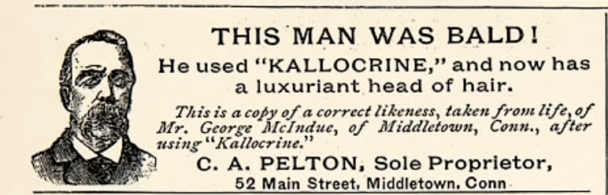
“This man was bald!” read one Argus ad published today, Dec. 5, 135 years ago. The ad included a sketch of a well-groomed man’s portrait. “He used ‘Kallocrine,’ and now has a luxuriant head of hair,” The Argus explained. “This is a copy of a correct likeness, taken from life, of Mr. George McIndue, of Middletown, Conn., after using ‘Kallocrine.’”
Another ad from Dec. 5, 1890, struck a similar note, this time from a local druggist, promising a “liberal discount” and advertising a “new thousand dollar soda fountain” serving hot chocolate, bouillon, coffee, and even clam broth.
After the establishment of the FDA in 1906, new businesses filled the many gaps left by The Argus’ former patent-medicine patrons. Conveniently for anyone reading in retrospect, the new postings in the paper’s Dec. 5, 1910 issue, 104 years ago today, better hint at campus life and local commerce of the day.
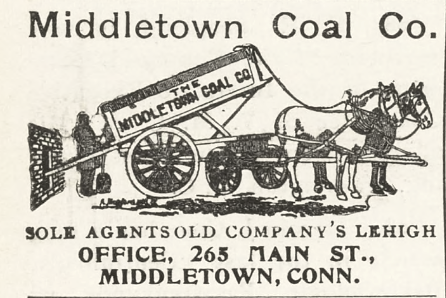
One ad came from Middletown Coal Co., a Main Street dealer advertising that it carried Old Company’s Lehigh coal, a widely sold household heating coal shipped in from Pennsylvania. For student boarding houses still heated by coal, this would have been a routine stop. A few columns over, readers would have found a promotion for Tuttle’s Orchestra, a local music outfit headquartered at 100 Grand St. and managed by C. B. Tuttle, the sort of ensemble possibly hired for campus dances and fraternity events.
Another ad in the Dec. 5, 1932 issue pointed to the local student coffee spot in a world before Perk on Main. The Coffee Bar, right next to Fisk Hall at 220 College Street, offered students a second drink “on the house” and pushed fudge cake and toasted chicken sandwiches as the ideal pairing.
Still, tobacco remained a steady presence in Argus advertising well into the 1930s. In the same issue, a promotion for Edgeworth pipe tobacco explained that “a pipe is the most popular smoke,” and suggested that “while you ‘cram’ for that exam… just light up a pipeful of Edgeworth Smoking Tobacco.” The ad called it “the favorite college smoke.”
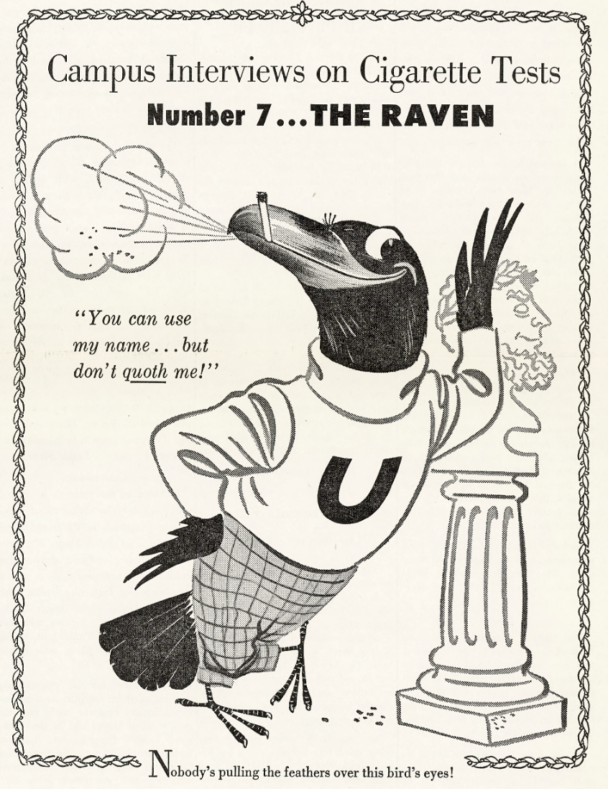
By 1950, The Argus was running cigarette campaigns with a real sense of structure. In the Dec. 5 issue, a Camel ad appeared under the headline “Campus Interviews on Cigarette Tests,” presenting a cartoon raven who announced, “You can use my name… but don’t quoth me!” The copy insisted that “one fast puff or a quick sniff” couldn’t tell a smoker much, and proposed an experiment to remedy the issue: “the 30-Day Camel Mildness Test,” in which students were invited to smoke Camels “pack after pack, day after day.” At the end of the month, the ad said, one’s “T-Zone (T for Throat, T for Taste)” would settle the matter.
The issue on Nov. 20, 1951 was another case of the cigarette ads swarming The Argus in this time. In this edition, The Argus published an advertisement that asked the question “How many times a day do you inhale?” The company, Philip Morris, was promoting their cigarettes, which were supposed to prevent “cigarette hangover” and provide “more smoking pleasure.” They claim to have created cigarettes that prevent throat irritation, citing that they make their cigarettes with the help of nose and throat specialists. While these “specialists” may seem convincing, the advertisement gives no indication to specifically how throat and nose irritation is reduced through their special formula.
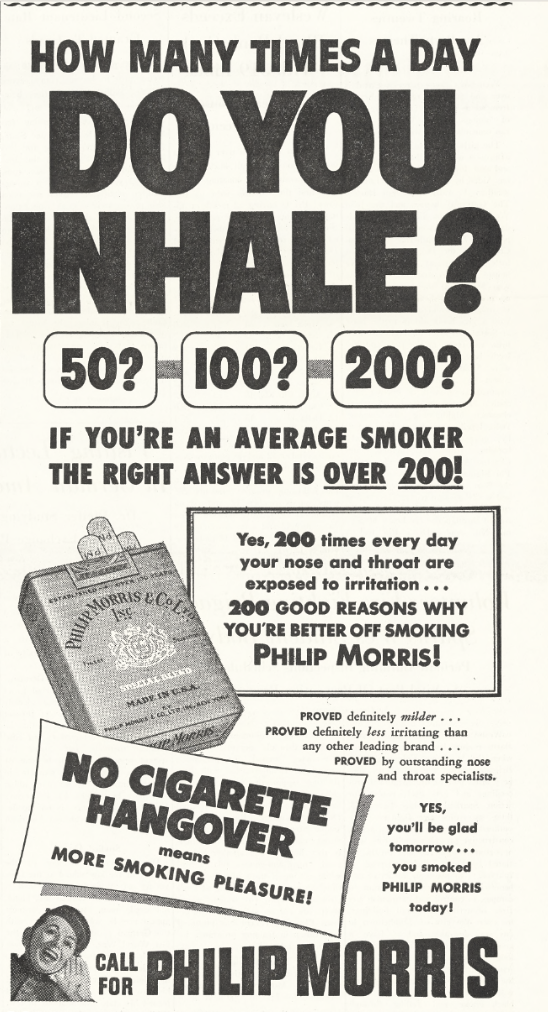
Moreover, Philip Morris use extreme language to make three points about the effectiveness of their cigarettes, saying, “PROVED definitely milder… PROVED definitely less irritating than say any other leading brand… PROVED by outstanding nose and throat specialists.”
However, while this advertisement might not be very scientific, it definitely knows its target audience. Smoking culture still prevails at Wesleyan, as it does at many other universities. Whether it’s students taking a cigarette break on the steps of Olin or their balconies, this advertisement remains applicable even over 70 years after publication.
The advertisement ends with a final appeal to students to change their cigarette brand to Philip Morris.
“YES, you’ll be glad tomorrow…you smoked PHILIP MORRIS today.”
But The Argus didn’t limit itself to peddling nicotine products. On March 3, 1992, The Argus published an issue that contained an advertisement for meditation workshops. However, the absurdity of this advertisement was not actually within its content; it was what the workshop actually entailed. The Argus published an article on Oct. 24, 2025, titled “From the Argives: Campus Workshops Serve as Cult Pipeline,” which discussed the cult—disguised as said meditation workshops—that ensued on campus. In its original ad, The Argus merely promised that attendees would “develop creativity,” “increase personal power,” “experience stillness of mind,” and “control thoughts & emotions.”
In tiny little block letters at the bottom of the advertisement was the company behind the cult and advertisement, The Hartford Meditation Society. The “society” was a front for the schemes that the cult leader, Frederick Lenz, was plotting on Wesleyan’s campus.
What wasn’t in the advertisement is that these workshops would function as a doorway to initiation into the cult, where every aspect of a cult member’s life would be controlled. Moreover, while the advertisement said that admission to the meditation workshop was free, some cult members would have to pay monthly dues of $2,500, which made Lenz around 5 million dollars per year. Who would’ve thought that an innocent meditation workshop could lead to something so sinister?
On Apr. 21, 1970, the Argus published an issue advertising Pelton’s Drug Store, which decided to go with the super catchy slogan, “Always glad to cash Wesmen’s checks—[we’re] especially glad to cash Weswomen’s.”
These Weswomen were not available to comment on this enticement. But the drug store’s creepy advertising approach feels especially jarring considering that 1970 was the year that Wesleyan became a coed university.
Yet Pelton’s even offered free delivery! So, if female students didn’t feel like going to the store, Pelton’s Drug Store would come to you!
Pelton’s Drug Store is one of an array of bygone businesses in the Argus ads timecapsule. On Dec. 5, 1980, 45 years ago today, The Argus printed one such ad from Middletown Lanes, the city’s former bowling alley. Middletown Lanes on Washington Street then had 36 lanes, an electronic game room, billiards, a snack bar, and a cocktail bar.
Several businesses that patronized The Argus in 1980 have stuck around, however, including Jerry’s Pizza, which was also promoted in this Dec. 5 issue. Their ad reminded students that Jerry’s would deliver “to your room—[every] night except Saturday,” taking calls from 9 p.m. to midnight: the kind of availability that keeps a place around.
Most of the businesses in these pages have come and gone with the decades, though a few have managed a longer run. Smith & Bishel Hardware is among them. Founded in 1898 and now the oldest family-run business in Middletown, it first appeared in Argus advertising on May 31, 1899, calling itself the “new hardware store” in town. The shop has remained on Main Street ever since, enduring changes in location and generations, and leaving one of the earliest local footprints in the paper.
Hope Cognata can be reached at hcognata@wesleyan.edu.
Lara Anlar can be reached at lanlar@wesleyan.edu.
“From the Argives” is a column that explores The Argus’ archives (Argives) and any interesting, topical, poignant, or comical stories that have been published in the past. Given The Argus’ long history on campus and the ever-shifting viewpoints of its student body, the material, subject matter, and perspectives expressed in the archived article may be insensitive or outdated, and do not reflect the views of any current member of The Argus. If you have any questions about the original article or its publication, please contact Head Archivists Hope Cognata at hcognata@wesleyan.edu and Lara Anlar at lanlar@wesleyan.edu.





Leave a Reply