
Short Hours, “Fresh” Food from New Jersey, and Empty Shelves: Weshop Can Do Better
We’re in the era of the convenience store. Known for their fresh food offerings and 24/7 convenience, Wawa, Kwik Trip, and Buc-ee’s have developed cult-like followings across the nation. Even the modest 7-Eleven still delivers. If you show up at midnight, you can count on a slice of (probably a few days old) pizza and a Slurpee.
Then you have Wesleyan’s convenience store, Weshop. It comes off looking like a Golden Corral you might pass on the highway. It looks pretty solid from the outside—and then you walk in.
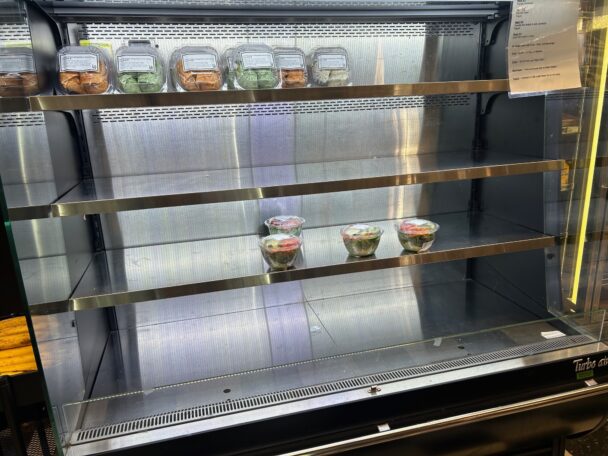
The biggest problem is that I have literally never seen this place fully stocked. The premade options are just sad. It’s usually three or four wilted salads and a couple of dry and bland sandwiches. The sushi is trucked in from New Jersey. Is it really that hard to find fresh food for students that did not come from across the George Washington Bridge?
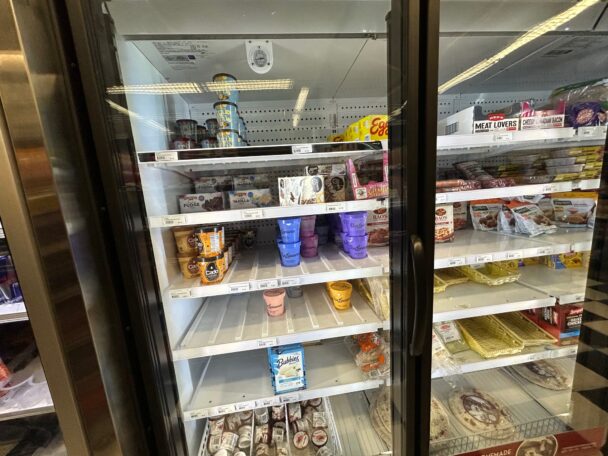
The restocking problem is not just limited to the sandwiches and salads, either. There are times when there are more empty spots on the shelves than sparkling water available. Small bottles of chocolate milk being in stock are a coin flip. I bought a Hershey’s Special Dark chocolate bar last year—the offering has never been restocked.
At the same time, Weshop has plenty of items that nobody wants. Drinkable konjac jelly that is infused with collagen? Frozen cakes? Three different varieties of pickles? I’ve never seen anyone buy these items.
What students could actually use are small packs of precut apple slices or carrots, packs of trail mix (not the industrial-sized ones that are sold here like students are preparing to hike the Appalachian Trail), apple sauce, and peanut butter crackers. These are all easy options to eat on the run.
Also, who organized the layout of this place? Half an aisle is nothing but candy. You have at least three types of Sour Patch Kids, virtually every Haribo gummy known to man, and the ever-important Jolly Rancher gummies. The other half is home to massive boxes of cookies and crackers—inconvenient for students looking for a quick snack and take up space that could be used for more grab-and-go options.
Go an aisle over and there is a shrine to sodium. It’s a wall of just chips. These aren’t just little bags either. They’re those massive family-sized bags you would serve at a July 4th party where 20 people chant “U-S-A.” It’s like Weshop said “Variety? Convenience? No, just sell enough salt to make up the Dead Sea.”
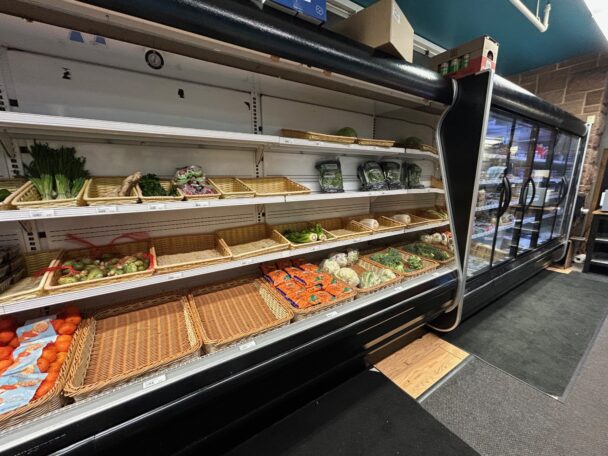
Across from that is what looks like a farmer’s market that got lost on campus. The only problem? Most students don’t have kitchens and the ones who do don’t have the time to break out a pan in the 20 minutes they have in between classes. It looks like a produce truck dumped a few boxes into the parking lot and the farmer drove off yelling “see you later.”
Even students who do cook cannot get what they need at Weshop. So many people I know drive off campus every week to go to supermarkets because Weshop does not have sufficient items.
Go to the last aisle in the store and half of it is dedicated to water. Smartwater, Gatorade Water, LIFEWTR, and something claiming to be alkaline-infused water—that’s got to just be a marketing ploy. That’s not even counting the sparkling water.
Let’s not act like this inadequacy is normal at most colleges and universities. Peer liberal arts colleges including Williams, Amherst, Swarthmore, Bowdoin, and Middlebury have grab-and-go markets offering a variety of fresh and tasty food—not collagen jelly and mystery sushi that was assembled closer to Atlantic City than Middletown.

Then there’s the weekend hours. I’ve seen kids’ lemonade stands open for longer. On Friday, they close at 6 p.m. Saturday: They’re open from 2 p.m. to 6 p.m. Four whole hours. This issue is only exacerbated now that Usdan Café, once a reliable spot for grab-and-go items, is closed on the weekends. So if you’re looking for a real breakfast on campus during the weekends, you have to wait until 11 a.m. Staffing difficulties may make longer hours tricky, but right now there are basically no school-run lunch options on the weekends.
Sure, there’s the independently owned Red and Black Café, as well as its counterpart WesWings, but it is not possible to eat there that often on a consistent basis. Why? The University takes 7.5% of their income from sales for points used at these locations. To remain profitable, these restaurants must charge higher prices. It is a system that punishes students for supporting local restaurants that serve good, quality food.
Wesleyan can do better than Weshop in its current form. Here are the suggestions that I propose:
- Keep the location open until 8 p.m. minimum on Friday and Saturday.
- Remove unpopular items and replace it with grab-and-go foods: fruit cups, protein boxes, yogurt parfaits, cheese and crackers—stuff that college students actually eat.
- Add a counter with a variety of fresh sandwiches and salads, including vegan and vegetarian options, that are made on site and are constantly restocked.
- Ensure that the shelves remain stocked at all times.
These changes would not be massive, nor would they cost nearly as much as the new science center, but it would ensure that students are fed on campus. It’s the bare minimum.
Thanksgiving Break is coming. The moment I walk into a convenience store back home, my eyes will light up like Boris Yeltsin in that supermarket in 1989: The shelves are actually full with food people want to eat. If the Soviet Union can be stunned by abundance, then Wesleyan can properly run a convenience store.
Blake Fox is a member of the class of 2026 and can be reached at bfox@wesleyan.edu.






Leave a Reply