
“The Secret Agent” Is Magical (But Leaves Too Much Undercover)
Let me be abundantly clear: This is a rave review. During Saturday’s pre-release screening of “The Secret Agent” at the Wesleyan Film Series, I was utterly enraptured for just about every second of the film’s sizable 161-minute runtime, a big, stupid grin plastered across my face, intensely fighting the urge to stand up and clap at random intervals as a show of my appreciation.
A painstakingly detailed, exceptionally constructed film that truly feels like a time capsule, Kleber Mendonça Filho’s 1977-set political thriller is without question one of the year’s best films, which is particularly impressive considering the litany of other quality films this year including “One Battle After Another,” “Sentimental Value,” and, of course, “Den of Thieves 2: Pantera.” The film is genuinely exceptional, yet as the screen cut to black and the credits began to roll, I was shocked to find myself filled with immeasurable disappointment and frustration. In case it hadn’t become clear already through my writing, I have a tendency to hyperbolize, but the more I attempt to reckon with my feelings on the film, the more puzzled I become about my conflicting views.
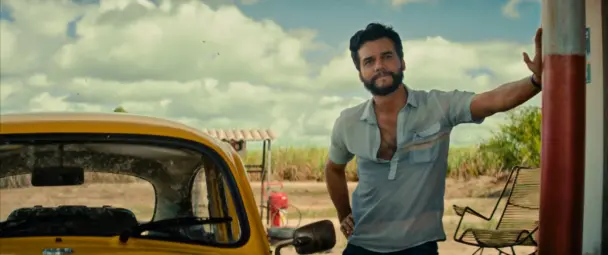
The film follows Armando (Wagner Moura), a former researcher hiding out in Recife while attempting to flee Brazil’s authoritarian government (as well as a pair of hitmen). The setup is simple, but along the way the film veers in about as many directions as you can imagine, with plot threads examining corrupt cops, the cultural impact of “Jaws,” and rumors of an evil disembodied leg wreaking havoc among Recife’s gay community (trust me, it makes sense in context). In the interest of keeping our glass half full, let’s start with what this movie does well.
My foremost concern before seeing the movie was its length; two hours and forty minutes is daunting, and as someone with a dreadful attention span, I was worried the film would lose me. To my pleasant surprise, Filho manages to pull off a cinematic trick rarely seen: making the film feel dynamic while simultaneously taking things slowly and soaking in the atmosphere. On the whole, the movie moves at a relaxed tempo, luxuriating in the scenery and providing each sequence with ample breathing room. However, the nature of the film’s narrative ensures that these moments all feel worthwhile; we stay on the edge of our seats through these languorous scenes as Armando’s backstory is slowly revealed and the world of the film gradually becomes clear. Instead of detracting from the tension, the slow pace and copious side plots (did I mention there’s an evil disembodied leg?) serve to strengthen our connection to the world and the characters, making the inevitable violence all the more emotionally impactful.
The violence in the film raises interesting questions, particularly in its extremely sparing use. Despite the lengthy runtime, there is only one sequence depicting strong violence on screen, and although there’s plenty of other implied nastiness and more than enough shots of a disembodied leg, there is very little action for a political thriller. The film’s greatest strength lies in this subversion of genre; it manages to string together elements of family drama, political satire, and outright comedy, as well as more than enough scenes of intrigue and danger to qualify as standard paranoid thriller fare. This constant shifting is yet another way Filho keeps the film engaging, keeping us on our toes as each scene threatens to go in many different directions.
This genre blending would not feel so seamless if not for the talent of the film’s cast. Moura is made to do a lot of heavy lifting here, and he leads the film with poise and restraint, giving us an enigmatic yet sympathetic protagonist in Armando. As someone who, like many American viewers, only knows his work as that scary wolf in “Puss in Boots: The Last Wish,” this part makes clear that the man is a bona fide movie star, a leading man reminiscent of Hollywood legends like Robert Redford and Henry Fonda. Supporting him is a canny cast that carries out their assignments to perfection. Tânia Maria is a scene-stealer as Armando’s delightfully unfiltered landlord, Dona Sebastiana, and Carlos Francisco brings unexpected emotional depth and complexity to what could have been a dull role as Armando’s father-in-law.
Much like the ’70s films it is influenced by, the film excels in casting actors who look like real people. Roney Villela and Gabriel Leone make a spectacularly unglamorized pair of hitmen, two actors with, to be blunt, something not quite right about their faces who you would be hard pressed to find in a modern American film. Ítalo Martins, who plays a hitman subcontracted by the pair, looks as though he’s been ripped straight out of the streets of 1977 Recife; he only appears in the final third of the film, but makes every second on screen count, bringing immeasurable anxiety and menace to an already tense sequence. This inspired casting of supporting players furthers Filho’s ultimate goal of immersing us in the world of the film, and brings both realism and memorability with aplomb.
On the topic of our immersion, the film’s visuals are freaking awesome. Shot on vintage Panavision anamorphic lenses by Russian cinematographer Evgenia Alexandrova, the movie gives us intimate close-ups and gorgeous static camerawork with a soft, warm edge, making the city feel alive and textured. Paired with a color palette of saturated browns and oranges and quick, efficient editing that keeps you on your toes, the film’s camerawork creates countless indelible images that won’t be leaving my head anytime soon. A hyperspecific but necessary side note: we need to bring back the phone booths they had in ’70s Brazil, which can be best described as giant tangerines sliced in half and hollowed out. I fundamentally struggle to grasp the efficacy or intention behind this design, but I can assure the Middlesex County Planning Board that if I were to walk past one of those phone booths, I would be making a call.
Now, here’s where things get difficult. After a thrilling sequence of truly shocking violence, the film pivots to a thread it’s been following intermittently throughout: Flavia, a history student in the present day, is researching Armando’s life. For the most part, I found this side story to be a disappointment; for a film so adept at immersing me in the moment, deliberately stepping out of it felt jarring. The final 20 or so minutes of the film follow Flavia as she meets with Armando’s son Fernando, now a successful doctor. They discuss his memories of his father, and she gives him a thumb drive of recordings of Armando. The scene raises some interesting thematic questions, and made me curious to see how the 1977 plotline would tie back into it.
At that moment, tragedy struck. The camera settled into a long shot of Fernando’s hospital and the adjacent road, and after a second of stillness, a terrible thought entered my head: “Is this it?” That couldn’t be the end, could it? There were so many questions left unanswered, so many characters’ fates unseen. There was no closure, no epic gunfight or passionate monologue. Sure enough, the screen went black, the credits rolled, and the rest of the audience began to clap while I sat there with jaw dropped and brow furrowed.
I understand and acknowledge why so much is left ambiguous, and the lack of easy answers is a clear result of the film’s overall vision of the impossibility of making sense of the past. The reviewer part of my brain wants to respect this, but in my heart, I feel deep disappointment. I had grown so invested in the characters and their various plotlines, and by the end of the epic journey, I felt innately connected to the hustle and bustle of Recife. For it to end, just like that? I felt betrayed. I feel betrayed.
It’s hard to make sense of this dichotomy between the brain and the heart. At the end of the day, Filho, like any director making a film that aspires to any remotely thoughtful objective, must prioritize an ending that brings the content to a head and ties the message of the movie as a whole into a coherent statement. Throughout every minute of “The Secret Agent,” however, I found myself so fascinated and gripped by the narrative, the cast of colorful characters, and the vibrant setting that I began to feel disinterested in the subtextual aims of the screenplay. When the text is so entertaining on its own, why should I exert effort looking for subtext? Movies are for absorbing, not thinking; it’s almost as though Filho made a movie that was simply too good, so good that I never wanted it to end, particularly on a deliberately anti-climactic, thought-provoking note.
“The Secret Agent” is a spellbinding work of cinema that asks us to fall head over heels in love with a place and a time. I answered the call, but in the end, my heartbreak at our sudden divorce was devastating. It’s hard to blame the film instead of my own flawed mentality, but in the end, what is the point of a movie if not the way it makes you feel? For “The Secret Agent,” those feelings were largely ones of joy, of tension and sadness, of exhilaration and connection, but in the end, I was left cold and empty.
As a reviewer and as someone who truly bought into the film’s narrative and aesthetic vision, it’s disappointing; in any case, we’ll always have the disembodied leg.
Lucas Chiorini can be reached at lchiorini@wesleyan.edu.




Leave a Reply