
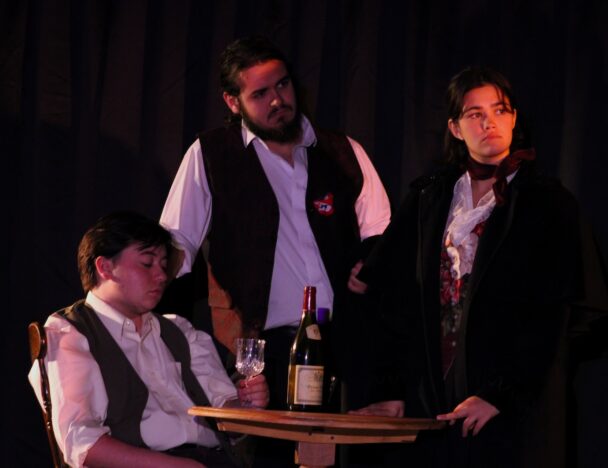
“What Horizon” Reimagines “Les Misérables” for the Stage, Breathing New Life into an Enduring Classic
Every year, the University’s theater scene boasts a strong mixture of shows, with a varied enough slate that anyone could find a production of interest. Go to enough shows and you will have seen your fair share of both original student work and handsome productions of theatrical mainstays.
You’re less likely to experience something at all resembling what Percy Liftin-Harris ’28 did with his play “What Horizon,” performed in WestCo Cafe on Saturday, Nov. 14 and Sunday, Nov. 15.
“What Horizon” adapts the source text of one of the most iconic musicals of all time, Victor Hugo’s “Les Misérables,” with an original script. Rather than taking cues from the musical, however, Liftin-Harris returns to Hugo’s (gigantic) novel to mine an entirely different story. In fact, anyone who thinks the musical is too long should take note: the book is so big that a two-and-a-half hour play can be made of the excised subplots alone.
“‘Les Misérables’ is such a monster of a novel that I’m surprised there aren’t more adaptations that try to pluck out just one storyline,” Liftin-Harris wrote in an email to the Argus. “It often reads more like a collection of intertwining anecdotes than a linear, protagonist-focused novel, so it felt like the natural choice to try to adapt it in a way that does justice to one of the more frequently misunderstood plot points.”
There’s much in the text, and Liftin-Harris knows it. The script radiates a love for the source material, and especially for the peripheral characters and their stories. Lovers of the musical, or its (abysmal) 2012 film adaptation, would only know of shades of these characters. Liftin-Harris’ production follows the likes of “Natasha, Pierre, and the Great Comet of 1812,” which adapts just a tiny slice of another tome, “War and Peace.” Liftin-Harris also cited Tom Stoppard’s “Rosencrantz and Guildenstern Are Dead,” which focuses on what happens offstage to Hamlet’s college buddies. But unlike “Great Comet,” “What Horizon” offers a fully formed story from start to finish, and unlike “Rosencrantz and Guildenstern Are Dead,” that story feels in no way self-consciously marginal. Indeed, I came out of “What Horizon” wondering why the story of these revolutionaries was a subplot in the first place.
“Before writing this play, I’d watched a lot of different adaptations of ‘Les Misérables,’ and I found that nearly all of them completely misrepresented the barricades—at best, a group of idealistic but naïve students who fail tragically, and at worst, just a backdrop of violent struggle for the climax of Jean Valjean’s arc,” Liftin-Harris said. “It was so hard to find a version of the story that validated Les Amis’ original role in the novel as the potential agents of real systemic change and gave them the screentime they deserved.”
The play begins with—like the song goes—empty chairs and empty tables, before Enjolras (Kate Lyman ’26) makes his entrance, staring down the audience as his fellow revolutionaries charge in from behind him. Immediately, we’re placed in the eye of the storm; it’s the morning of the June Rebellion of the French Revolution, and the rebel group Les Amis de l’ABC are about to mount their last stand against King Louis-Philippe. From that point on, to invoke another recent work about a revolution, it’s one battle after another. The group is besieged at the barricade by police and the national guard, by ideological discord and insurgency in their ranks. The body count builds, and by the second act, we’re reminded just how many people die in “Les Misérables.”
The action is not confined to the June Rebellion, however, as the show features numerous flashbacks to the debates and camaraderie that brought us here (accompanied by a handy reminder of the date of a given scene, pinned onto the set). This non-linear structure adds to the show’s pathos appreciably; in an email to the Argus, Kate Lyman wrote, “[The] show’s non-linear structure means that we all are collectively observing how these characters and relationships have developed, and there’s this beautiful retroactive tragedy when moments of severity and grief are sharply contrasted by a scene taking place five years ago, full of playful teasing and plans to ‘go to the theater tomorrow evening’ being made by characters who we have just watched die mere minutes ago.”
Lyman, it should be noted, is astounding in the role of Enjolras, a role which lends itself in other versions of the story to a one-dimensional signifier for revolutionary leadership. An actor could dine out on the character’s impassioned spiels, but no such shortcuts are taken here. Instead, Lyman keys into Enjolras’ intense empathy and his concern and admiration for his comrades. I was immediately struck by her gravitas—the way her voice commanded a confident authority—but she is just as electric a performer when she is demonstrating care through listening.
“For me, the most important part of Enjolras is this deep, earnest sensitivity he has to him,” Lyman said. “It’s so important that we see Enjolras scared, embarrassed, comforting, nervous, distraught, laughing, distinctly divorced from traditional ideas of masculinity. He is simultaneously devout in his commitment to the revolution and [is] a socially awkward young man who is just so deeply in love with his friends.”
There’s not a weak link in the rest of the cast, either; Julia Lebow ’29 makes a meal out of the second act’s lyrical interludes as Prouvaire, while Theodore Bellavia-Frank ’27 fully embodies Bahorel’s chaotic bravado. One of the most impressive characterizations—despite only showing up halfway through—comes from Liev Shpitalnik ’27, who has the thankless task of playing a Jean Valjean without an explained backstory. The way the protagonist of “Les Misérables” is made to be a mysterious cypher when the story is viewed from this perspective is extremely evocative, and Shpitalnik gives a performance that justifies the character’s significance, even if it is decentralized.
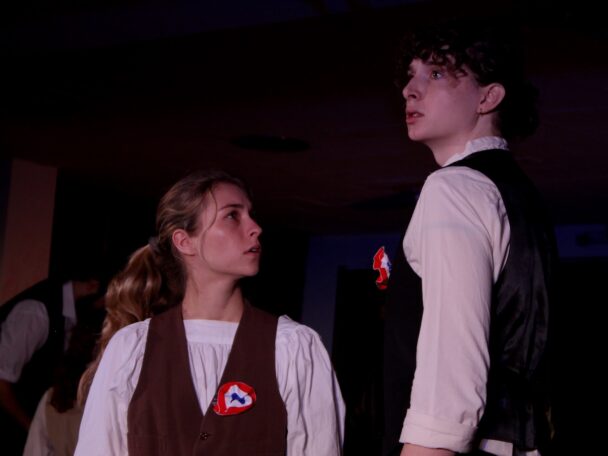
Liftin-Harris spoke extremely flatteringly of the actors’ abilities to find angles on the material.
“There was so much in the script that I left up to actor interpretation, and suddenly I had actors finding whole character arcs that I hadn’t known could be there,” he said. “There was so much that turned out completely differently from how I’d pictured it, and I’m so glad for it—every time that happened, it was so exciting to find new meaning in what I’d written and see other people make this story their own.”
More than just a showcase for good acting, however, I found “What Horizon” to be a profound reassertion of values, an attempt at rethinking the easy ways that revolution can be deployed in character-driven stories as a way to broaden their scope without real care for what that revolution was fighting for.
This approach is as successful in the “Les Misérables” musical as it is in “RENT,” where AIDS activists are made to be the backdrop of a bog-standard starving artist plot. Many of the scenes in “What Horizon,” by contrast, depict ideological debates that recenter the actual discussions that went into the sensational violence that the popular conception of the French Revolution valorizes. Speaking about his play’s relationship to the musical, Liftin-Harris said that “knowing that my audience is likely most familiar with the musical, some of the ideas I’ve tried to emphasize in ‘What Horizon’ are [intended] to counteract the idea of Les Amis as ‘schoolboys, never held a gun,’ or to answer the question that goes unresolved in the musical: the impact of the rebellion.”
The most poignant, rousing part of “What Horizon,” however, is that it shows the rage of Les Amis in equal proportion to the immense love they have for each other and for their cause. Though the play is ultimately tragic, it is with this charged solidarity that Liftin-Harris leaves us; we end where we began, with impassioned people ready to take on their system for the betterment of one another’s lives. That their physical presence is liminal—the play’s structure leaves me with something of a sense that the characters were always, on some level, ghosts—is immaterial in the face of the camaraderie that hangs in the air.
“This show and character, to me, is all about love, and it’s no coincidence that the word ‘fraternity’ appears maybe half a dozen times in the script,” Lyman said about the moment the show clicked into place for her. “It is unflinchingly genuine. Love is what fuels this show. So much love was poured into its writing, its direction, its production, its design, its performance, and I could see that even from the first read-through. In the days following closing night, I’ve felt so full of love, so much pride for my friends old and new, and so much hope for the future.”
Louis Chiasson can be reached lchiasson@wesleyan.edu.


Leave a Reply