
Behind Wes Arabesque’s “The Nutcracker”: Dedication, Intensive Schedule, and Precise Teamwork
As the November cold starts to seep in, you might begin to realize that the holiday season is right around the corner. For the world of ballet, the holidays only mean one thing: “The Nutcracker.” On Nov. 14 and 15, the student-run ballet troupe, Wes Arabesque, performed “The Nutcracker,” directed by Scarlett Albertson ’28, Leela Chauhan ’28, and Lael Blackmore ’26 in the Patricelli ’92 Theater.
As the lights dim down and Tchaikovsky’s iconic soundtrack began, the audience was seamlessly transported into the iconic party scene opening of “The Nutcracker.” Parents, girls, and boys filled the stage, each wearing vibrant expressions that lured us into the atmosphere of a lavish party room on Christmas Eve. “The Nutcracker” follows the adventures of the main character, Clara (Francesca Carnovale ’26), as the nutcracker doll she receives as a present comes to life.
After the party scene, the story moved into the Waltz of the Snowflakes, led by first-year Amelie Zosa ’29, who took center stage as Snow Queen. The snowy pale-blue lighting accentuated Zosa’s and the six other performers’ vibrantly delicate and synchronized moves.
“I had a lot of difficult sections in [Waltz of the Snowflakes] that I had to practice over and over again to get good at, but the hardest part was really building enough stamina to get through the whole show,” Zosa said. “We ran through the show so many times during tech week that I felt like my legs were going to fall off by the end.”
Nini Hayes ’26, who played the Sugar Plum Fairy, also recalled the importance of stamina in her performance. “During one of the full run-throughs of the show, my watch told me that my heart rate went up to 192 bpm,” she wrote.
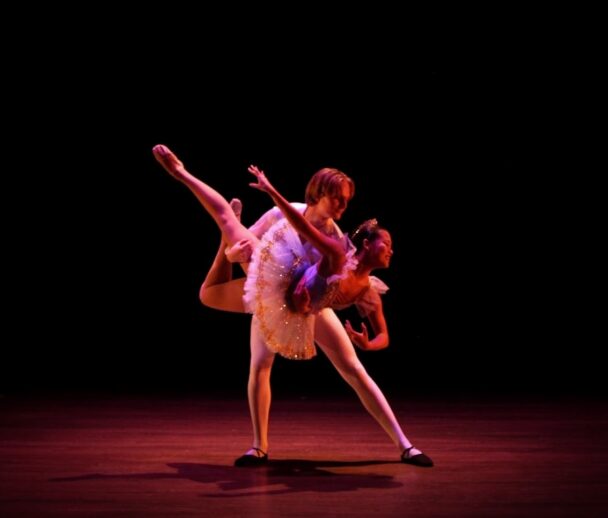
During the Dance of the Sugar Plum Fairy, Hayes and Henry Ewing-Crystal ’26 danced together, immersing the audience in the snowy dreamscape. They displayed effortless lifts and elegant, unified moves, which received numerous cheers from the audience. The biggest challenge for Hayes, however, was the wooden floor of the ’92 Theater.
“For dancers, the best floor [surface] to dance on is called marley,” Hayes said. “It provides the perfect amount of slickness for pirouettes, but also friction to prevent slipping. I grew up dancing on marley, so encountering the extra challenge of performing difficult choreography while dancing on a slicker-than-normal floor was challenging.”
She eventually overcame this challenge by moving to the Fayerweather studios, where the floors are also wooden.
“With water on our shoes [to add friction] and lots of practice, we gradually got used to the floor,” she said.
What makes theater in the ’92 special, performers said, is how personal it can be for both the performers and the audience.
“[The ’92] is also such an intimate space, and it was really special to be able to make out the faces of my friends and family in the audience,” she said. “It was comforting to pass by them as I was running on and off the stage.”
As performers navigated the challenges of being on stage, directors had to navigate a different obstacle: time. As the club fair only happened in mid-September, the group only had six weeks to dedicate to rehearsal time. While most traditional ballets are choreographed by a single director, at Wes Arabesque several Wesleyan students are part of the creation of the choreography. In an email, artistic director Scarlett Albertson ’28 described the ways in which this element present challenges under time constraints.
“Choreographers often have different views about what certain scenes, as well as the overall story of the show, should look like,” she said. “[I had to] mediate these differences of opinion and to work alongside Lael and Leela, the stage and financial directors, to bring to life a “Nutcracker” that makes sense as a cohesive story.”
The world of “The Nutcracker” ballet required extensive original choreography to bring the enchanted winter wonderland and Christmas atmosphere to the audience.
“The hardest part was balancing our imaginations with realistic financial limitations,” Chauhan said. “[But we were] blessed with incredibly talented choreographers and directors, so with some creative brainstorming we were able to find workarounds to our daydreams. Sometimes those alternatives actually led to better costuming than what we originally envisioned.”
Stage manager Lael Blackmore not only scheduled rehearsals and served as liaison to the tech crew; she was also one of the many choreographers. She expressed that when choreographing, she would “focus entirely on the music and the feeling behind it.”
“To me, dance is an embodiment of music,” she said. “I also look for ways to showcase the beautiful dancers, and to create a balance of different steps for them, with moments of rest in between.”
The finale of “The Nutcracker” concluded with each dancer making their way onto the stage to take their bows and a well-deserved standing ovation. Cheers and applause filled the theater, celebrating the hard work and passion that brought the performance together. Overall, the show’s charm and energy left the audience eager to find out what Wes Arabesque will bring next to the stage in the spring semester.
Haruka Kodaira can be reached at hkodaira@wesleyan.edu.



Leave a Reply