
Emmy Award–Winning, Former MSNBC President Rashida Jones Talks Leadership and Media
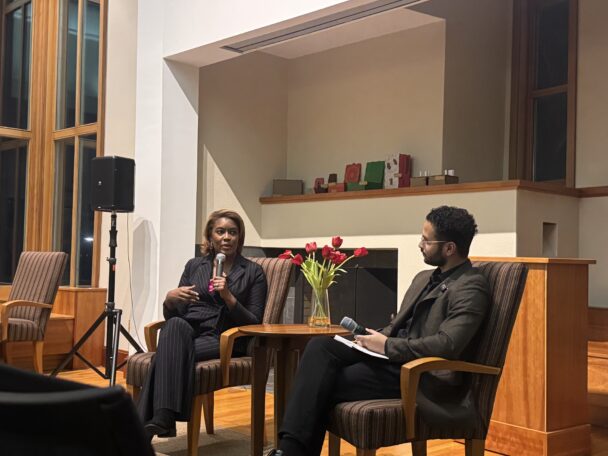
On Thursday, Nov. 13, Emmy Award–winning television executive Rashida Jones visited the University as a part of the newly rededicated Patricelli Center for Entrepreneurship (PCE). Jones is a former president of MSNBC, a member of the board of directors at the We Are Family Foundation, and a trustee at Hampton University.
“Rashida embodies purpose-driven leadership, pairing a deep commitment to public service with a relentless pursuit of excellence,” Entrepreneur-in-Residence Marisa MacClary ’94 said.
Jones’ day began at the University with a faculty lunch at the PCE board room, followed by a Q&A with students in “Leadership and Social Innovation” (CSPL252), and concluded with a fireside chat at the McKelvey Room at the Office of Admission.
The latter event began with an introduction of Jones by Executive Director of the Allbritton Center for the Study of Public Life and Rob Rosenthal Distinguished Professor of Civic Engagement Khalilah Brown-Dean, followed by a talk about leadership development by Jones. A major part of the event was the fireside chat moderated by Director of the Patricelli Center for Entrepreneurship and Assistant Professor of the Practice in Public Policy Ahmed Badr ’20.
Jones described her media-influenced childhood, starting her own newspaper, the ambition of becoming a journalist, and pursuing studies in college that fulfilled her interest. She continued to talk about the discovery of different possibilities in media and her own transition to becoming a broadcast major, shifting from print media.
“I did not know that there was [the role of] a producer, who was in charge of putting all of these things together, who chose the stories, who helped write the stories, [and] who directed the team…all those things sound like all of those leadership attributes that I loved from that time I started the neighborhood newspaper up until now,” Jones said. “When I found out that there was a way to marry the things that I loved about storytelling and the things that I loved about being the leader in the job of a producer, I immediately said, ‘Sign me up.’”
Jones described the tendency of her colleagues to gravitate toward reporting and anchoring positions, while she was drawn toward producing.
“I [loved] the idea of being the person in the group project who helped guide and direct and lead everyone to what they wanted to do,” Jones said. “So it was pretty early in my career that I knew I wanted to marry this idea of being a content person and a leader in the same boat.”
Transitioning from covering important events like Hurricane Katrina as a weather analyst to going back to a traditional news room, Jones talked about her journey working in Virginia, South Carolina, and ultimately—to her own surprise—New York.
“I [was] thinking, ‘There’s no way I’m going to move to New York,’ because at that time, it was just me and my four-year-old and my seven-year-old,” Jones said. “‘I’ll take the interview because it seems like a very cool way to get a free flight to New York and go talk to some people and maybe network and then go back home.’”
But she stayed, and ascended rapidly through the ranks at MSNBC.
“Being a leader when no one has asked you to be a leader, filling white space, [and] leaving yourself open for evolution and change has been kind of the story of how I’ve been able to navigate my career,” Jones said. “I think one of my most important leadership skills is not just having done the work, not [just] having the experience, but…it’s because I bring the [same] empathy, the understanding, the passion, the fierce support that I do in my house to my kids. [Leadership] has been bringing all pieces of my life together.”
Badr and Jones also discussed working under the intense pressure of a television news channel. Jones described working in the newsroom during the 9/11 attacks as a formative experience, and said that the 2020 presidential election presented challenges in balancing audience interest with ethical reporting.
Jones spoke to the challenges of polarization, the role of influencers and activists, and the ever-evolving landscape of journalism. The conversation also touched on the relationship between local and national media, highlighting COVID-19, when journalists not only reported on the pandemic but also held significant worries about the safety of their own families, and crises like Hamas’ Oct. 7 attacks. Jones also delved into the impact of streaming in the current world, including an increase in low-budget films, and the importance of authenticity and accuracy in storytelling.
Jones lastly emphasized the importance of curiosity, people management, and application of experiences and skills as an integral part of being in media. When asked about her legacy, she said that she hoped to help other journalists navigate, pivot, and inspire their careers.
The event was well attended and received by both students and faculty.
“I think it was a very thought provoking event, and one of the things addressed was having diversity of thought and confidence, which is something all of us should carry with us,” Amal Mallick ’27 said. “It was very interesting, and I would encourage everyone to attend more events like this, because it really opens your mind to careers other than very streamlined ones.”
Students also appreciated Jones’s real-world insight.
“I thought the event was great,” Palmer Zarzycki ’28 said. “I thought she did a good job of conveying her leadership. To actually get the inside scoop from somebody who’s worked [at a major news network] and is very honest with their opinions is great.”
Brown-Dean praised Jones’s talk as a valuable chance to hear from an adaptable leader and decision maker.
“I think the benefit of having guests like Rashida is that it gives us an opportunity to see how these things play out in real time,” Brown-Dean said. “We can better understand the complexities of decision making, the complexities of an environment that is always in flux, but also have an opportunity to learn from one another about what those possibilities are. And the real takeaway from this event is that if we can develop these skills and habits where our expertise meets the opportunity, we can be prepared for any situation, and I think that that’s particularly important when we think about public life.”
Reflecting on her visit to the University, Badr appreciated being able to host Jones at PCE.
“Rashida embodies the best of leadership and public service,” Badr said. “We are honored to have hosted her at the Patricelli Center.”
Raiza Goel can be reached at rgoel@wesleyan.edu.


Leave a Reply