
Song Analysis: How I Hear “Hollow Knight” in Lorde’s “Team”
The wind howls and shrieks. Beside the foreboding cliffs winds a gaunt path. Darkness hangs palpably in the air, thwarted only by the light of street lamps. A shadowy cloaked figure trudges along, a small sword slung over its back, sharp white horns contrasting the gloom. Finally, the figure halts, tilting its head from side to side, as if surveilling its surroundings cautiously. Carefully it begins to lower itself down the village well; the chains sway, clinking like a metallic rope. Beneath the earth, a dull thud marks the conclusion of its descent. A fleet of insects takes flight, twittering with indignation, yet their angry screeches fade away, leaving an eerie quiet behind.
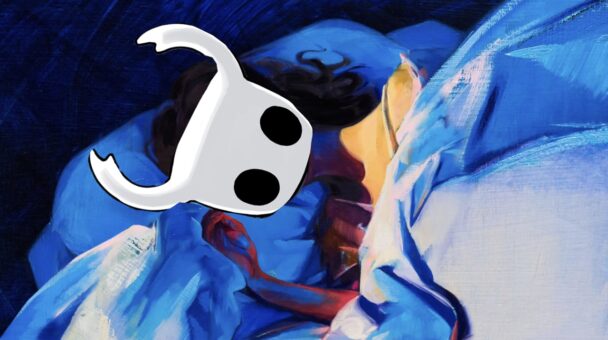
“Hollow Knight” is an indie Metroidvania video game which takes place in the once-proud kingdom of Hallownest. Hallownest has been brought to its knees by the Infection, a plague spread by the primordial deity known as the Radiance. In efforts to curb the proliferation of the Infection, the patron deity of Hallownest, known as the Pale King, created the Pure Vessel—a hollow creature in the form of a knight, devoid of a sense of self—designed to absorb and ultimately contain all infection. However, this plan fails, as the Pure Vessel is not truly hollow and begins to crack and weaken, only partially able to quell the Infection. The player-controlled character known as The Knight explores Hallownest, only to discover that as a result of the failures of the Pale King, the vast majority of the bugs (citizens) of the kingdom have been completely wiped out or else consumed by infection, persisting as mindless husks which attack The Knight on sight. As the plot of “Hollow Knight” comes to a head, The Knight is revealed to be hollow, and thus must correct the failures of the Pure Vessel, forfeiting its existence in order to finish the Infection once and for all.
Lorde’s Pure Heroine is an album which depicts the struggles of teenagers finding individuality and contentment within themselves in the modern world. The song “Team” reflects the themes present throughout the album, and expands these notions to include the power of community: During these times, rigid societal standards are arbitrarily placed and enforced, and people begin to compare themselves to one another, which breeds resentment. It is essential to realize that “we’re on each other’s team,” and to form circles which support others. Lorde also points out that nothing can last forever; there is tremendous importance in accepting this and being able to reinvent oneself. Though the lyrics of “Team” share many motifs and similar subject matter of “Hollow Knight”, I believe it is the direct references and allusions that tie them together.
First, Lorde chronicles the return of the Knight to Hallownest: “Wait til you’re announced / We’ve not yet lost all our graces.” This tandem of lines captures the fading pulse of Hallownest, grasping at its last traces of sophistication, and evokes a sense of the changing of the guard. The time is nigh for the Knight to assume the mantle of ward of Hallownest. The diction of “the hounds will stay in chains” evokes the Knight as the guard dog whose being is enslaved by the Infection in order to liberate Hallownest.
Next, Lorde’s lyrics bring to mind several locations throughout Hallownest, starting with the affluent capital of the Hallownest, the City of Tears. I hear the extravagance and wealth of its inhabitants: “A hundred jewels on throats / A hundred jewels on teeth.” Moreover, her lyrics accurately recount how this aristocracy chose to cling to their materiality. Aptly named “gluttonous” and “envious,” these husks turned their backs on the rest of the kingdom in dire straits, believing they could ride out the course of infection shielded in the city. I next think of the Infected Crossroads, a central location to Hallownest. The line “Now bring my boys in / Their skin in craters like the moon” speaks to the husks who mindlessly amble through the crossroads, their skins erupted with pustules and boils of the Infection. The lines that fortifies my notion that the song is intimately connected to “Hollow Knight” are “Dancin’ around the lies we tell… / Even the comatose / They don’t dance and tell.” Husks by definition are comatose; they are unresponsive and merely exist unconsciously. Moreover, the husks dance around the lies they tell, as the City has become a husk, perished because of lies they told themselves out of greed. What follows is arguably one of the most important lines of “Team”: “The moon we love like a brother.” The diction of the moon stands out because the masks of all vessels (and the Pale King) resemble the moon in color and shape, and because their powers are derived from the moon. The diction of “brother” stands out because the Pure Vessel is an elder sibling to the Knight. The moon (Pure Vessel) is beloved because it shines as a beacon of hope, representing the ability to restore Hallownest.
Lorde continues with lines that evoke “Hollow Knight”: “We live in cities you’ll never see on screen / Not very pretty but we sure know how to run things.” I think of the City of Tears and Dirtmouth, the two major locales in the Hallownest. The City of Tears earns its name because of the hopes and dreams that were crushed by the Infection, the echoes of which still haunt the streets and because of the many dilapidated buildings. In the case of Dirtmouth, many of the houses are sealed from the inside in, and the town is referred to as “Dirtmouth, the Fading Town.” The lyrics “Livin’ in ruins of a palace within my dreams,” is about as 1:1 as it gets: Here is the White Palace, the ruined fortress where the Pale King dwelled, which one can only enter though the dream world by use of a maxed-out Dream Nail.
More on the White Palace: Lorde notes “The cups got broke / Shards beneath our feet,” which represents the palace workshop. The workshop is where many discarded attempts of vessels can be found. The lines “Everyone’s competing / For a love they won’t receive / ’Cause what this palace wants is release,” illustrate how the vessels each wanted the Pale King’s blessing, but he knew he could never give it, as they would fail in their quest to purge the Infection, and because all the Pale King wanted was to save his kingdom, not care for his children. Though the Pale King deflects blame—“It wasn’t my fault”—it is precisely because the Pure Vessel tried to please the King that made it un-hollow and ultimately a failure.
A question yet to be solved is the identity of Lorde; for me, she is the Pale King. This is seen through a litany of evidence: The second verse of “Team” is entirely dedicated to the Pale King’s desires and shortcomings pertaining to the creation of the vessels. “We’ve not yet lost all our graces” represents the patron of a fallen kingdom holding on to the last remnant of sophistication; the White Palace exists within “my” (the Pale King’s) dreams and is where his corpse is. The diction of “all of the ladies” and “my boys” is important because it was the Pale King who granted the bugs of Hallownest sapience. The Pale King states he is tired of being told to throw his hands up in surrender and recounts how it was long ago when he “reveled without a care.” Finally, “And you know, we’re on each other’s team,” could be the motto of the Pale King and the Knight, both fighting to scourge the Infection from Hallownest.
The Infection orchestrates the fall of Hallownest by capturing the minds of its citizens, and in the process blots out their senses of self. This serves as an excellent allegory for the modern world, where societal pressures and expectations can poison the authenticity of an individual, infect their mind, and make it difficult for them to live a life of their own. The Infection pushes Hallownest’s inhabitants to unite against it and fight for a common cause. This allegory exemplifies Lorde’s notion of being on the same team: It is necessary to realize the common goal of living freely and true in society and important to challenge the tyranny of illogical social constructs and forces. The mistakes that doomed Hallownest were made by a divine figure in the hopes of having his kingdom last forever, which illustrates two points: Everyone can make mistakes, and it is the response to a mistake that determines the ultimate outcome. Nothing can last forever. It’s therefore a necessity to expand upon oneself, and to grow in new, often unforeseen directions. Even the very reason why the Pure Vessel failed to judge its own immense responsibilities is reminiscent of the world today: Simply put, it’s hard to deal with all of one’s responsibilities and please others simultaneously. Moreover, who could have predicted that the fall of a mighty and deadly warrior like the Pure Vessel could be its attempt to please its father? The tandem message of “Hollow Knight” and “Team” reflects the need for growth, acceptance, and flexibility. These traits extend far beyond the world of Hallownest, to the broadest breadths of life itself.
Ryland Breen can be reached at rkbreen@wesleyan.edu.




Leave a Reply