
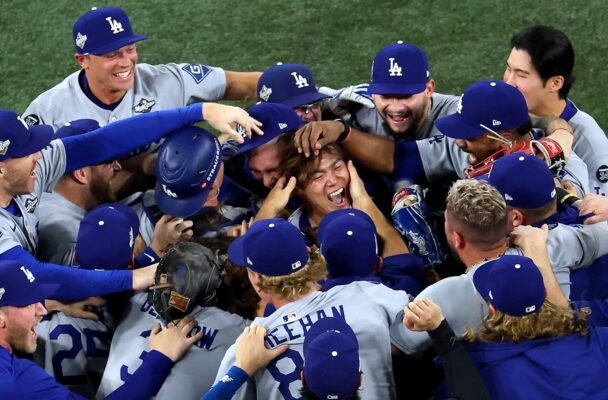
Los Angeles Dodgers Win Second-Straight World Series in a Fall Classic for the Ages
On Saturday, Nov. 1, the Los Angeles Dodgers won the World Series after a seven-game thriller, including an 18-inning Game 3 and an extra-inning spectacle in Game 7. This World Series marked the Dodgers’ ninth World Series win and second in a row, tying them for third in all-time championship wins.
The series concluded on Saturday in Toronto after an 11-inning nail-biter. The Blue Jays’ Bo Bichette struck first in the third inning with a 3-run home run off Shohei Ohtani. Bichette’s home run was joined by Andrés Giménez’s RBI double in the fourth. For the Dodgers, Teoscar Hernández and Tommy Edman hit a sacrifice fly in the third and sixth innings, respectively. Max Muncy and Miguel Rojas each had solo home runs in the eighth and ninth. Rojas’ home run tied up the game at 4–4 going into the bottom of the ninth. The Dodgers’ defense was able to ward off the Jays and the game was sent to extra innings. Will Smith, the catcher for Los Angeles, hit the first extra-inning home run, putting the Dodgers up at the top of the 11th inning. The Jays’ attack was then further thwarted by a double play from Mookie Betts to Freddie Freeman.
The Jays took the first game 11–4 in Toronto on Friday, Oct. 24, highlighted by a dominant sixth inning where they put nine runs on the board. The Dodgers battled back the next day, Oct. 25, to take Game 2 5–1 as they looked to build momentum returning to the City of Angels.
They did just that. Game 3 on Monday, Oct. 27, was an 18-inning defensive masterclass at Dodger Stadium. The game lasted 6 hours and 39 minutes, tying the longest game (by innings) in World Series history. The Dodgers are not strangers to the 18-inning World Series game after their 2018 World Series Game 3 against the Boston Red Sox, both of which ended in walk-offs in LA. In 2018, Max Muncy walked it off, but this time it was Freddie Freeman, one of the pillars of this Dodgers team and organization. The game used 19 pitchers total: LA with 10 and Toronto with 9. Ohtani set a postseason record, reaching base nine times.
Toronto did not back down. They came back on Tuesday, Oct. 28, and dominated the Dodgers in a 6–2 offense masterclass, seeing runs from Vladimir Guerrero Jr., Daulton Varsho, Ernie Clement, and Andrés Giménez. In the final game of the series in Los Angeles, the Jays were determined to go up before heading back to Toronto, and that’s exactly what they did. In another offensive show-out, the Jays won 6–1 and led the series 3–2 heading back home.
Yet for the Jays, this is where it all started to go downhill.
Toronto faced a vengeful Dodgers squad on Friday, Oct. 31, who forced a winner-takes-all game after a 3–1 win. On Halloween, the scariest thing the Jays were looking at was Shohei returning to pitch for Game 7.
And, well, we all know how Game 7 ended. The Dodgers won it 5–4 in Toronto and returned to the Redwood State as champions. The game averaged nearly 26 million U.S. viewers, the most-watched game since 2017. With declining viewership, big games like these have become increasingly important for the MLB to maintain relevancy.
This outcome wasn’t surprising or unexpected for baseball fans. The Dodgers organization spent nearly $500 million in the off-season trying to repeat their 2024 World Series victory, and they did exactly that.
In December 2023, Ohtani signed a record-breaking 10-year, $700 million deal with the Dodgers. The pitching and hitting superstar was a free agent after his contract with the Anaheim Angels expired earlier that year. Originally from Japanese professional team Hokkaido Nippon-Ham Fighters with which he played five seasons, he has quickly risen to dominance since coming to the States in late 2017. Playing six seasons with the Angels between 2018 and 2023, Ohtani became the face of baseball, and his trip across town has now earned him his second ring in as many seasons.
Later that December, the Dodgers added RHP Yoshinobu Yamamoto with a 12-year, $325 million deal. Yamamoto’s performance on the mound has rivaled the greats, as he became the first player since Randy Johnson in 2001 to win three games in the Fall Classic. For these efforts, he was the obvious winner of the World Series Most Valuable Player award. With him and Ohtani on the mound, even the best offenses faced a nearly impenetrable defense.
Their team is padded by other top-paid players including Tyler Glasnow ($32.5 million/year), Blake Snell ($26.8-28.4 million/year), Mookie Betts ($26.1 million/year), and Freddie Freeman ($22.7 million/year). These numbers put the Dodgers at the top of MLB spending in 2025, and although money can’t buy happiness, it can buy World Series victories.
Here is the problem with these Dodgers around: Nearly no one else has a chance. The Jays were a team made up of well-researched young talent, but the majority of MLB teams simply do not have the funds to support a payroll like what the Dodgers tout. And with the long contracts and pure dominance, there is no sign of the Dodgers slowing down.
Looking ahead to next season, the Dodgers look to become the first team since 2000 to three-peat the World Series. They’d join only the New York Yankees, most recently achieved between 1998 and 2000, and the Oakland Athletics, between 1972 and 1974, are the only franchises to win back-to-back-to-back championships.
As this off-season and free agency begins, the Dodgers may look to repeat their big off-season spending to secure a third World Series win. These players could include Chicago Cubs outfielder Kyle Tucker—arguably the number one free agent—San Diego Padres right-hander Dylan Cease, Jays’ shortstop Bo Bichette, or Houston Astros’ southpaw Framber Valdez, among others.
Regardless of whether the Dodgers add in their quest for a three-peat, their second-straight World Series win wraps up another entertaining year of baseball.
Leila Feldman can be reached at lfeldman01@wesleyan.edu.
Leave a Reply