
Traverse Square, Beloved Student-Run Program, Rolls Back After-School Services After JCCP Cuts
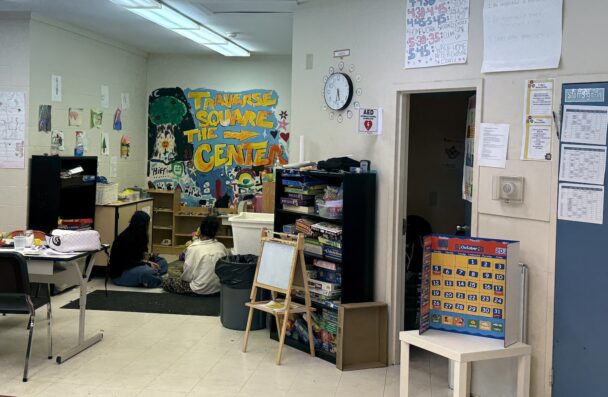
Traverse Square, also known as “the Center,” has long served as a vital link between the University and the broader Middletown community. Run entirely by Wesleyan students, the program provides free after-school care for children ages 4 to 17 living in the Traverse Square community, a section 8 housing development located just east of the University’s Low Rise housing. The Jewett Center for Community Partnerships (JCCP) has historically funded the work-study positions of dozens of Traverse Square student staff members; in the wake of a budget reckoning that forced the JCCP to make sweeping cuts to affiliated student organizations, the program now faces significant setbacks.
Over 75% of Traverse Square’s student staff members are on work-study; the JCCP budget cuts forced a large portion to leave the program to find employment elsewhere on campus. In the Spring 2025 semester, Traverse Square had 59 students on its staff, with 45 work-study employees; this semester, that number is down to 28, with only 13 on work-study.
Since 2001, Traverse Square has operated five days a week, providing children after-school services including one-on-one help with homework, facilitation of games, and a place to hang out after school. In conversations with The Argus, tutors, program coordinators, and parents argued that the JCCP cuts have damaged an invaluable partnership between Wesleyan and Middletown.
According to multiple sources familiar with the JCCP’s budget, Traverse Square could return to last year’s employment levels with a semesterly budget infusion of $17,000.
A Day at Traverse Square
“On a typical day, the students will get off the bus and come into Center,” Youth Advisor and former Program Coordinator Liana Lansigan ’26 said. “We have story time, then we pass out snacks, and students pair off one-to-one with a Wesleyan youth advisor of their choosing.”
Students work with Wesleyan youth advisors on homework, if they have any, and then spend the rest of the day playing games, creating art, and interacting with peers. The day ends with clean-up and a Closing Circle, where students and youth advisors give shout-outs to celebrate what a specific person accomplished that day or a notable moment. Then, the youth advisors walk their students home.
On Fridays, the program hosts educational field trips with the students, taking them to places including the Exley Science Center, local organizations such as the Middletown Racial Justice Coalition, and on-campus spaces including Psi Upsilon for arts and crafts and movie nights.
“A lot of times, it’s just about engaging with the kids in whatever activity they choose, whether it’s a game of tag or Connect 4,” Traverse Square Youth Advisor Ellie Powell ’28 said. “You always want to encourage the kids to use their time at the Center for homework help, but for the kids who are too young to have homework, a lot of the job is this kind of engagement through play.”
The impact of the program is felt beyond the staff. Parents in the Middletown community described how the advisors’ commitment goes far beyond structured programming.
“[The advisors] showed up on their days off,” Megan McElhone said, mother to three children under 18 who are enrolled in the program. “They showed up when Center wasn’t [in session]. They took turns buying me groceries. They took turns buying me stuff for the house because I couldn’t.”
McElhone shared how the advisors’ support extended to difficult times in her personal life.
“When I got cancer, they took turns cooking dinner,” she said. “They took my kids out on Friday nights because I couldn’t. These kids literally change lives, and they don’t even realize it.”
McElhone also shared how helpful the advisors were after her husband’s passing, when she was unable to leave her house.
“My kids didn’t miss a beat,” McElhone said. “My kids were out every single day. They were still laughing and having fun. My kids didn’t have to get all sad and depressed and hate everything, because these students made sure they didn’t.”
The Effect of JCCP Funding Cuts
The JCCP, which was created to serve as an on-campus hub for funding community-building initiatives between Middletown and the University, funded 45 work-study positions for Traverse Square staff in the Spring 2025 semester.
At the beginning of the academic year, student-run organizations associated with the JCCP, including Traverse Square, were informed that the work-study hours funded by the JCCP would be significantly decreased. Executive Director of the Allbritton Center for the Study of Public Life Khalilah Brown-Dean wrote that the “JCCP’s student employment expenditure significantly exceeded its budget,” and that the JCCP would be required to lower its expenditures on student organizations to balance its budget.
According to Traverse Square Coordinator Maya Nelson ’27, the JCCP informed the group that their weekly work-study hours would be cut in half at the start of the Fall 2025 semester.
Traverse Square is the biggest recipient of JCCP funding, receiving almost one-third of the JCCP’s total work-study hours, and a vast majority of its student staff members were on work study in Spring 2025. The cuts had a significant impact on the group’s staffing, Nelson said, decreasing its staff by more than 50% and significantly altering the program’s schedule and operations.
“We used to be open Monday through Friday, 4 to 6, but now we’re open Monday through Thursday, 4 to 5:45,” Lansigan said. “And on Fridays, we really sadly can only be open very occasionally, which means we can only do very occasional field trips. It’s really heartbreaking, and I’ve had conversations with our students about why this is happening. It’s so hard to explain to them why they have less this year. They notice that there are fewer adults working with them.”
Known for its individualized approach to tutoring, the program has also had to scale back operations in ways that the student tutors say compromise the program’s core mission. Instead of individual pairings, the students are placed into small groups led by fewer advisors.
“We really prioritize the one-on-one model, where the kids get our undivided attention, and I think it’s really beautiful…. Because teachers and parents are so busy attending to so many things, [but] we [would] have college students who have [two hours] to just dedicate to being fully present with our kids,” Lansigan said. “That one-on-one model has gone away, and now we’re more of an activity-based model, so kids are working in groups with their advisors. That [individual] choice has been taken away from them since we just don’t have enough hours.”
In addition, the reduced staffing capacity has raised concerns about safety and program quality.
“Reduced staffing capacity has definitely meant things like more incidents and less supervision,” Nelson said. “It also meant that we had to severely expedite and lessen our training requirements for tutors. It means that administrative work, things with emergency contact forms, had to be severely cut because we can’t get paid for a lot of the administrative work that we do. I’m [also] just terrified of the idea that there might be an incident because kids are not being properly supervised.”
Community and Student Impact
Parents have seen firsthand the profound success of the program, expressing the need for continued funding to extend the program’s impact.
“By taking that funding away, you’re taking that away from our kids, too,” McElhone said, noting that the program is their sole source of educational advancement beyond school. “You’re taking it away from these kids who don’t get to leave Traverse Square.”
For Lansigan, these changes have been personally challenging. After serving as a coordinator since Spring 2024, she was one of three coordinators forced to step down this semester due to limited hours from the JCCP.
“As of the beginning of this month, I am no longer a Traverse Square coordinator,” she said. “I now work as a youth advisor and for Bon Appétit to make up for the hours I’m not working at Traverse. I’m really frustrated that the JCCP forced me into this transition, but I am happy that I can support my Traverse kids, even if it is in a different role than I was expecting.”
Some coordinators expressed concern that the University, which first informed the JCCP of the need to decrease expenditures on student organizations, did not understand the full extent of the JCCP’s impact on the community surrounding Wesleyan.
“I do think that there is a fundamental lack of [administrative] understanding about what it is that the JCCP does,” Nelson said.
Student Activism and Beyond
Wesleyan United Student/Labor Action Coalition member Luca D’Agruma ’27, who has led cross-organization efforts to reinstate JCCP funding through the nascent “Stop the JCCP Cuts” movement, argued that cuts to organizations like Traverse Square would have a far larger negative impact on Middletown than on Wesleyan students.
“The largest JCCP groups with the deepest roots in Middletown face the biggest cuts, disproportionately impacting Middletown community members,” D’Agruma said.
Nevertheless, Traverse Square coordinators expressed hope that, despite the setbacks in funding and staffing, the program could continue and improve in the future.
“I know a lot of people are working tirelessly to fight these changes,” Lansigan said. “I think a lot of good can come out of this, and rallying around how important and special these community connections are to [us] has been beautiful, and I hope to continue to do that.”
She emphasized that even before the JCCP funding cuts, the team had been working to secure sustainable support by finding a community partner to help run the program. Lansigan emphasized the need for a community partner to spearhead the program’s operations and stabilize the workload for the coordinators.
“We just need [a community partner],” Lansigan said. “I mean, we’re just college students. We are trying our best. We’re working closely with the JCCP to find funding and find a person or organization to help us run this program so it’s more sustainable for everyone. That’s our big next step.”
Lyah Muktavaram can be reached at lmuktavaram@wesleyan.edu.
Miles Pinsof-Berlowitz can be reached at mpinsofberlo@wesleyan.edu.
Janhavi Munde contributed to reporting.

Leave a Reply