
Singing on Sundays: Song Circle Brings Together Students, Faculty, and the Middletown Community
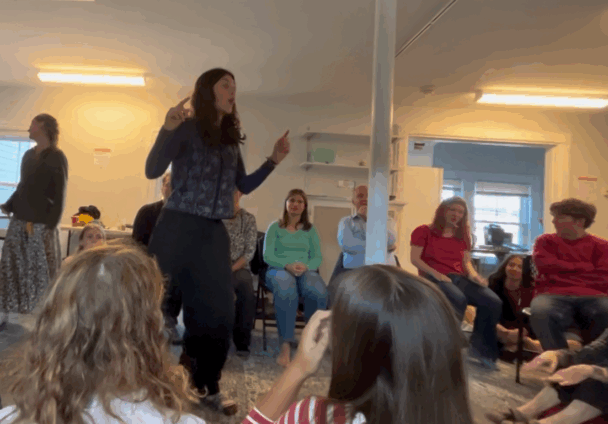
A few weeks ago, while doing homework one Sunday afternoon, a friend pulled me away from my assignments to accompany her to the second floor of the Office of Religious and Spiritual Life. She told me we were going to the “Song Circle.” I was quite confused, admittedly, but as someone who loves music and to sing, I was also quite excited. I entered the room, where I was offered a cup of tea and instructed to take off my shoes and find a seat on the couch or one of the many plush floor cushions. What followed was one incredibly joyful hour of singing in rounds, harmonies, and in unison, all led by Lilia Yorkhall ’28.
I left the session feeling lighter than I had in weeks, revitalized and so excited to return the following week. After the first song circle, I suddenly found myself singing the songs under my breath in the shower, doing homework, or walking across campus.
The people I met at the song circle had nothing but wonderful things to say about it; some of them have been attending every week since the first meeting.
“Not a day goes by that I don’t think about this and smile,” Chris Record ’29 said.
Yorkhill said she was first introduced to song circles growing up in Minneapolis and began attending them with her family five years ago. She described the vibrant community in her city that connects through song in this call and response style. Song circles have taken over the Midwest largely thanks to Liz Rog, a folk song leader from Decorah, Iowa who pioneered the movement to teach others how to lead song circles. Song leaders from other states as far as the West Coast have traveled to Minneapolis and engaged in the song circles there, and the practice continues to spread (even all the way to Middletown, Connecticut).
Yorkhill has a specific method for curating each session’s songs. “In every song circle…I bring a couple old ones [and] a couple new ones, so that there’s some familiarity and some new material,” she said.
She teaches songs from her song circle back home but also mentioned how people are constantly writing new folk songs and sharing them with each other in the circles.
“[There’s] something really powerful about this movement,” she said. “People can carry these songs and teach them where they go and spread [song circles] to even more people.”
When applying to the University, Yorkhill knew she hoped to bring this practice and the sense of community it fosters to the school.
“[The song circle is] something that I’m carrying, and I have a responsibility to share,” Yorkhill shared.
Last year, Yorkhill invited friends to a Wednesday night song circle but eventually realized that she wanted a song circle with both Wesleyan students and Middletown residents.
“It’s such an awesome way to build community with people who you don’t necessarily share a very obvious thing in common with,” she said. “Wesleyan people, Middletown people, professors; there’s not a lot of spaces where we can all interact and connect, so I wanted to create that.”
Eventually, Yorkhill connected with Middletown residents through the Center for the Arts and got the song circle settled in the Office of Religious and Spiritual Life. Now, students are joined by other folks from Middletown in the song circle. This past Sunday, the song circle had even more energy, as some students’ parents joined in as part of their Family Weekend activities.
Another draw of the song circle is that amidst a culture of hyper-busy students and an urge to use all of one’s time in a productive manner, it provides a respite from the chaos.
“Singing circle is a place where people really drop any negativity,” Sasha Raskin ’28 said. “[They] leave at the door any tension or any stress or even schoolwork.”
Students make time for the song circle, making sure to attend even when they have pressing work for classes or extracurriculars.
“I haven’t missed a week because I know it makes me so happy, so even when I’m really stressed, I’m like, ‘No, this is something I have to prioritize because I know it’s gonna pay off in the long run,’” Miranda Factor ’29 said. “It’s a moment of rest. I don’t have to think about anything. I can just sing with people.”
The song circle is also a space that can ease people into the world of social justice.
“[It’s] a jumping-off point for change in the world,” Yorkhill said. “A place where people come and they feel in community, like they belong and that their work is important.”
Members described the song circle’s special ability to make hope and social justice accessible.
“Living within a lot of darkness and hearing so many things going on in the world that are just always bad, you hear a lot about the importance of maintaining hope, but there aren’t many spaces to facilitate that,” Raskin said.
It’s not just social justice that the song circle is an entry point for. This space can ease someone into the artistic and creative scene at the University by being a non-judgmental zone for engaging in music.
“It’s about being together in community, and singing…. The act of singing can move a lot in the body, and is a really awesome form of expression,” Yorkhill said. “Being in community and getting to share that experience with others and feel connected through the music that we’re creating creates a sense of belonging to this space, even for people who haven’t been coming every week. We don’t even have to talk.”
Sasha Chajet Wides can be reached at schajetwides@wesleyan.edu.



Leave a Reply