
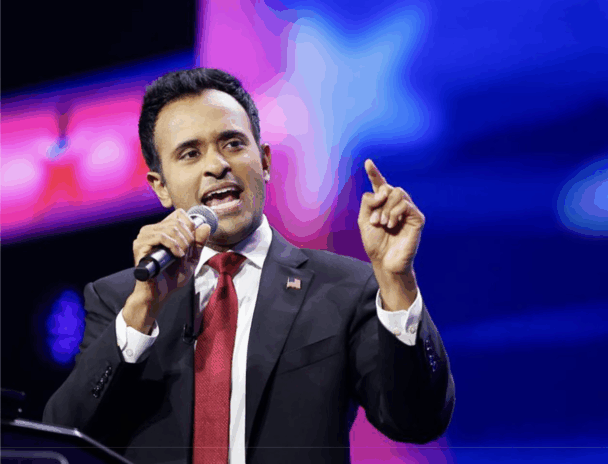
Dear Vivek Ramaswamy, Conservatives Will Never Fully Accept You
Vivek Ramaswamy. Former biotech entrepreneur, 2024 Republican presidential candidate, Ohio gubernatorial candidate, and, most recently, a speaker at a Turning Point USA rally.
Turning Point USA, an organization marked by its strong roots in right-wing identity politics, promotes a vision of patriotism that sometimes conflates “true American values” with Christianity, whiteness, and uncritical nationalism. This organization leaves little room for figures like Ramaswamy, an Indian American who practices Hinduism and whose faith and background represent a significant deviation from that constructed community. Despite consistently echoing the rhetoric and ideology of the modern Republican movement, Ramaswamy has struggled to garner the support of many of the people he seeks to represent.
A few weeks ago, Ramaswamy spoke at Montana State University as part of a Turning Point USA tour to honor Charlie Kirk. During his speech, he urged the audience to revive the nation’s core values: free speech, economic opportunity, meritocracy, and the promise of the American Dream. Afterwards, during a Q&A, the crowd heavily questioned his credibility in office due to his religion and ethnicity.
“How can you represent the constituents of Ohio, who are 64% Christian, if you are not a part of that faith?,” one student asked in particular. “If you are an Indian, a Hindu, coming from a different culture, a different religion than those who founded this country, those who grew this country, built this country, made this country the beautiful thing that it is today, what are you conserving? You are bringing change. I’ll be 100% honest with you—Christianity is the one truth.”
Ramaswamy received even more questions regarding his background, as members attempted to establish him as unfit to serve as an influential conservative figure in America.
“Isn’t Charlie Kirk’s organization founded on Christian values as well?” another student probed. “And isn’t America based on what Protestantism is and based on how those values are? Wouldn’t that contradict your beliefs?” Ramaswamy spent some time conversing with these students, attempting to justify Hinduism as a religion closely tied in values to Christianity, to which he then received a question regarding why he chooses to “masquerade as a Christian” despite still identifying as a Hindu.
These encounters reveal how figures like Ramaswamy constantly have to revalidate their belonging to fit the persistent religious and racial biases within conservative politics. His credentials as a successful biotech entrepreneur, former presidential candidate, and close ally of President Donald Trump still are not enough for the conservative movement to see him for more than his skin tone and religion. Throughout his political career, Ramaswamy has intentionally adopted every performative aspect of the MAGA identity, including maintaining a strong anti-immigration stance, vying for Americans to put God first, and being an outspoken critic of “woke” culture. However, even though he has made several attempts as such to signal ideological alignment, his failed assimilation is proof that conservatism’s gatekeeping depends not on loyalty, but rather on race and religion.
Ramaswamy is just one example of this paradox of inclusion on the American right. The conservative movement often celebrates their few minority individuals as proof that it has transcended prejudice, yet their acceptance remains conditional. The movement welcomes figures including Ramaswamy, Nikki Haley, Candace Owens, and Tim Scott as long as they affirm the myth of a colorblind America, but they are never welcomed as equals allowed to make their individual mark on the nation. They serve as the movement’s tokens of diversity so long as they do not challenge the core identity or values of the conservative movement. Ramaswamy’s experience, in particular, illustrates this double standard with striking clarity. His now-infamous “culture” tweet, initially meant to rally conservatives around shared values, was met with backlash from many prominent right-wing figures, such as Laura Loomer, Batya-Ungar Sargon, and Mike Cernovich, who accused him of misunderstanding American culture. The criticism, from influential voices within the very conservative movement Ramaswamy seeks to join, showed just how tenuous his acceptance truly is. The same movement that claims to defend the Constitution’s principles of freedom and pluralism is earnest to enforce a rigid persona of Christianity and whiteness within its circle. This contradiction exposes the modern right-wing movement as defined by its attempts to control who is allowed to claim the American identity, and on whose terms.
Ultimately, Ramaswamy’s struggles to ingrain himself entirely within the broader conservative realm are less about political perspective disagreements and more about identity boundaries. No amount of ideological conformity will ever be enough to bridge the gap between his background and the conservative image of an “authentic American.” His treatment by even his own Republican peers clearly exhibits how their vision of unity depends not just on shared ideals, but on shared identity. Ramaswamy’s political journey is a greater reflection of America’s ongoing struggle to reconcile its rhetoric of equality with its enduring hierarchies of belonging.
Shloka Bhattacharyya is a member of the class of 2028 and can be reached at sbhattachary@wesleyan.edu.





A classic example of sepoy syndrome. I wonder when he’ll figure out what the Republicans really think about him…