
Signs of Women’s Labor in Japan: A Student-Curated CEAS Exhibit
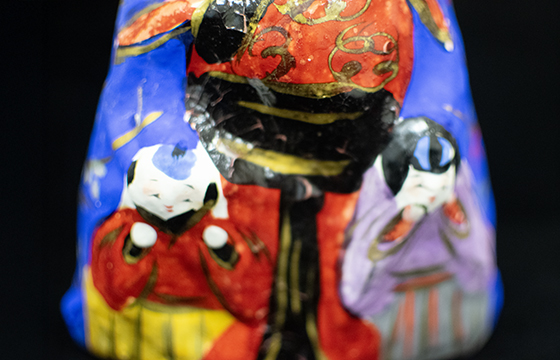
At the Mansfield Freeman Center for East Asian Studies, the exhibition “Forgotten but Once Known: Signs of Women’s Labor in Japan” is on display from Tuesday, Oct. 7 until Thursday, Dec. 4. The exhibition highlights the sphere of women’s labor in Japan both within and outside of the home through its collection of Japanese art from the College of East Asian Studies (CEAS) art and archival collection. The objects chosen are domestic objects as well as spiritual and cultural ones, and all hold a unique significance in Japanese daily life and culture. The exhibition sheds light on a sphere of labor that often goes unnoticed, a story that student curators Adrian Peoples ’26 and Chloe Duncan-Wald ’26 wanted to tell. Peoples spoke with The Argus, providing insight into the curatorial process and the historical significance of this exhibition.
Curating Within the CEAS
Peoples and Duncan-Wald curated art for the College of East Asian Studies as a part of the class Curatorial Practice and Exhibition Creation (CEAS 405). In the class, students are introduced to curatorial practices in art, working with the College of East Asian Studies Faculty, the Associate Director of Visual Arts, and the University’s Exhibition Manager.
“So I just found out about it when they sent an email to Art History majors, but it’s like, you apply to work with the curator of Zilkha here,” Peoples said. “You have to apply with an idea but you can change it later, pick a layout, pick the objects. We write a pamphlet to go with the exhibit. They give you dates and meet with you once every couple of weeks and give you feedback, but overall it’s very self run.”
Peoples, then, had a very self-directed experience of curating the exhibition, though still under the guidance of the faculty. Other years have focused on different themes present in East Asian art. For example, last year’s exhibition, titled “Exploding and Netting: A Somatic Archive of Transpacific Movement,” featured student art by Loren Yuehan Wang ’25, and another titled “Understanding China in the Age of the Unequal Treaties” focused on China and the Opium Wars. This wide range of focuses showcases the freedom that Peoples and Duncan-Wald had in curation and in getting to pick the pieces to showcase the intended theme of their exhibition.
This exhibition intentionally uses pieces from the College of East Asian Studies Arts and Archival collection rather than bringing in outside works, since Peoples described an interest in working specifically with what Wesleyan University already had in its collection. Furthermore, when asked about the curatorial process and how they picked the pieces and the story they wanted to tell, Peoples remarked that they were specifically interested in everyday objects that were found in the home, drawing focus to objects and art that are often overlooked.
“I think overall a lot of archeology and history is really based on really fancy things and what’s in elite burials,” Peoples said. “And so I wanted to work with more everyday objects, because I don’t think they are as written about, and I think they tell a lot more about what regular people [were] doing in their everyday life.”
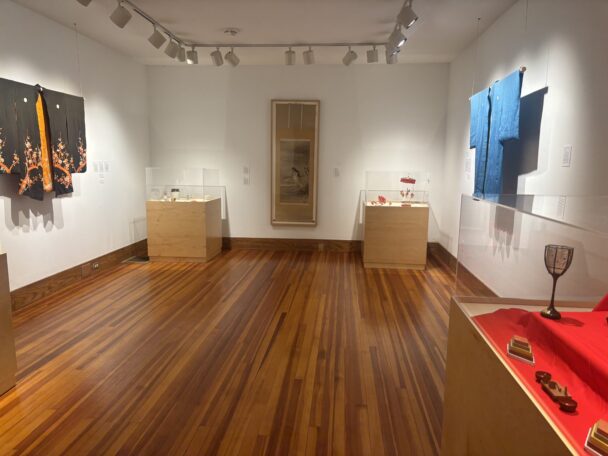
An Immersive Layout
When one enters the exhibit, although much of what they see are beautiful and adorned objects, they can also clearly view a representation of the everyday lives of women in Japan. When walking through the exhibition space, the display is split into four sections: clothing, cooking, child-rearing, and emotional labor. Some of the objects on display include a sekazuki (sake cups), chasen (bamboo whisk), a blue horai, Hinamatsuri dolls (Girl’s Day dolls), and Takamatsu Hariko toys. Peoples made it clear that the story told to the viewer is not meant to simplify the role of women in the household but is instead intended to highlight their importance and power within the home, where they raised the children, controlled expenses, and were respected for their work.
“I feel like there is always the assumption that women were subjugated in the house and were expected to do all this stuff,” Peoples said. “And I think, to an extent, they did have a lot of pressure and a lot of expectation on them. But I also think that, especially in the past, like the 1600s [and] 1700s, they also played an important role. They were expected to work in the home and do a lot of stuff, but they were also very powerful, and the home was their domain.”
This focus on the home would change soon after this era, with the advent of the Meiji Period in Japan (1868–1912), during which labor was transforming and women began to enter the workforce in factories. Further significant shifts would take place after World War I, when women started to be relegated solely to the home and child-rearing, a transition to a complete division of labor by gender in Japan. This exhibition holds space for these two ideas—that women were both subjegated within the home yet also held power and responsibility within that domain.
Although this period in time might feel far removed from many viewers who visit the space, Peoples argued that people can still feel a connection to the household items they encounter. In fact, the University has been holding tours for fourth graders to view the new exhibit. Peoples described the children finding connections between the objects and their own home lives, remarking that one child even connected the ladle on display in the exhibit to the ladle their mom uses at home to cook dinner.
Peoples invites the viewers into the space to learn about the lives of Japanese women within the home, discovering something new about Japanese culture and the crucial role women played in it. This exhibit successfully gets viewers to ponder the themes of cultural critique, gender roles, visual storytelling, and familial and social hierarchies.
Amelia Haas can be reached at ahaas01@wesleyan.edu.



Leave a Reply