
Writing Things the Way You Think Them: Why You Should Read Julie Hecht
A very sorry thing right now is that very few people seem to be reading Julie Hecht’s books. You’d think that somebody who has been called “the most reclusive and elusive American fiction writer living today,” with only two photos of her available online (both are in black and white and show her wearing sunglasses and surrounded by nature), would at the very least spark some kind of interest among today’s image-obsessed populace. Clearly this hasn’t happened, but if any interest were sparked, that populace would immediately realize how unusual and daring Hecht’s writing really is.
To start, Hecht may be the funniest living writer I have ever read; she has the unique ability to pack swaths of jokes into each and every paragraph of her writing. In her story “Over There” from the collection “Happy Trails to You,” she wrote, “My neighbor was lucky that her cataract surgery had been successful. Many old people are not so lucky. She could be even luckier if she’d get a hearing aid. But I wasn’t going to tell her that. Even if I had, she wouldn’t have been able to hear me.” Each and every sentence is impressively focused on both getting to the punchline and amplifying it a step further.
More interestingly, in Hecht’s only written interview to be found online, she said: “[My editor] read me a sentence from one of my stories and said, ‘Are you telling me you didn’t try to make that funny?’ And I said, ‘No. That’s just how it occurred to me. I just write things the way I think of them.’” In this interview, she also described the ways she thinks that society has been failing as of late, including (but not limited to) a lack of carpenters willing to build bookshelves, people using the word process when talking about a writer’s writing habits, loud music in stores, a lack of editing in publishing, and much more. These complaints only add to an ever-growing list of grievances in her stories, including a hatred for ice cubes, articles of clothing with visible brand names on them, and New York City subways.
Her stories are always semi-autobiographical and in the first person, following the exploits of a photographer named Isabelle. Isabelle befriends a surgeon, the surgeon’s son, a young man in Austin trying to interview her, chefs at a restaurant she works at, and various other neighbors she runs into as she tries her best to get through the day. Despite her hatred of so much, Isabelle is endlessly curious about the people in her world and is quick to learn more about them. In the end, a cacophony of different voices represent idols, enemies, and so much more in Isabelle’s life.
Hecht tries to write about what it means to live as a person in this world while keeping your sense of humor intact.
In Hecht’s story “The Thrill is Gone” from her collection “Do The Windows Open?” she said, “I felt myself to be a wastrel and my life to have been wasted. My adult life, anyway. In my childhood, I might have worked harder and been more worthwhile. Certainly, I looked better and was cuter.” She ended “The World of Ideas” in the same book by saying, “Maybe that was the time of the world of ideas. But this was a new world. What kind of world was it? It was some other kind of world, and there was no escape.”
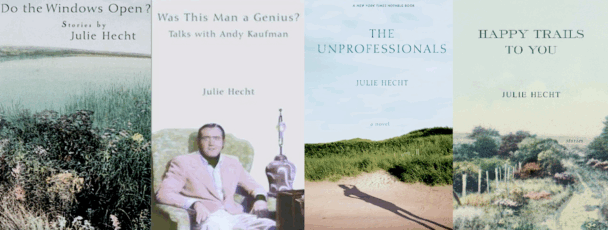
Julie Hecht is one of those rare authors whose books can actually be judged by their covers. Each cover is a mix of blues and greens with a distinct font and an emphasis on natural surroundings. Even her only official non-fiction book, whose cover shows Andy Kaufman sitting in a chair, attempts to make him and the objects around him as nature-adjacent as possible (the back wall looks similar to the sky). These covers perfectly convey the pleasures of reading one of Hecht’s works.
To dive into Hecht’s world, you should read her books in order of publication. The books themselves are only collections of standalone stories—except for her novel “The Unprofessionals,” which is really more of a novel told in stories—but I have found that these stories are best read in order so that by the end you can almost predict Isabelle’s reaction to a particular topic. Fans of the comedian Andy Kaufman will love that he gets the classic Hecht treatment for a whole 192 pages (her longest story focused on a single person yet) in her book “Was This Man a Genius?”
In the spirit of Julie Hecht’s signature brevity, I will end this review by simply saying that it’s sad that her last book was published in 2008, because I think the world needs Julie Hecht now more than ever. We are in dire need of writers who seriously care.
Henry Kaplan can be reached at hrkaplan@wesleyan.edu.





Leave a Reply