
ReUser Shutters, University Spends $52k on Disposables as Summerfields Reverts to Single-Use Takeout Containers
This May, the reusable packaging business reUser shut down, shuttering its distinctive Eco To-Go program at Usdan and Summerfields. reUser, launched in 2021 by James Wilson ’17 and Luke Lira ’17, helped dining services save on packaging costs and reduce the environmental impact of single-use takeout.
Eco To-Go containers were initially integrated in 2009 and then discontinued in the Fall 2020 semester when the University began using disposable containers due to the COVID-19 pandemic. They were reintroduced in the Summerfields Dining Hall at the beginning of the Spring 2022 semester.
To operate the system, students could access Eco To-Go containers through the reUser app, which was used to check out and return containers by scanning a QR code at the dining location. Containers were washed once checked back in. The app incentivized the return of the containers by providing students with digital tokens every time they returned a box. Students were required to use 7.5 tokens (the equivalent cost in meal plan points) to check out a container and would receive those tokens when they returned the container.
Wilson and Lira collaborated with dining teams to determine challenges with preexisting takeout systems and designed an app to reimagine and streamline the process of takeout packaging. According to his LinkedIn, Wilson raised over $100,000 for the project. The University served as one of four college pilot programs.
Wilson could not be reached for comment at the time of publication.
The reUser program had proved to be highly successful at reducing takeout waste before it shuttered.
“With reUser, we’d seen a 98% container return rate,” Sustainability Director Jennifer Kleindienst said. “There wasn’t enough time to decide on a suitable replacement and get WSA [Wesleyan Student Association] feedback before implementing something new at the start of the school year.”
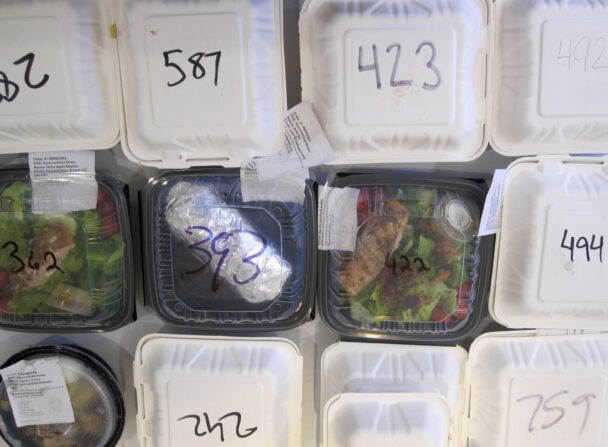
There are currently two varieties of to-go boxes at Summerfields: compostable paper and recyclable plastic. The major downside of this solution is the lack of composting and recycling options available near the dining hall.
“Luckily, we have some here [in Summerfields], but there aren’t any outside by the dorms,” Bon Appétit Dining Manager Michelle Wright said.
Wright has observed that the lack of nearby compost and recycling bins disincentivizes students from disposing of the takeout boxes sustainably, with a majority ending up in the courtyard trash bins.
While the current system is temporary, Wright hopes to see it become more eco-friendly until the new takeout system is implemented. Takeout cutlery, for instance, remains non-recyclable.
“I would like to see more compostable containers, more things made from bamboo,” Wright said.
Environmental Fellows Coordinator Lucy Schwalbe ’26 highlighted the potential risk of students disposing of the reusable containers.
“I think reUser was a step in the right direction of helping Wesleyan achieve its long-term zero-waste goals, but purchasing reusable containers is only sustainable if they’re being effectively and successfully reused,” Schwalbe said. “Otherwise, we’re still contributing to the waste stream by having to replace them.”
Kleindienst indicated that a new reusable takeout system, Alma, is being considered by the University. Schwalbe, Kleindienst, and collaborators at the Wesleyan Sustainability Office are currently working with Wesleyan Dining and the Post-Landfill Action Network, a third-party consulting company that helps college campuses reach their zero-waste goals, to integrate Alma containers into the dining system.
Alma containers would be made of stainless steel and have silicone lids. The University’s internal communications indicated that the new container material would not only make the dishwashing process easier but would also eliminate health concerns associated with heating plastic to the high temperatures required for dish sanitization.
According to data provided by the Wesleyan Sustainability Office, the University spent $51,946.86 on 272,840 disposable to-go containers in the 2024–25 academic year. If those containers were substituted by Alma containers, the number of containers needed to meet student demand would decrease to just 9,744 and cost the University a one-time investment of $25,624.64 plus just under $600 per year in maintenance costs: a clear financial benefit.
Like reUser, the proposed system would use QR codes to check containers in and out, and students who didn’t return the containers would be fined.
Though the proposal still needs to be finalized and approved, the Sustainability Office aims to have reusable containers back in dining halls before the semester ends.
Aarushi Bahadur can be reached at abahadur@wesleyan.edu.



Leave a Reply