
Player of the Week: Mathis Blanc ’26 Talks Goalkeeper Mentality, Choosing the Cardinals, and Taking It All In
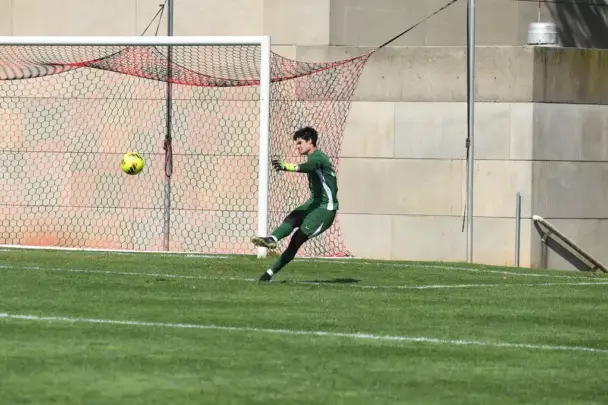
In Player of the Week, our goal is to highlight outstanding Wesleyan athletes that deserve extra attention.
Mathis Blanc ’26 is a math and physics double major from Mountain View, Calif. The starting goalie for the Wesleyan men’s soccer team, Blanc has led them to a second place standing in the NESCAC, as of publication. Blanc paces the entire NESCAC with 27 saves on the season. On Sunday, Sept. 28 against No. 7 Middlebury, he put on a show, posting a career-high eight saves in a 1–0 shutout win against the Panthers. For his performance, Blanc earned the NESCAC Player of the Week award, the first of his career. The Argus sat down with Blanc to discuss his accomplishments, the responsibility of his position, and the crossover between athletic leadership and academics.
The Argus: Can you introduce yourself?
Mathis Blanc: My name is Mathis Blanc. I am from Mountain View, California. I’m a senior this year. I’m a goalkeeper on the [soccer] team, and I’m a math and physics double major.
A: When did you first start playing soccer?
MB: I first started playing soccer when I was five years old. My family [had] moved out to Singapore, where the main sport was soccer. Because here: basketball, football, baseball. So when I went to Singapore, at recess everyone was playing soccer, and I hopped in and fell in love with the sport.
A: Do you have a favorite soccer memory? A time when you fell in love with the game?
MB: I remember as a kid my dad signed me up for the wrong age group for club, and so I played up with guys who were two years older than me, and they put me in goal. And for some reason in my head, I was like, “This is it. This is what I want to do.” I love being in goal, diving around for the ball. And I just remember they were like 10 yards away, shooting as hard as they could. I was just diving around, really enjoying it. I was like, “That’s my sport.”
A: When did you focus in on being a goalie?
MB: I started when I was seven, two years in. Before that, I was a left winger, not a good one, but a left winger. And then I had a goalkeeper coach when I was eight. That just made me fall with the sport, and he was a great guy.
A: What’s your favorite part about the position and what is the hardest part?
MB: My favorite part is a save you get to make as a goalkeeper. [You’re] able to be on that field and [to be] a leader as well, because you play 90 minutes. Others may not always play the full game, [but] you’re constant in that back line, and people depend on you. That’s the sense of responsibility I really enjoyed. And it’s something I really had to grow into my four years here. I guess that’s also the hardest part of it, where the mentality is if I make one mistake, it will be a lot more emphasized than a mistake anywhere else on the pitch. So figuring out how to deal with everything else around you and still playing the game is very hard, but when you get it right, it’s really great.
A: How has that kind of responsibility and leadership affected you in other parts of your life?
MB: When I do research in the physics department, for example, and I’m working with groups, [I enjoy] being able to just talk to people. It’s not “I’m a leader in this scenario.” It’s “How can you work with people and draw the best out of everyone around you?” And you don’t have to be a leader to do that. You can just talk and listen to people. And that’s also why I love playing a team sport. Everyone on our team plays a massive role. No matter where they are on the field, where they are on the bench, they play a massive role: day in, day out. Finding a way to have everyone shine translates into what I do— whether it’s in the physics department, math department, [or] my everyday life.
A: When did you start considering playing soccer in college?
MB: Funny story, when I was in high school, I had this idea in my head that I [wanted] to go pro. And then a few years happened, [and] I was like, “Maybe I should go to college.” And so I started really doing recruiting when I was a sophomore. It was particularly difficult for me [because] the recruiting period I was applying [was] during COVID. Back in California, we started up games a lot later than the rest. So while other college coaches [came] out to games, whether it be on the East Coast or [in the] Midwest, California didn’t have games, so I couldn’t even send film. But that’s more or less when I started thinking about it—my sophomore year.
A: Coming from California to Connecticut is a big move. What stuck out about Wes that made it the place for you to continue your career?
MB: I knew about Wesleyan because it was a Little Ivy. I knew that we had a good physics program and a good math program here and that I would be very well supported in what I wanted to do. And then when it comes to athletics, you can’t do better than NESCAC. I had D-I offers here and there, but not from schools I wanted to go to academically. And so I knew that the NESCAC, even though it was D-III, you compete at the highest level in D-III. When I spoke with the coaches, they were very upfront with me, saying that they never had seen me play, but they took a chance on me. And it was obvious to me in a 30 minute conversation with them, that they had massive ambition, and they wanted to do things the right way, go to the very top. And that ambition, that purpose, is really why I wanted to be a part of this project.
A: Was there a moment early on in your career here that solidified your love for this program?
MB: When I first got here before preseason, we gathered for a day or two with the team to get to know each other. When I got there, I didn’t know anyone, but by the end of those two days, every single person was like a brother. That was the best thing about it. [Then] I actually forgot my gloves and my boots for preseason. So I was stressing, and then I had a guy I’d never met before go, “Don’t worry, I got you.” [He] lent me pair of shoes to play in. Soccer is like music, right? A universal language. [It] doesn’t matter if you don’t know the person, you get to know him really well on the pitch.
A: Pivoting to your senior year, what were your personal hopes going into this year? What were your hopes for the team?
MB: [It’s a] massive year for the seniors. I came [into] my freshman year wanting to enjoy it. I came [into] my sophomore year wanting to enjoy it. And my senior year, I’m looking around and taking it in. Every time you walk out on that field, you take it for granted a little bit. And so now, [I’m] just soaking up the crowd, absorbing every emotion whether positive or negative. There’s gonna be some negative points, and there have been, but [I’m] soaking it in and understanding that that’s part of the process. Team-wise, every year we say we want to win NESCACs and do very well in the NCAAs. This year, we have a lot of freshmen, and they’re a phenomenal group, great players. So as the six seniors and the whole leadership group together, [we’re] finding ways to pass on the experience that we have and use their exuberance, their talent, and make the best of it. Earlier on this season, it was a bit harder to find that balance, but now we are really finding that stride, that rhythm. And that’s now the goal of the team, like, to win NESCAC, there’s a very good possibility. And from there, we have the talent [and] ability to win nationals.
A: How does the team build chemistry and incorporate the first-years?
MB: Most of it happens off the pitch. We spend so much time together that it becomes second nature. A lot of us get to the team a bit apprehensive, a bit shy. Then as soon as preseason goes, and you’re just spending time with everyone, getting to know them really well, you flow into it. Those bus trips as well. This past weekend, we spent 15 hours on the bus. When you stay in a hotel and you have a roommate, you’re just up till 2am talking, and you’re like, “Bro, we got a game the next day.” We love each other—that’s it.
A: On September 28 against Middlebury, you notched a career-high eight saves in a 1–0 nailbiter, and you got NESCAC Player of the Week for the performance. How does it feel to be recognized with an award like that?
MB: I remember my freshman year when the goalkeeper here got [the award], Liam Devanny [’23]—he was ridiculously good. Cool. And so seeing him do that, [now I was] just walking around my house, erupting with laughter, like, I can’t believe I did it. Just joy for it, enjoying it. But really, I would not have gotten this award at all without the team that we have: Londy [Aiden Londergan ’27] scoring that goal, Joshwin [Jennings ’27] having I don’t know how many blocks that I [didn’t] have to make a save on, […] [Zach] Feldman [’27] and [Dylan] Clack [’27] [filling] up everything in the middle, all the energy we got off the bench, from the whole way we approached it to my roommate talking late at night. Those are the times that build into that game. The recognition is great for sure, but, for me, moving forward, my task is to not make this the highlight of the season. There’s a lot better things to come, and that’s what I’m most excited for with the whole team.
A: Finally, if you could give your first-year self a piece of advice for succeeding at Wesleyan, what would it be?
MB: It’s funny because saying something and living [it] are two very different things. Freshman year, I knew all the sayings: Don’t pay attention too much to what’s around you, just focus on yourself and things like that. But it really took four years for me to truly understand the depth of those words, and I’m still understanding right now. So if I had to tell him something, it’d be enjoy it for what it is. Don’t get ahead of yourself, don’t get down on yourself because of what happened. The past and future will have to take care of [themselves]. Just live here, cherish what you do. We’re very lucky to be in this position, to be at a great university, on a great team joined by great people. Take it in.
Ethan Lee can be reached at ejlee@wesleyan.edu.

Leave a Reply