
In Attempting to Silence Kimmel, Trump Grinds Away at Pillars of Free Expression
The First Amendment grants us the rights to freedom of speech and freedom of the press. But to what extent are these rights truly provided to us?
Recently, the debate about what constitutes speech without consequence has captivated the nation. Hypocritical rhetoric from both sides has only further fueled the ardent flames of political polarization, with constant finger-pointing and failure to take accountability. Surely though, people cannot expect to perpetrate harmful messages and get away entirely unscathed. Even if the First Amendment shields such speech from government censorship, it does not protect against social sanctions. So, how do we know where to draw the line?
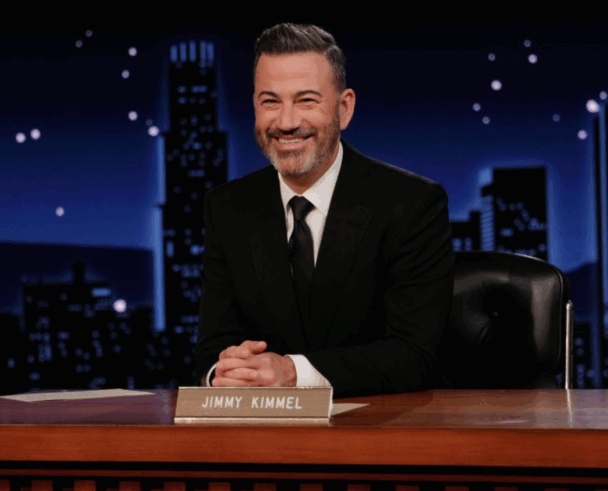
Let’s consider the case of late-night talk show host Jimmy Kimmel. Two weeks ago, the American Broadcasting Company (ABC) suspended Kimmel indefinitely for his comments surrounding Charlie Kirk’s assassination. ABC then reversed this decision because of immense pushback and brought Kimmel back on air last week. Most recently, President Donald Trump has implied that he will sue ABC for allowing Kimmel’s return.
But was what Kimmel said truly so controversial that it should have nearly cost him his career? In the last episode of his show before he was suspended, Kimmel insinuated that many members of the Trump administration, along with their followers, were refusing to consider the possibility that Kirk’s alleged shooter, Tyler Robinson, was perhaps not as left-leaning as they wanted to believe.
“We hit some new lows over the weekend with the MAGA gang desperately trying to characterize this kid who murdered Charlie Kirk as anything other than one of them and doing everything they can to score political points from it,” Kimmel said. While this may be a contentious viewpoint, it should not be defined as speech worth losing a career over. The dispute over Kimmel’s comments highlights a larger pattern, however: that speech challenging authority is often met with suppression rather than open debate.
It cannot be ignored that the Trump administration has taken a unique position on reprimanding speech that it views as critical of it, particularly those critical of Trump himself. He has continued to chastise individuals and media corporations that paint his actions and words in a perceived negative light, regardless of whether the reports are fact or opinion. From the administration being one of the first in decades to control the White House press pool to Trump filing several frivolous lawsuits against media outlets and making threats to revoke the broadcast licenses of networks that have portrayed him poorly, the actions of the party that has so righteously claimed that they are against cancel culture fail to live up to their own words.
The government’s choice to censor only what they do not like to hear directly goes against the purpose of the First Amendment. Texas Senator Ted Cruz recently spoke about the implications of the cancellation of Jimmy Kimmel on his podcast and how he believes it will affect liberals and conservatives alike.
“If the government gets in the business of saying—‘We don’t like what you, the media, have said; we’re going to ban you from the airwaves if you don’t say what we like’—that will end up bad for conservatives,” Cruz said. “They will silence us. They will use this power, and they will use it ruthlessly.”
Allowing subjective judgments of what the definition of hate speech is to be politicized will undoubtedly have great repercussions. The sheer volume of censorship within the past year alone has been alarming and is actively contributing to the erosion of democratic norms. If left relatively unchecked, such practices risk blurring the line between holding individuals accountable and outright suppressing dissent, weakening the very foundations of open discourse in America.
The truth is, it is not up to us to control what people can and cannot say. Freedom of speech protects our right to express ourselves entirely. Still, it would be naïve to think that somebody could say anything they want without facing some sort of repercussions. While freedom of expression is certainly a human right, protection against discrimination is as well. Someone presenting their controversial opinion that other people may disagree with and get upset over is not a form of discrimination; someone who voices a clearly hateful statement that undermines others’ well-being and contributes to a hostile climate is engaging in harmful speech.
Speech that leads to imminent, lawless violence or hostility is where constitutional protections stop, and individuals who choose to promote this sort of speech should be held accountable. Nevertheless, it is still crucial for us to be able to acknowledge that the former voicing of controversial opinions, however distressing it may be, is necessary to evoke change in society. Reform has never occurred by shutting people down, but instead by choosing to have those difficult conversations that challenge our perspectives. Rather than resorting to censorship and violence, we must choose to open our ears, especially when it is hardest.
This commitment to dialogue becomes even more urgent when we remember how fragile free expression has become today. That is precisely why it is so troubling to see those in power claim to defend free expression while working to silence it in practice. In a time when freedom of speech is being threatened so gravely, our ability to critically analyze situations around us is pertinent to maintaining a degree of individuality of thought. With America’s current political state as divided as it is, we must all be capable of recognizing nuance.
The Founding Fathers were insistent on adding the First Amendment because they refused to be under an authoritarian system where everybody was forced to think the same. Our unalienable right to express what we think and feel must be asserted wholly, without the government having a say in what ideas we are allowed to hold. As George Orwell warned in his novel “1984,” “If all others accepted the lie which the Party imposed—if all records told the same tale—then the lie passed into history and became truth.”
Ultimately, the strength of our democracy depends not on silencing the voices we disagree with, but on safeguarding the principles of free speech, accountability, and critical thought that the First Amendment sought to protect.
Shloka Bhattacharyya is a member of the class of 2028 and can be reached at sbhattachary@wesleyan.edu.



Leave a Reply