
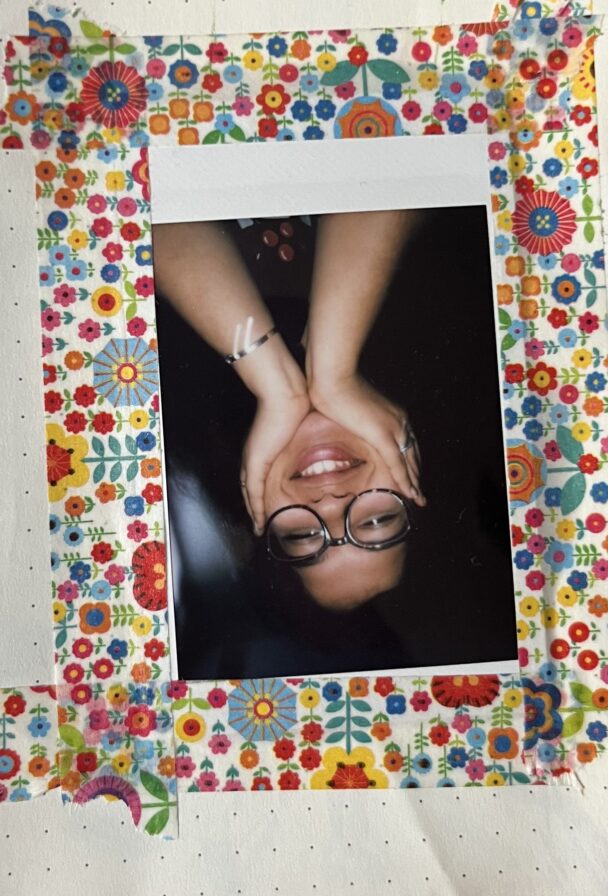
WesCeleb: Annie Hedgepeth ’26 on Farming, Finding the Sublime, and Enjoying Things Earnestly
If you take a short stroll around campus with Annie Hedgepeth ’26, you’ll notice that she has many people to greet, hug, and remind about the Co-op form. Hedgepeth is the financial manager of Long Lane Farm, the leader of Wesleyan Local Co-op, a member of the art history majors committee, and a woman about town. This week, The Argus sat down with Hedgepeth to ask her about the art she loves, the reason she farms, and her most controversial opinions.
The Argus: Why do you think you were nominated for WesCeleb?
Annie Hedgepeth: I think I’m often around campus. I’m often doing things. I feel as though I know people around town.
A: What kinds of things are you involved in?
AH: I’m heavily, heavily involved in [Long Lane Farm]. I’m the financial manager of the farm, so I spend at least around 20 hours a week doing that. I also do [Wesleyan Local Co-op]. And then I’m working at the Pruzan [Art Center], which I adore. We just got great tote bags.
A: What drew you to the farm?
AH: I started going to the farm literally the first weekend [of] freshman year. I’ve always had an interest in farming, and I volunteered on an urban farm in D.C., City Blossoms, doing off-season work. And, funnily enough, I was in a book growing up that my mom wrote called “We Grew It, Let’s Eat It!” It was semi-true; it’s about two girls, Annie and Veda [my twin sister], and [their] dream of wanting to have a garden. My mom and her high school English teacher [also] had a plot in a community garden, and we worked on this little plot. We had lettuce and squash and all these raspberry plants. It was great.
A: What has it been like to work on Long Lane for all four years of college? What are some of the challenges of essentially running a farm?
AH: I love the farm. I think it will forever be the greatest thing I’ve done. I met my two best friends, Michael Minars ’25 and Giovanna Vitale ’25, working on the farm. One of the hard things, though, is just that there aren’t enough hours in the day; I’ve summer-farmed for the class three summers, and when you do something 40 hours a week, there’s so much more that you can actually do. There are just not enough hours in the day, and if I could spend all my time farming, I would, but I can’t. I would love [my own] farm: a gorgeous little homestead plot of land, ideally, about an acre, a market garden. That’s my dream.
A: Why is farming important to you?
AH: I think people are so disconnected from so many of the things that they do in their everyday lives. And my favorite thing about the farm is that I just find it deeply satisfying that you can do something from cradle to grave. I also really like the fact that we grow food for the school and for the people of Middletown. And we grow a lot of crops that other farmers don’t grow, like collard greens and okra. It’s just really special.
A: What drew you to the art history major?
AH: It’s funny, actually. I took an art history class in high school, and I failed the exam. But I always really liked the class itself. I liked the stories. I think it’s this point of analysis that I really appreciate compared to history, because there’s an aesthetic devaluation of something because it’s not, like, a court document that’s signed, sealed, delivered. But the way that people create, make, and construct, I think, is all informed by the ways that they are living, thinking, acting, breathing, and feeling, and it is this deep window into someone else’s mind in this fun way. But also, I love the stories. My first art history class at Wesleyan was with [Associate Professor of Art History] Nadja Aksamija: [“Art and Culture of the Italian Baroque”] (ARHA233). It was just this magical class, especially because the Baroque is so captivating, dramatic, sensual, theatrical; it’s like emotion, turned all the way up. And she would just tell you these stories, and it would just change your day.
A: What’s your favorite class you’ve taken at Wesleyan, in art history or otherwise?
AH: That class really radically, wildly informed the way I am and was, but my favorite class probably was the “Black Grief Geographies” (AFAM392) class I took last fall with [Assistant Professor of African American Studies] Zaira Simone-Thompson. It was a really intimate class. There were supposed to be five of us, and then two people left the semester early, so then it shrunk to three. We would just talk, really honestly, candidly, and openly.
A: Do you think art history has affected how you see things on an everyday level?
AH: I think that there’s a vocabulary there that wasn’t there. But I also think that so much of what the art history program is really good at, for me personally, is a kind of decolonial investigation. I really enjoyed a lot of the American art history classes I’ve taken, but understanding the relationship with the land and how the Americana project [was constructed] has really informed [the way I see] everything. More than anything, I think that the falsity of prestige really comes through. There’s this demystification of, oh, anyone who had enough money, they were now generating these huge art pieces. They’re kind of assholes. I think that’s really funny. Especially with a lot of older religious art, they were really worried about buying a place in heaven. It’s like, I would also pay my way if I thought that’s what was happening, right?
A: What are some of your favorite pieces of art?
AH: Somewhat controversially, I think that one of my favorite pieces of all time is Paul Gauguin’s “Vision after the Sermon (Jacob Wrestling with the Angel).” In my [“Aesthetics and Race” (AFAM288)] class, we were talking about the idea of the sublime, and I don’t know if the painting the most beautiful thing I’ve ever seen, but I think there’s something he was able to capture. You’re almost seeing a vision into his descent into madness, because the whole thing is: He’s from Paris and had a family, wife, kids, [but] Paris was becoming this city with a metro and steam engines and coal, and he hated [the industrial world] and believed that there were better ways of life.
And so then he moves to Brittany but leaves his wife and kids in order to pursue this naturalness that he feels is lacking. That’s when he paints “Jacob Wrestling with the Angel.” And they speak in a very different dialect in Brittany. For me, it’s decolonial, but deeply colonial. Like it’s “natural,” it’s “authentic.” What does that mean, right? I got to see the painting, actually. It’s in Scotland. I went by myself.
A: Can you talk a bit about your art history thesis?
AH: I’m writing my thesis on Melvin Edwards and his sculptural series, and [what] I am investigating—or what I hope to assert—is how his political views as someone who is deeply pan-Africanist [inform] his relation to himself and to the world within the diaspora, and I want to look at how he works abstractly; most of his works are welded. I want it to be a combination of the different ways I’ve learned to think of things so far. I’m also an African American Studies minor. [I’m] unpacking that aesthetic in his art…. Everything’s a choice. That’s what I like so much about all of his work: He chose all these objects and he meshed them together. He’s really forcing them to work with one another in this way. I like those choices, and I’m interested in understanding them.
A: You grew up in D.C. What was that like?
AH: I love D.C. I think it is one of the greatest cities, but I do think it is this really niche experience…. My mom has been pulled over by the Secret Service, like, three times. And I think there’s this placelessness of D.C. sometimes, because obviously, it’s very small geographically, but also just the idea [that] I walk 20 minutes, I’m in Maryland, and I’m like, you have a senator. I don’t have that. But also, at least for me, there wasn’t this strong political nature to everything that people always associate with D.C. Neither of my parents is involved in politics or the government, and a lot of people’s parents are, but a lot of people’s parents aren’t. Also, I feel like I’ve been in D.C. for a lot of things: January 6 was really crazy, as were the [“Trump Train” convoys].
I love the humidity, the thunderstorms. Oh my god. I love the thunderstorms. They’re kind of almost like nothing else: clouds rolling in, true darkness, and it’ll rain and rain and rain. I like that.
A: If you could give advice to your freshman self, what would it be?
AH: I think [I would share] the idea that someone can be totally great and awesome, and they can still just not be someone you’re gonna be hanging out with. Not everyone has to be a good friend, but it’s really nice to have people in your life that you know you enjoy and you don’t see very often. I think there’s a lot of pressure to be like, we’re either friends or not, and that is so limiting.
A: I feel like you’re very in touch with your own opinions about things. What is a controversial opinion you have?
AH: I think people often woefully misinterpret the idea of what it means to do something for yourself. One of the things that people have really taken and run with, as the result of being in way too much therapy, is the idea that things have to be so black and white, and [that] if something doesn’t serve you, don’t do it.
I also think that there is this very standoffish attitude [that] people sometimes have, both towards Middletown and the Central Connecticut more broadly. And it’s like, your enjoyment of say, the Durham County Fair—of something you think is simple or rural—doesn’t have to be filtered through ten layers of irony. A fair is fun. Like, yeah, you got popcorn, you saw a cute bunny, you walked around, you went on a ride.
A: It doesn’t have to be “camp.”
AH: No! It’s genuine enjoyment. I’m just never gonna be doing something I’m not going to be enjoying. Why would you not want to be enjoying things? I love to enjoy. It’s my favorite thing on earth.
I also think the way you approach the world is the way the world is for you. You choose to wake up every day and tell yourself certain narratives. And I think enjoying and being happy should be part of that narrative. Things aren’t out to get you. Big things are big and small things are small. Let things roll off your back.
A: To me, you’re someone who knows yourself very well. Has that always been the case?
AH: That’s funny. I remember freshman year, my friend was like, “I feel like I’m just changing so much since I’ve come to college.” And I was like, “I don’t think I’ve changed once since I was five.” I feel like I’ve always been exactly the way I am.
This interview has been edited for length and clarity.
Lula Konner can be reached at lkonner@wesleyan.edu.

Leave a Reply