
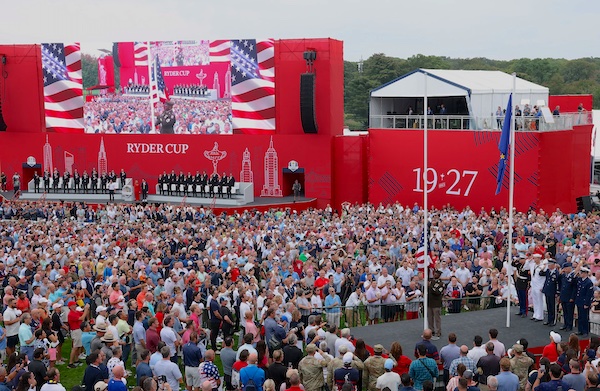
Why the Ryder Cup Is the World’s Greatest Sporting Event
Golf is the ultimate individual sport, but for one week every two years, it becomes about suppressing individual identity for team success. The Ryder Cup forces 12 elite competitors who’ve built careers on individual decision-making to suddenly function in partnerships and put team success ahead of personal glory. No other sporting event asks athletes to completely reverse their fundamental identity. The spectacle most fans see—the crowds, the pressure, the drama—sits atop layers of cultural psychology and strategic preparation that make the event far more sophisticated than it appears, and for my money, the best event in sports.
How Europe Transformed the Ryder Cup
For decades, American dominance was so complete that the matches barely registered as competitive events. With top U.S. players voluntarily sitting it out, the event was on the brink of extinction until 1979, when Continental European players joined the British and Irish team. The transformation accelerated under Tony Jacklin’s European captaincy, which began in 1983. While American captains focused on logistics and ceremonial duties, Jacklin obsessed over partnerships, course setup preferences, player psychology, and team chemistry. Jacklin realized the Ryder Cup was a team sport disguised as an individual sport, and it immediately paid dividends: Since Europe’s first win in 1985, they are 12–6–1.
If Jacklin was the brain of the transformation, Seve Ballesteros was the heart. Ballesteros’ passion for the Ryder Cup bordered on obsession. His charisma was magnetic, almost dictatorial in the way he rallied and unified people. The way Europeans still talk about him borders on religious. If you didn’t know better, you’d think they were describing a god. His captaincy in 1997 led to a 14.5–13.5 European victory, with Ignacio Garrido making the statement, “We may have held the clubs, but Seve hit the shots.” Still, this carries. In 2023, there were 13 lockers in the European team room: one for each of the 12 players and one in honor of Ballesteros.
With Ballesteros establishing a deep cultural foundation, European players had a shared team identity and collective purpose. But they also had external fuel as they internalized a perpetual underdog mindset against American dominance. Even when Europe wins, they maintain that chip-on-the-shoulder mentality, because golf’s power structure—money, tours, global influence—remains American-dominated. It’s the perfect psychological setup: Europeans get the confidence of recent success while retaining the motivation of historical grievance.
For decades, Americans believed that winning Ryder Cups was simply about playing better than the opposition when the time came, but European success convinced the U.S. team that their stars would have to work together. From 1985 to 2006, the U.S. team only triumphed outright twice. At times, they tried to mimic the European way, but they were attempting a European solution to an American problem. European players, despite being elite competitors, grew up in societies where collective identity runs deeper culturally: social safety nets, public healthcare, and worker protections. American golfers, by contrast, are products of hyper-individualistic systems where they’ve succeeded by being relentlessly self-focused, making the European approach of 12-as-one feel forced and artificial when American captains tried to replicate it. But pure individualism also fails because the Ryder Cup genuinely requires partnerships and collective strategy. This led to Paul Azinger’s ingenious strategy in 2008. Drawing inspiration from the Navy SEALs, Azinger split the team into three pods of four players grouped by personality. It was the Goldilocks zone: Pods of four were small enough to maintain individual identity while large enough to create authentic relationships and chemistry. It led to a 16.5–11.5 victory at Valhalla.
Since that 2008 victory, however, the U.S. team has moved away from rigid pod systems toward what recent captains call “less is more.” This is remarkable because they’re essentially back to treating elite golfers as individuals who can figure it out themselves, which is exactly what wasn’t working before 2008. “Let the individual be the best individual they can possibly be to add to the team,” Bryson DeChambeau recently said, describing the key to team success. “That’s it. Don’t try to put someone in a bubble and say you need to do this, you need to do that.” There are two key issues with this thinking. First, the “just go play your game” approach ignores the unique pressures and formats of the event. It leaves players isolated when they face situations they’ve never encountered in individual competition. Second, pods don’t constrain individual ability. They channel it toward collective purpose.
The Modern Home Field Advantage
No other sporting event sees home-field advantage matter this much. While other sports offer crowd noise and familiar surroundings, the Ryder Cup transforms the entire playing field into a weapon. The 2015 entry of professional consulting firms is where things went from 10 to 100. Twenty First Group began working with European captains, while Scouts Consulting Group (SCG) advising American teams starting in 2016, with 22-month preparation cycles becoming standard. Both sides employed some of the best statisticians in the world, including Jason Aquino, SCG’s president, who spent a decade leading war gaming projects related to future military competitiveness for the U.S. Department of Defense. The home team has won the last six Ryder Cups, and while the crowds play a massive role, there’s an entirely different level of preparation happening behind the scenes.
Home teams control rough length, mowing lines, green firmness, and manipulate tee boxes to engineer sequences in their favor. For example, if your best wedge player is teeing off on even holes, you might move a par-five tee box back so it is unreachable in two shots. Par-three tees can be nudged forward or back by just a few yards to dial in the exact number for a player’s preferred iron. Teams map out where approach shots will fall, and match that against each player’s performance in different distance bands. The U.S. team can designate forward or back tees before the event so that, for example, Bryson DeChambeau’s 330-yard drive would consistently leave Justin Thomas his preferred 120-yard wedge distance. If Team USA captain Keegan Bradley wanted Thomas to be paired with Harris English, officials could instead use a shorter teeing ground, ensuring English’s drive still leaves Thomas in his sweet spot. Bradley and the U.S. team can’t make changes mid-tournament, but they have pre-event flexibility with the teeing ground. The adjustments can also be incredibly granular. For example, maybe the U.S. players have an advantage on wedges when the greens are firm, but prefer softer greens on longer iron shots, so the holes are watered differently. This example is just a guess, because even stats nerds have no idea how deep this goes. Teams will occasionally share broad strokes about their process, but the real insights stay locked away.
The statistical home-field advantage creates its own edge, and then you layer on crowds that operate nothing like normal golf galleries. These players are accustomed to polite applause and silence during shots. Instead, they face 40,000 people who cheer every missed putt, and create an atmosphere that can break even the most composed professionals. Bethpage specifically is lining up to be a bloodbath. New York crowds already have a reputation for hostility in other sports, and they’re getting their first Ryder Cup in decades. The Europeans are so concerned about this jeering that they’re training with VR headsets to simulate the experience of American crowds.
The difficulty of winning on the road adds another captivating element entirely. An away victory has become so rare that victory guarantees immortality for everyone involved. A European road win would cement Rory McIlroy as the undisputed greatest European player ever, elevate Luke Donald’s captaincy to perhaps only behind Jacklin in Ryder Cup history, and earn Jon Rahm a place alongside Ballesteros, José María Olazábal, and Sergio García in Spanish lore. Moreso, we have no idea who will become immortal. Christy O’Connor Jr. was a journeyman until his 2-iron at The Belfry made him a folk hero. Justin Leonard is more renowned for his 40-footer at Brookline than for his major championship. These moments matter more than major championships because they’re rarer: There are eight majors held in every two-year Ryder Cup cycle, and road victories happen once a generation. The Ryder Cup has this unique ability to elevate role players into legends through single moments. Signature moments in majors come on the backs of par-70 holes of excellent golf; it doesn’t need to be that way at the Ryder Cup. In such circumstances, every player is one shot away from legendary status.
The Ryder Cup Drama Machine
The Patrick Cantlay hat controversy perfectly captures the absurd drama that only the Ryder Cup can produce. It started with a single tweet posted on Sept. 30, 2023, by journalist Jamie Weir. It says Cantlay was allegedly refusing to wear the team cap because players didn’t get paid and sitting apart from teammates, fracturing the team room. The Ryder Cup desperately needs villains, so within hours, a routine wardrobe choice became proof of American greed corrupting golf’s sacred traditions. The absurdity is that none of the specific details mattered: Was there actually a separate area in the team room? Why had Cantlay really skipped the gala dinner? Cantlay’s desire to be paid was no secret, but would he really sabotage team chemistry in the process? We still don’t have answers, but nobody cared about verification. And it wasn’t far-fetched, because American players have a recent history of Ryder Cup uprisings, with Phil Mickelson and Patrick Reed both openly criticizing their captains in the previous two U.S. losses.
This controversy also proved how desperately fans and media seize on any shred of interpersonal conflict. Golf operates in a drama desert compared to other professional sports, with its typical “controversies” involving slow-play penalties and equipment violations. During Ryder Cup week, everyone knows this is their one shot at witnessing genuine team dynamics and personality clashes, so they’re primed to amplify even minor incidents. Golf media began firing off any hat-related tweets they could think of, and when Cantlay walked to the 16th tee, 10,000 European fans were synchronously removing their caps and twirling them overhead while chanting.
When Cantlay then drilled a 43-footer on 18, his caddie Joe LaCava began celebrating in a way he has never done in his decades as a caddie. He held the celebration too long, lingering in McIlroy’s putting line as the Northern Irish tried to tie the match. By day’s end, what started as equipment speculation had escalated to a parking lot confrontation between McIlroy and LaCava, with McIlroy showing uncharacteristic anger. The Cantlay saga demonstrates what makes the Ryder Cup compelling: It forces an entire ecosystem to operate completely outside its comfort zone. Golfers, caddies, journalists, and fans are all improvising their roles because it’s the only tournament where golf’s traditional frameworks don’t apply, forcing everyone to figure out how to be part of something they fundamentally don’t understand.
2025 Ryder Cup at Bethpage Black
For all the strategic sophistication and cultural advantages, golf remains fundamentally unpredictable. Data Golf ran 100,000 simulations with perfectly matched teams on neutral ground, and it revealed that only 52% of Cups finish within four points. Consider that no foursomes match over the past five Cups has seen a team favored by more than −190, or that Sergio García—the greatest Ryder Cup player ever—converted just 63.3% of his points. Teams spend months making inspirational videos and years manufacturing advantages, but if McIlroy can’t buy a putt, or Scottie Scheffler has some bad fish, or the Europeans just get most of the lucky bounces, it can override whatever marginal chances they have created in the past two years.
The 2025 Ryder Cup has been circled since it was first announced for Long Island, New York, on one of America’s greatest public courses, with a stage grand enough for the characters who will occupy it. It’s tempting to pick Europe because of the culture and continuity, but the U.S. team is much stronger, especially towards the bottom. Funnily enough, in a complete reversal of past cups, Europe actually has the bigger names, while the U.S. team has the more underrated players. Going off the Data Golf rankings, only McIlroy, Rahm, and Tommy Fleetwood rank higher than Ben Griffin, Russell Henley, J. J. Spaun, and Cameron Young. Add on how hard it is to win an away Ryder Cup and the hostile New York crowds, it’s an uphill battle for Europe. Europe will keep it close, giving us our closest Ryder Cup since 2012, but ultimately the United States of America will prevail, with Ben Griffin etching his name in Ryder Cup history, taking down one of the Europe’s top dogs on Sunday for the clinching point.
Sam Weitzman-Kurker can be reached at sweitzmankur@wesleyan.edu.

Outstanding piece. As a tremendous Ryder Cup fan I’d say this rivals any coverage I’ve read in the NYT and other national press.