
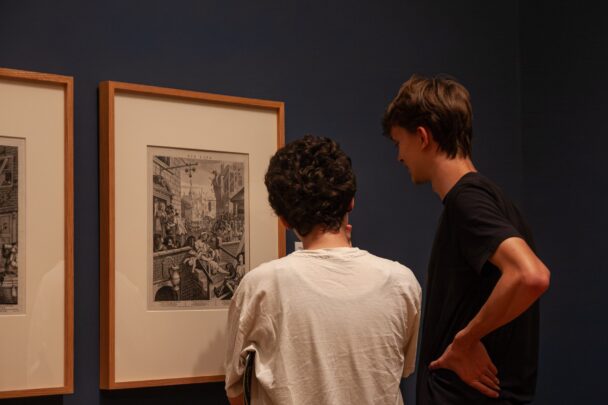
Pruzan Exhibition “Squalor City” Reflects Present Moment Through London History
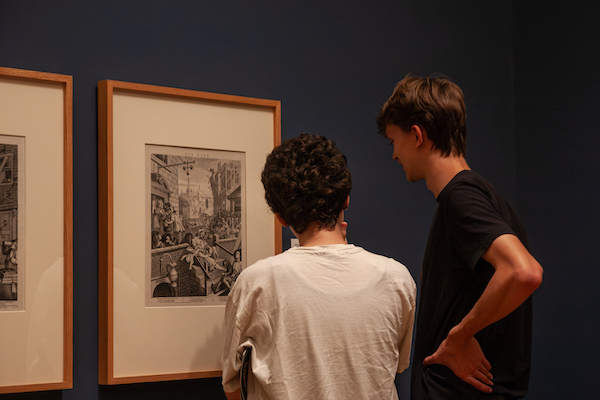
From Sept. 23 to Dec. 13, the Pruzan Art Center will present an exhibition of William Hogarth works, focusing specifically on his depictions of the city of London. The artworks, showcasing the daily lives of contemporary Londoners, represent a departure from the traditional portraitures of Hogarth’s time. The landmark pieces on display are “Marriage A-la-Mode,” “Four Prints of an Election,” “The Four Stages of Cruelty,” “Beer Street,” and “Gin Lane.”
The Argus sat down with Curator of the Davison Art Collection Miya Tokumitsu to discuss the exhibition’s themes, history, and message.
At the time of Hogarth’s work, Georgian London was a rapidly changing yet consistently central place where capitalism and liberal democracy emerged. The exhibition revealed a time of great reform, a period immediately preceding the Industrial Revolution when England was still the center of global commerce. This historical moment, according to Tokumitsu, is central to contextualizing his work.
“Georgian England is the society in which these kinds of social formations really originated,” Tokumitsu said. “The North American colonies split off from the British Empire. So this hit his society; his is really the society that spawned our own.”
In fact, Hogarth himself was a product of a shifting focus from rural lands to the city’s growing centrality. Coming from a lower-class family with a father in debtors’ prison, Hogarth made his way out of poverty through his entrepreneurship skills, marking his art with this firsthand understanding of his changing society.
His depictions of modern life follow these transitions. One of the exhibition’s main pieces, “A Harlot’s Progress” depicts the life of a young economic migrant from the countryside who travels to the city only to become a sex worker, subject to a life of violence.
“[The painting’s subject] can’t stay with her family in the country because of this movement that had been occurring in England over a century called the enclosure movement,” Tokumitsu said. “And this is a fundamental milestone in the development of capitalism, which is the closing off of the common lands. For the peasantry in the countryside, a really essential source for maintaining themselves was being denied.”
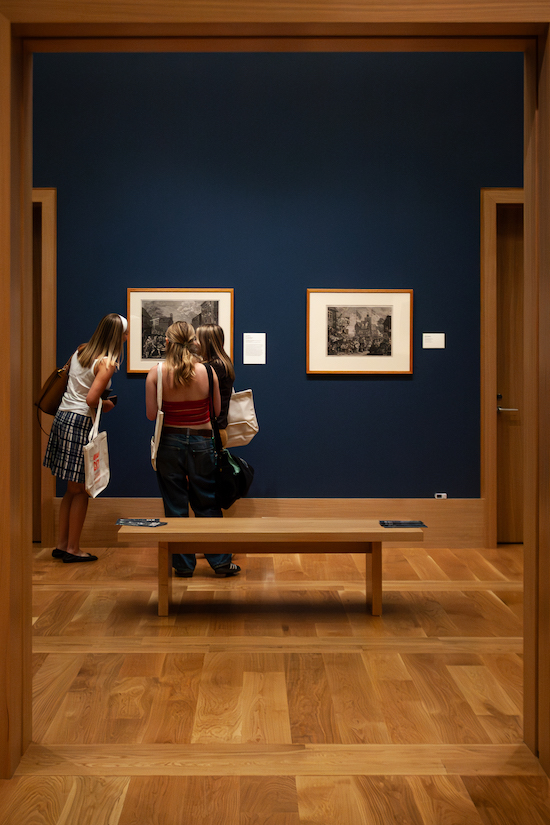
Tokumitsu chose to not arrange the exhibition space chronologically. Rather, she divided the walls into three main themes to depict the various purposes and sides of Hogarth’s work. The section “City Creatures” focuses on the animals in London, “Perilous Progress” on the journey of the protagonists in his different stories, and “Dramas of the Street Parlor” on his storytelling abilities.
When asked the reason for arranging the exhibition in this specific orientation, Tokumitsu said, “[Hogarth] also had this activist side. He really wanted his art to inspire people to improve their behavior and their treatment of people and animals. I wanted to show these different sides of Hogarth: the entrepreneur, the social reformer, and the satirist.”
This thematic arrangement allows the viewer to understand Hogarth’s lifelong journey within Georgian London. Tokumitsu tells a compelling story with a focus on animal ethics, electoral corruption, family politics, and the criminalization of sex work. The people of Georgian London faced many of the same fundamental questions that those in the United States face today. Through the thematic approach, the viewer understands their own moment through the lives of people hundreds of years before.
“Hogarth’s Squalor City has the potential to appeal to people just passing by because Hogarth’s work is just such a spectacle,” Tokumitsu said. “There’s so much to see and find in each sheet. There are so many surprising details, and I think it gives people a really vivid view of this world that existed so long ago. This is a distant time and place, but our society is really an extension of this one.”
Today’s viewer will be called upon to ponder the same moral questions that Hogarth asked his viewers—questions about the ideas surrounding the influence of capitalism and consumerism on today’s culture, the scarcity of democracy, and the moral questions of daily life.
Amelia Haas can be reached at ahaas01@wesleyan.edu



Leave a Reply