

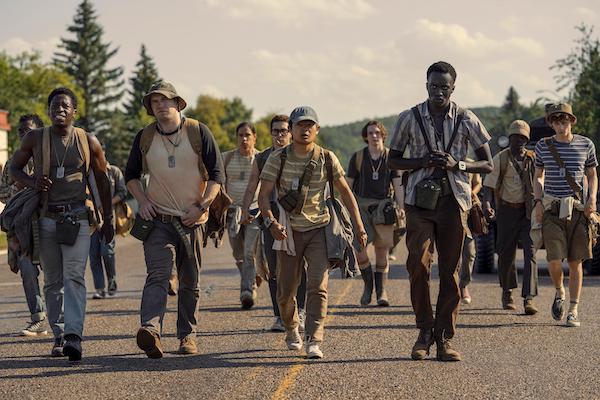
Once upon a time, Stephen King’s “The Long Walk” floated in adaptation limbo. King wrote the novel when he was a freshman in college (though it was published later, in 1979), and its premise is brutally simple. Every year, one hundred teenage boys line up at the Canada-USA border and begin to walk. If they fall below a speed of four miles per hour, they are given a warning. More than three warnings means immediate execution at the hands of armed soldiers. There are no breaks, there is no finish line, and the last one standing wins.
The reasons for the story’s supposed unfilmability lie in this simplicity. The novel takes place almost entirely on the road. Tension is built through drawn-out conversations that reveal the delicate relationships between the walkers. Scenes of horror are unflinching. As the competition progresses, readers track the deteriorating mental states of the characters through rambling internal monologues. A movie adaptation would need to successfully balance the novel’s blunt brutality with all the trappings modern theater-goers have come to expect: flashy action, adrenaline-fueled set pieces, and, underneath it all, a sense of heart.
“The Long Walk,” directed by Francis Lawrence of “The Hunger Games” fame, pulls off this tightrope act. Some aspects of the film are surprisingly restrained; like the book, most of its runtime takes place on the road, with the exception of some admittedly unnecessary flashback scenes. The backstory of the film’s dystopian future remains intentionally cryptic, with only fleeting mentions of book-banning and political insurrections. Though we know it takes place in Maine, the actual stretch of road is unnamed. Like the minds of the film’s central characters, the movie’s focus lies entirely on the grueling competition itself.
While the setting and worldbuilding display a surprising amount of self-control, the scenes of horror, violence, and heart within the walk remain perfectly uninhibited. The film pulls no punches: When a walker is shot, their faces burst in horrific detail. Legs are broken and bodies splay on the asphalt. To quote The Major—the face of this future’s totalitarian regime, played by Mark Hamill—“the blood will flow… suddenly.” At no point does the audience become numb to the raw barbarity being displayed, preventing the film from falling into the trap of fun violence that you might see in “John Wick” or even Stephen King’s other death game novel, “The Running Man.” Make no mistake, “The Long Walk” wants to make you squirm.
If the film sounds miserable, I don’t blame your judgement. At times it can be difficult to stomach, but there’s a surprising amount of humanity underlying the film. Much of it comes from the potent performances by lead actors Cooper Hoffman and David Jonsson. So much of the novel’s power rested in the relationships between the boys, and Hoffman and Jonsson communicate their characters’ care for each other so genuinely.
In fact, the boys’ compassion is a large part of what makes the film work. It would be all too easy to portray the walkers as cynical and selfish, jumping at the chance to get each other eliminated and be the last one standing. This isn’t the case; despite the fact that they are rivals in a death game, the characters crack genuinely funny jokes, cheer each other on, and sometimes even risk their lives to ensure their new friends make it another day. They display authentic humanity, and it’s a refreshing and welcome contrast to the cold lack of empathy that defines their circumstances.
“The Long Walk” is bold and unrelenting. It knows how to make the audience feel disturbed, but it also knows how to carefully introduce an unexpected sense of optimism. If you can sit through two hours of nearly constant distress, you’ll be rewarded with a surprisingly moving story of perseverance, friendship, and sacrifice.
Inigo Hare can be reached at ihare@wesleyan.edu.

Leave a Reply