
Film Review: “The Cruise” Isn’t All Smooth Sailing

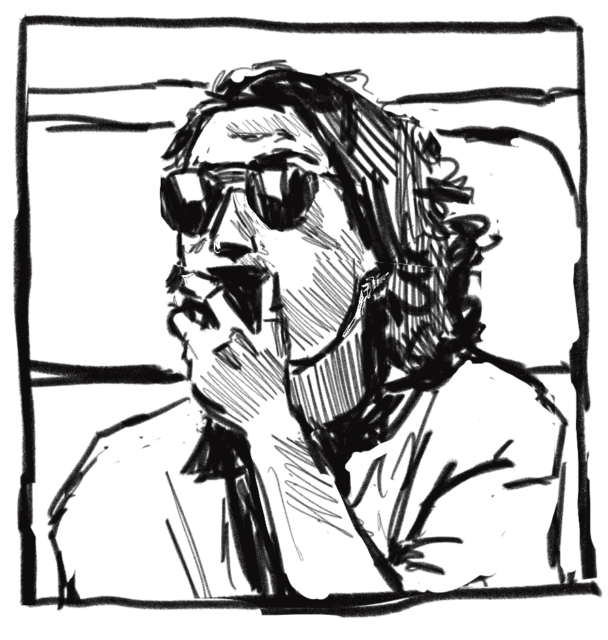
Tour guide Timothy “Speed” Levitch earns his nickname—his quick paced ramblings outshine everything else in a documentary about his life called “The Cruise” (1998).
“Speed” Levitch is totally brilliant. He knows everything (and more) about the city that never sleeps. And as his bus barrels down the avenues, it’s a wonder to watch him breathlessly list all the writers and actors and cultural figures who roamed the streets of his New York City. While rapidly describing these figures, he inserts his own jokes and maintains a unique vocabulary that somehow feels both infinitely expansive and effortlessly understandable.
After he made “The Cruise,” his first ever directorial effort, director Bennett Miller earned considerable recognition for the other movies in his filmography: “Capote,” (2005) “Moneyball,” (2011) and “Foxcatcher” (2014). I believe “The Cruise” is worthy of being considered at least an equal to his other films, not only because Miller shot it as he walked around the streets of New York City performing as sole cameraman, and not only because he shot around 100 hours of footage—in fact, he chose to scrap the first 77 hours entirely. Yes, the backstory behind the film is cool, but the film entirely sings on its own terms.
The film sings through Levitch, but Miller’s directorial choices hide parts of the tour guide’s murkier pasts: his later criminal conviction, for example.
Levitch is also at his best when delivering memorable one-liners. Two personal favorites of mine: “Why is it that some people have a narcissism that leads to mediocrity and nothing else?” and, “If architecture is the history of all phallic emotion, the Empire State Building is utter catharsis.”
This tour guide has the problems that all of us have, but he articulates them in novel, exciting ways. When Miller films Levitch standing on a roof overlooking New York City’s skyline, he experiences the city’s winter weather through a metaphorical monologue on marriage.
“My relationship with New York City is as vitriolic as my relationship with myself or any other human being, which means it changes every millisecond, that it’s in constant fluctuation,” Levitch says. “This winter I felt like we were getting a divorce and I was certainly the loser of that divorce. I had a reemergence in the summer. Maybe because I was able to refuel my cruise a little bit by working laboriously and crawled my way back onto the island.”
So, that’s it! This great problem that leads Levitch to compare his relationship with New York to a relationship he’d have with a human being is that it is financially hard to live in the city—a problem that many residents of the city face.
Yet, the documentary fails to probe further into Timothy Levitch’s lifestyle. At the beginning of the movie, we are told that he is living with a friend. We are not told that he had been couch surfing with friends for three years—allegedly by choice. This is an important fact of his life—why did Levitch make this choice? At best, we can tell that it fits with his dislike of societal expectations and man-made prisons, for which Levitch has his own nickname: “the anti-cruise.”
In fact, the concept of the “anti-cruise” may take on more weight than expected. When talking about a previous arrest, Levitch says he was told that the biggest problem with his case was that he had been running from the police for a year. Levitch then wishes aloud that he could have told the judge that he had been running from the “anti-cruise” for a lot longer than just a year.
It’s a great line, in theory. However, when you look up the movie, you will find that Levitch was arrested for violently shoving a female friend who did not share his interest in a romantic relationship. Suddenly, Levitch’s concept of the “anti-cruise” becomes less clean. It’s easy to find somebody who roots for an escape from societal establishments; harder to find somebody who thinks Levitch shouldn’t have faced consequences for what he did.
Miller depicts Levitch as an easy hero by obscuring his darker pasts. That’s part of the problem! Levitch claimed that Miller didn’t want him to go into the details of this arrest on camera—but why not? Couldn’t there be something interesting showing us a side of him that we wouldn’t like?
It feels like Miller does not trust the audience to understand that Levitch is both incredibly intelligent, with an interesting and exciting way of viewing the world, and also potentially deeply flawed on a personal level. There’s something slightly unethical about choosing not to show us the dark side of a figure that Miller brings into the spotlight.
To be fair, Miller isn’t a writer. He’s a director, and on a visual level he deserves even more praise. The entire movie, shot in black and white, looks stunning. The viewer lives in the world as Levitch sees it—the past along with the present on every street corner. New York City achieves deep expression in black and white. Its large buildings and cement sidewalks and gray skies lend themselves to the form without color, the type that is focused on drawing attention to the shadows and ever expanding brightness.
So, watch this movie if you love finding your way into worlds that you could never live in, and if you are somebody who is willing to be infected by contagious enthusiasm.
Henry Kaplan can be reached at hrkaplan@wesleyan.edu.




Leave a Reply