
Faculty Authors Read at Russell House
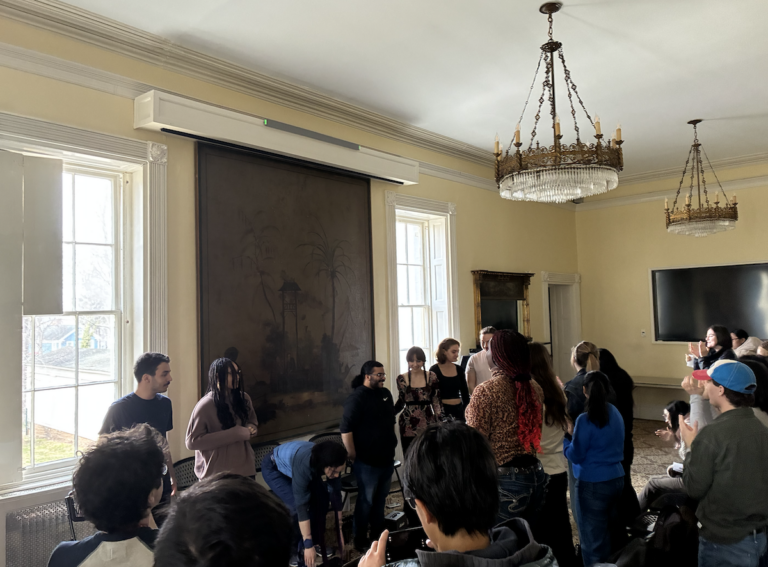
On Wednesday evening, a small room in Russell House was packed with faculty and students waiting to hear three professors share their writing. The room’s high ceilings and chandeliers created an intimate atmosphere, and the room filled up with people and chatter. This didn’t last long, however. After a few remarks of thanks and acknowledgement, the first writer was introduced.
Deb Olin Unferth, a new assistant professor of English, set the bar very high. The short story she read, “Pet,” was genius. It interwove a simple account of the “rescue” of two turtles and the more complicated story of a woman struggling to make a life for herself and her teenage son while dealing with alcoholism, drug abuse and general chaos. Yes, this story is familiar, but the tone of “Pet” made it new and fascinating. Unferth’s writing was simplistic and childishly matter-of-fact, and the straightforward observations of her characters revealed humor and tragedy without passing judgment on either. “Pet”’s innocent, often hilarious voice described the challenges in the life of one small family (and their turtles), but also commented on more universal challenges, like the impossible speed of the world as it rushes at you.
Lisa Cohen, also an Assistant Professor of English, took the podium next. The content of her non-fiction work was different from Unferth’s, but the excerpt she read from her biography of three historical women was similarly innovative. The selection transitioned smoothly between a dreamlike narrative and an abrupt historical voice as it described the lives of Maude Adams, the actress most famous for her role as Peter Pan, and Mercedes de Acosta, a writer and socialite. What really set this history apart from textbooks, however, was the deep, thematic thread. Wrapped up in the complicated lives of these two women was an intriguing consideration of the roles of idolization and devotion in our lives.
Finally, Elizabeth Willis, the Shapiro-Silverberg Associate Professor of Creative Writing at Wesleyan, stepped up to read her poetry. Unlike the other writers, she did not jump right in, and between her poems she often commented on her sources of inspiration. Willis’s poetry was thoughtful and often beautiful, and it resonated with the audience, who laughed at the right moments and “mmm-ed” at others. Despite the explanations, the images in Willis’s poems often expressed ideas that could be understood emotionally without further description.
Each author had something very different to offer, and although they were difficult to compare, the literary merits of each work were obvious. I had not known what I was getting into when I finally found Russell House, but I was entirely impressed by Wes’s Creative Writing faculty.



Leave a Reply